
It is not often that one experiences the extremes of despair and hope on the very same day due to encounters with the same subject.
Recently, I attended an academic conference at the University of Haifa on contemporary antisemitism. The sessions explored topics ranging from media bias and Holocaust denial to the climate on university campuses.
One session, devoted to the sources of Muslim antisemitism, was especially disturbing. I knew antisemitism was pervasive in the Muslim world, but I came away realizing that the phenomenon is far more deeply rooted and complex than I had imagined.
One scholar described Arab nationalism, the Arab left and Islamism as a three-headed hydra. Although each emerges from a different ideological tradition, all share the conviction that Jews and Israel are the primary obstacles to achieving their ultimate vision, whether it is political, religious, ideological or eschatological.
Another presenter examined Al-Azhar University, Egypt’s influential Islamic institution, which is often regarded in the West as a force for moderation because of its opposition to ISIS, Al-Qaeda and other extremist movements. Having met with Pope Francis, its leaders have acquired an aura of respectability and are frequently welcomed in Europe as voices of religious tolerance and moderation.
Yet when it comes to Jews and Israel, that image of moderation is peeled away and reveals something very different.
Al-Azhar has promoted some of the most inflammatory accusations possible against Jews. Through articles and scholarly publications, it has disseminated historical distortions and anti-Jewish propaganda under the guise of academic and religious scholarship.
One example cited was the revival of the medieval blood libel: the insane claim that Jews use the blood of children to bake Passover matzah. Al-Azhar uses it to “explain” why Jews are supposedly capable of committing genocide while, at the same time, justifying Hamas’s brutality.
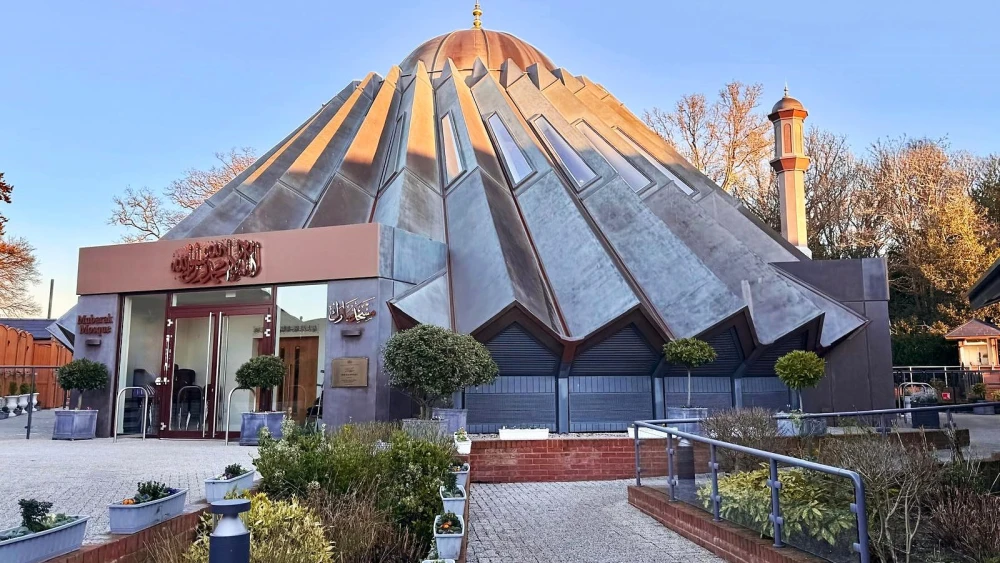
I met with Muhammad Sharif Odeh, amir of the Ahmadiyya Muslim Community in Israel. His message could not have been more different from that of the extremists.
What makes such rhetoric especially dangerous is not simply its content but its source. When these ideas come from an institution widely viewed as moderate and academically respectable, packaged in scholarly and religious language, it gives ancient antisemitic myths a veneer of legitimacy.
Al-Azhar’s extreme hatred of Jews and Israel often escapes serious scrutiny. Policymakers, the media and the broader public remain largely unaware of the extent to which classical antisemitic themes continue to be propagated and spread under the banner of religious scholarship and moderation.
The morning’s presentations left me deeply troubled. They reinforced the sobering reality that antisemitism is not merely prejudice against Jews but a widespread, comprehensive worldview in which Jews become the convenient excuse for political failures, social frustrations and the inability to realize religious, ideological or eschatological aspirations.
Then my day took an unexpected turn.
I met with Muhammad Sharif Odeh, the amir of the Ahmadiyya Muslim Community in Israel. His message could not have been more different from that of the extremists.
He told me that anyone who rejoices over the atrocities committed by Hamas or can visit Auschwitz without shedding tears does not understand what it means to be truly religious. “Such a person,” he said, “has no soul.”
He also pointed out that the Quran speaks of God bringing the Jewish people back to the Promised Land and argued that Muslims should therefore support, rather than oppose, the Jewish return to Israel.
The amir draws upon Islamic texts to demonstrate how radical Islamist movements have distorted their meaning, as he believes the most effective way to counter religious hatred in his community is by using the very sources extremists invoke to justify it.
The Ahmadiyya Muslim Community remains a small minority within the Muslim world. Although estimates vary, it numbers between 10 million and 20 million followers, with more than 10,000 mosques in more than 200 countries. While this is not insignificant, it represents only about 1% of the global Muslim population. Nevertheless, it is a bright light in a tunnel of darkness.
The contrast between these two encounters could not have been greater.
I began the day distressed by seeing how popular and intellectually sophisticated antisemitism has become in some circles of the Muslim world, and how many are willing to subscribe to it. I ended the day encouraged after meeting a Muslim leader who draws upon the very same religious tradition to reject hatred; affirm the Jewish connection to the land of Israel; and consistently promote religious freedom, peaceful coexistence and interfaith understanding. To him, authentic faith demands compassion rather than violence.
It is profoundly encouraging to know that there are allies in the Muslim world who understand that religion should not be manipulated to justify extremism and hatred. Instead, it should be a force for truth, justice and peace. That encounter transformed what began as one of the most discouraging days I have experienced in recent memory into one that ended with a genuine measure of hope.