
Israel ought to have its head examined. Its bleeding heart could use a check-up, too. Because something is clearly wrong with a country that repeatedly deploys its extraordinary medical expertise to preserve the lives of people who later dedicate themselves to harming it.
The latest diagnosis comes courtesy of an astonishing revelation this week by Avi Shushan, former spokesman for Tel Aviv Sourasky Medical Center-Ichilov Hospital, on the Channel 14 program “Sheva” with co-hosts Yehuda Schlesinger and Yaakov Bardugo.
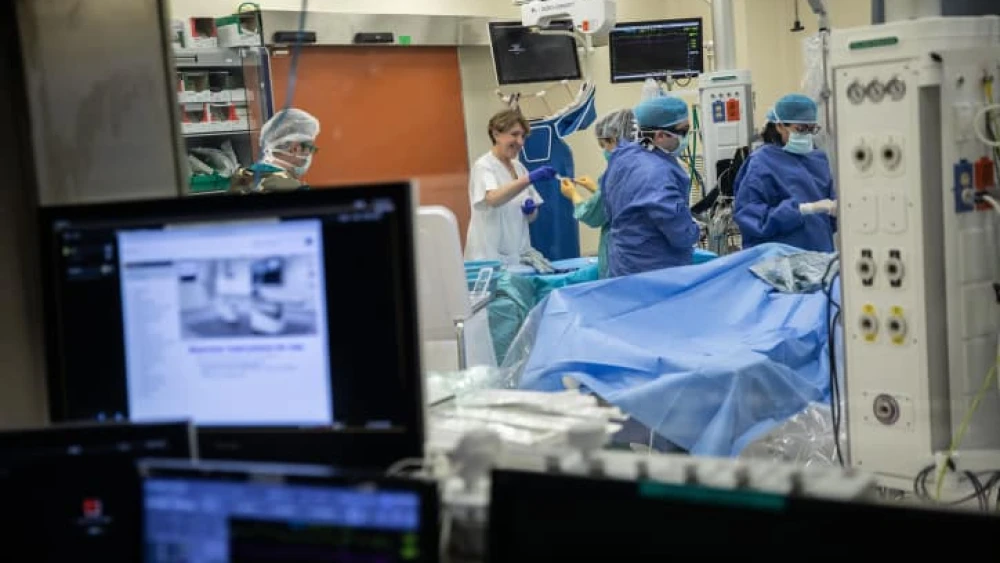
According to Shushan, about seven years ago, when Turkish President Recep Tayyip Erdoğan was gravely ill, the Mossad requested that an Ichilov specialist be dispatched to Ankara to treat him. The physician, Shushan said, did not travel as a private citizen offering personal assistance. He went, rather, “on behalf of the State of Israel.”
If true, the story is remarkable enough on its own. Israel, a country Erdoğan has repeatedly vilified, extended a helping hand when he needed one.
The gratitude wasn’t exactly forthcoming.
Turkey and Israel aren’t officially enemy states. They maintain diplomatic ties, even if relations have deteriorated dramatically. But Erdoğan’s words and deeds have long placed the neo-Ottoman-emperor wannabe firmly in the camp of Israel’s adversaries.
He has transformed Turkey into a political home for Hamas leaders. He has hosted members of the terrorist organization’s senior ranks and defended them as “freedom fighters.” He has backed flotillas aimed at breaching Israel’s blockade of Gaza. He has accused the Jewish state of crimes against humanity while embracing some of the most vicious antisemitic rhetoric in the international arena.
After the Oct. 7 massacre, when Hamas terrorists murdered, raped, burned and kidnapped innocent men, women and children, Erdoğan did not condemn the perpetrators. Instead, he portrayed Hamas as a legitimate resistance movement and attacked Israel for defending itself.
The man who, according to Shushan, was kept alive by an Israeli doctor, repaid Israel with hostility.
But Erdoğan isn’t an anomaly; he’s merely the latest patient in a long-running Israeli medical drama: a country that keeps curing those infected with a lethal hatred of the Jewish state.
Consider what happened after Oct. 7, 2023.
An Israeli hospital treated a wounded member of Hamas’s Nukhba force—the unit responsible for leading the massacre. The terrorist was not receiving care as a gesture of friendship or reconciliation. He was receiving it because Israeli doctors, bound by medical ethics and humanitarian principles, save lives.
The response from many Israelis was fury.
Herzl Hajaj, whose daughter Shir was murdered in a 2017 terrorist attack, condemned the decision, arguing that hospitals should not become sanctuaries for those who had just committed the worst atrocities against Jews since the Holocaust. His outrage reflected a painful question: How far can compassion go before it becomes self-destructive?
The debate isn’t new.
Hamas leader Yahya Sinwar, the architect of Oct. 7—who thankfully was eliminated by Israel Defense Forces troops in Gaza on Oct. 16, 2024—was cured of a brain tumor while serving four life terms for orchestrating the abduction and murder of two IDF soldiers and four Palestinian “collaborators.”
He was sentenced in 1989. In 2011, he was one of 1,027 Palestinian and Arab-Israeli prisoners released in exchange for abducted IDF soldier Gilad Shalit. After returning to Gaza, he rose to become the mastermind behind the massacre that claimed the lives of more than 1,200 Israelis and foreign nationals and led to the kidnapping of 251 others.
The medical personnel who saved his life couldn’t have known what the future held. But Israel’s political and military leaders should have.
Then there was Ismail Haniyeh, the since-assassinated Hamas chief who lived in luxury abroad while his organization turned Gaza into a terror fortress. This didn’t stop Israel from admitting members of his family to Israeli hospitals for top-notch TLC. Among these were his mother-in-law, daughter and infant granddaughter. Ditto for the sister of Hamas spokesman Moussa Abu Marzouk.
Meanwhile, Hamas continued firing rockets at Israeli civilians, calling for bloodshed and working toward Israel’s annihilation. But the pattern reaches even beyond senior terrorists.
In the award-winning 2010 documentary “Precious Life,” filmmaker Shlomi Eldar documented the efforts of Israeli doctors to rescue a Gazan infant. After months of intensive care, the baby survived. When Eldar asked his mother what she wished for her son’s future, she replied that she hoped he would grow up to become a shahid, a “martyr” for Jerusalem. You know, to be killed while slaughtering Jews.
Eldar later reported that the woman said she had made the remark out of fear, given the pressures of life in Gaza and the consequences of expressing views perceived as favorable toward Israel.
That explanation might appear to add complexity to her plight. Yet, it doesn’t erase the larger reality of the enclave in which mothers are forced—or brainwashed—to want their kids to die for Allah. Oh, and to receive hefty stipends from the Palestinian Authority in Ramallah in such an event.
This is the self-imposed paradox that Israel repeatedly faces.
A country founded after the Jewish people endured centuries of persecution has built hospitals that treat anyone who arrives at their doors. It trains physicians who provide care to enemies as readily as friends. It upholds humanitarian standards even when its adversaries exploit them.
This is taking nobility to dangerously naïve levels.
Perhaps it’s the Jewish gene that produces national amnesia. Or maybe it can be chalked up to a warped interpretation of Tikkun Olam—making the world a better place.
In his best-selling book, Suicidal Empathy: Dying to Be Kind, Gad Saad describes the phenomenon of societies extending compassion toward forces that seek their own demise. The concept doesn’t describe ordinary kindness, but a pathological refusal to distinguish between mercy and surrender.
A physician who rescues a patient is performing a sacred act. A country that repeatedly extends that benevolence to those determined to exterminate it must ask at what point the procedure actually enables the spread of a deadly virus.
For decades, Israel has demonstrated that it can restore the health of murderers. Too often, those same barbarians emerge from recovery only to resume their assault.
If that’s not medical malpractice, it’s difficult to know what is.