
Nearly every country in the world now has a vocal, energetic movement pushing the cause of “Palestine” in terms indistinguishable from those deployed by the terrorist organization Hamas—denouncing Israel as a “genocidal” state that practices “apartheid” and advocating a unitary Palestine, in which Jews would be fortunate to achieve the status of a subjugated minority, as the only solution that can deliver justice.
The list of countries includes the United Kingdom, Spain, Canada, France, Germany, Ireland, Italy and Australia, among many others. In the United States, the Palestinian issue has never enjoyed the degree of media exposure and public sympathy that it has until now.
However, there are distinctions among these nations. In all except one, there are elected politicians who regularly voice solidarity with Israel and media outlets that favor Israel, along with a more even split, even if it’s weighted towards the Palestinians, within public opinion.
But not in Ireland.
There, where a large proportion of the population has embraced the self-parodying tag “Paddystinian,” you can barely find a single politician willing to break with the consensus that there is no more pressing, no more just, cause in the world than Palestine. It’s the same story in their media.
Ukrainian children kidnapped by Russia? Druze children in Syria murdered by government forces? Sudanese children starving amid an atrocious genocide? They’re not interested.
But say the word “Gaza,” and the tear ducts open, the performative rhetoric flares, and the increasingly ugly attacks on Jews—who are largely a figment of the Irish imagination, given that not more than 3,000 Jews live there out of a total population of more than 5 million—are unleashed. Indeed, the only good Jews in Ireland now are the ones prepared to denounce not just Israel but their entire religion and history, as evidenced by the grotesque speeches last month in Dublin at a Jewish anti-Zionist conference that was largely attended by non-Jews. Meanwhile, the Irish government has redoubled its efforts to isolate Israel, last week passing a bill banning the import of goods produced in eastern Jerusalem, and Judea and Samaria.
Put another way, Ireland has truly swallowed the Hamas Kool-Aid. No other democratic country is in thrall to the cult of Palestinianism—with its keffiyehs, its flags, its mob formations, its casually antisemitic slogans urging the destruction of the Jewish state—in the manner that Ireland is.
That this is the case tells you much more about Irish society, its hang-ups and its crisis of identity than it does about the Middle East.
The reason Cape Verde was so appealing was because the Irish saw (or thought they saw) a reflection of themselves in the team.
Ironically, it took a news story that had absolutely nothing to do with the Palestinians to drive home that last observation to me.
Unless you’ve been living under a rock, you will know that for most of this month, the FIFA World Cup has thrilled audiences with some astonishing soccer on the field, and some entertaining disputes and controversies off it.
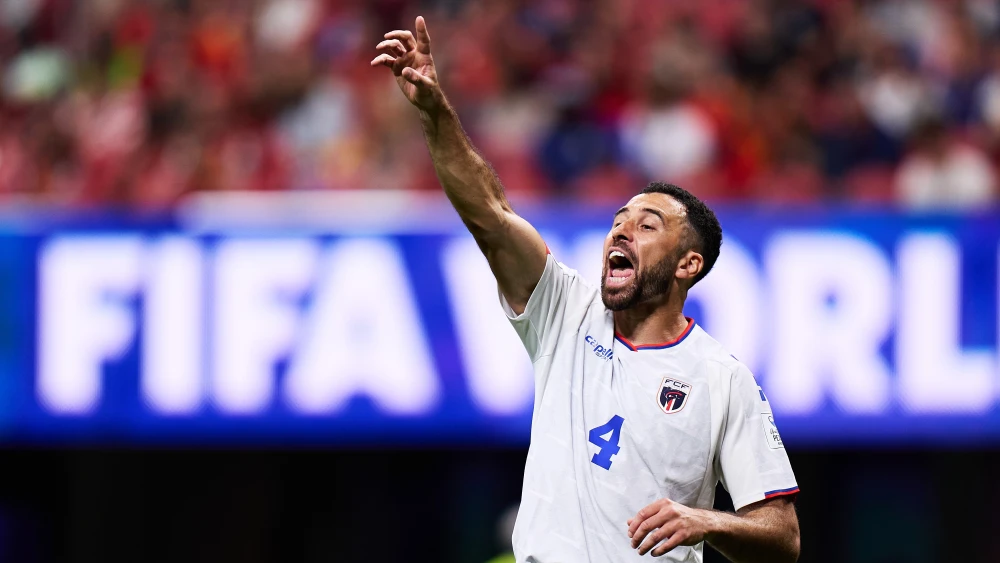
One of the most heartwarming stories was the success of ultimate underdogs Cape Verde—playing in the World Cup finals for the first time and representing a nation of just 600,000 people—who defied expectations by qualifying for the elimination stage of the competition. In their final match, they came tantalizingly close to defeating mighty Argentina, losing 3-2 after the tied game spilled into extra time. Cape Verde’s esprit de corps, hard work and technical ability excited soccer fans the world over.
But in Ireland, which last competed in a World Cup in 2002, the appreciation quickly morphed into something else.
The core reason for Ireland’s wholehearted embrace of Cape Verde as a surrogate team wasn’t entirely without foundation. Cape Verde’s captain, Roberto Carlos (“Pico”) Lopes, was born in Dublin to an Irish mother and a Cape Verdean father, and plays his soccer in Ireland’s underwhelming domestic league. In various media interviews, the 34-year-old took care to pay tribute to his Irish roots.
So far, harmless. If you look carefully, however, you can detect the same impulses that drive support for Hamas present in the Irish love affair with Cape Verde.
One thing the Irish have in common with the Jews is a large diaspora. In soccer teams in England and in baseball teams in America, you will find any number of players with Irish names. But those connections are not, in themselves, enough to win Irish hearts en masse.
If ethnic or national ties were all that counted, the Irish could have found a surrogate side in the England team they so detest. The two leading stars of the England side at this World Cup—Harry Kane and Jude Bellingham—are also of Irish origin and would have been eligible under FIFA rules to play for the Irish team had they chosen to do so.
The reason Cape Verde was so appealing was that the Irish saw (or thought they saw) a reflection of themselves in the team. Underdogs, like us, battling the odds. Underdogs, like us, with pride in their identity. Most importantly, underdogs, like us, untainted by a history of imperialism. That Lopes has Irish ancestry was simply a bonus, insofar as they could claim him as one of their own.
The same thinking informs Ireland’s attitude toward the Palestinians. Natives, like us, fighting off colonial interlopers. Natives, like us, forced to endure racism and oppression. Natives, like us, battling political solutions imposed from above by the “genocidal” rulers occupying our lands.
The Irish doubtless see all this as evidence of their charm and openness to others, as well as a willingness to discern parallels between their own history and those of other nations, invariably expressed in the irritating tones of moral superiority.
Yet there is another, far less generous way to understand the mass psychology here.
The Irish construct their history in much the same way as the Palestinians: noble victims cheated and persecuted by those in power. What this airbrushed version of the past reveals is not historical truth in all its complexity, but a perverse form of nostalgia.
The Irish are no longer persecuted by their British neighbors. As a nation, they are mediocre in their collective achievements, respectable but not especially memorable. To gain the recognition they crave and to truly stand out on the world stage, they graft their own self-image onto others, reliving their heavily edited version of their own history through the experiences of others.
There’s a word for that. It’s “appropriation.”
Some may say that I am being harsh and unfair. Harsh, certainly. After all the garbage and downright filth leveled at my people for nearly three years from the ranks of the Irish and their government, I have no problem admitting that my dominant emotion in this case is contempt.
Unfair? I’d prefer to say that there is a truth out there that the Irish are too afraid to recognize, because then their construction of reality would come tumbling down.
You don’t see yourselves, Ireland. And you most likely won’t. But we see you. And it’s not a pretty picture.