
Why would anyone oppose making a 3,500-year-old historical and religious site accessible to the disabled? Why would anyone resist protecting such a site from the elements?
In modern Hebron stands the Cave of the Patriarchs (Machpelah), believed in Jewish tradition to be the burial site of Abraham and Sarah, Isaac and Rebecca, and Jacob and Leah. Genesis (23:1-20) records Abraham’s purchase of the site from Ephron the Hittite. Herod built the current structure about 2,000 years ago. About 600 years later, Muslims claimed the site, calling it the Ibrahimi [Abraham] Mosque.
The Cave of the Patriarchs has always been of substantial significance to the Jewish people. Thus, for example, in a letter written by Rabbi Moshe ben Maimon [known by the Hebrew acronym Rambam] in October 1165, he related to Rabbi Yaphet bar Eliyahu the Judge the story of his visit to both the Temple Mount in Jerusalem and the Cave of the Patriarchs in Hebron:
… And on the first day of the week, the ninth day of the month of Marcheshvan, I left Jerusalem for Hebron to kiss the graves of my forefathers in the Cave of Machpelah. And on that very day I stood in the Cave and I prayed, praised be G-d for everything.
At the time, Jerusalem and much of the Land of Israel were under Crusader rule, ensuring Christian access to holy sites and limited Jewish access.
Jews continued to live in Hebron through the centuries, though access to the site became limited after the Ayyubid Muslim conquest.
The Jewish presence in Hebron was devastated in 1929, when Arab neighbors carried out a massacre, executing 67 people. Many of the victims were murdered in Beit Hadassah, built in 1893 with funds donated by the Jewish communities in North Africa, India and Baghdad. At the time, Beit Hadassah served as a hospital treating both Jews and Arabs.
The last remnants of the Jewish community in Hebron were ethnically cleansed by the Jordanians, who invaded Israel in 1948. Under Jordanian rule, the synagogue in the modern-day neighborhood of Avraham Avinu [Abraham our Father], originally built in 1540, was turned into an animal pen.
After a long absence, the Jews returned to Hebron and the Cave of the Patriarchs on June 8, 1967, during the Six-Day War, when the town was liberated.
For many years thereafter, while Muslims continued using the site, the Cave of the Patriarchs was gradually opened for Jewish prayer, and worshippers faced recurring terrorist attacks. By the early 1990s, the site had become a joint place of worship for Jews and Muslims. This joint use ended in 1994, when Jewish terrorist Baruch Goldstein murdered 29 Muslims during their prayers in the cave.
After that event, the site was divided: The larger, covered area, including the Hall of Isaac and Rebecca, was allocated to the Muslims, while the smaller areas—the Halls of Abraham and Sarah, Jacob and Leah, and an open courtyard—were allocated for Jewish prayer. For 10 days each year, the entire site is open exclusively to Muslims, and for another 10 days, exclusively to Jews.
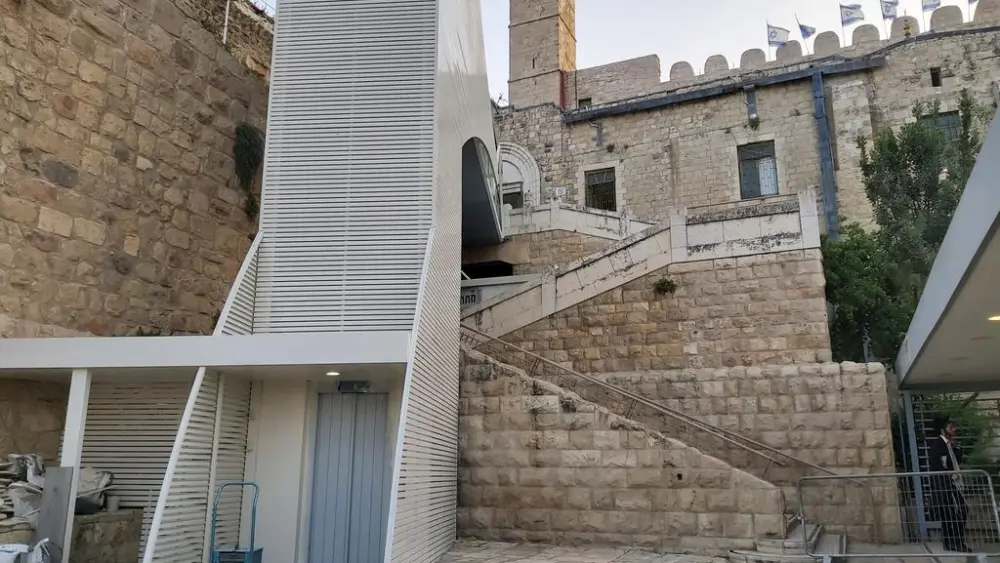
Since, for decades, access to the Jewish part of the site required climbing at least 59 stairs, it was practically inaccessible for the disabled. After much discussion on the subject, Israeli authorities attempted, in the last several years, to coordinate with the Palestinian Authority to add an external elevator. The elevator would also have served disabled Muslims seeking access during the 10 special days.
The P.A. objected to the addition, claiming that the site is an exclusively Islamic holy site and that adding the elevator would merely “strengthen the settlement in this area.”
While noting the objections and even as the P.A. submitted legal challenges against the plan, Israel nonetheless proceeded to install an external elevator, thus making the site disabled-accessible. The elevator serves all the disabled people, including Muslims.
Covering the courtyard to protect the site
In recent years, the need arose to cover the site’s open courtyard. This courtyard, located in the section designated for Jewish prayer, had a temporary covering that was ultimately destroyed by weather and age. Due to the covering’s dilapidated condition, substantial flooding occurred, inundating the courtyard and rendering it unsafe, and allowing water to seep into the structure itself.
The discussion of the need to replace that covering began in 2008. Once more, the Israeli authorities tried to coordinate with the P.A. over the following years, but again to no avail.
Once again, the P.A. rejected any Jewish presence in the Cave and rejected any measure that would facilitate Jewish freedom of worship in any part of the building. Subsequently, the P.A. claimed that, because UNESCO had recognized the Cave as a World Heritage Site, it needed to consult UNESCO.
Later, as is commonplace with the biased U.N. organizations, in 2017, UNESCO ignored 3,000 years of history and the unequivocal Jewish connection to the site, and recognized the Cave of the Patriarchs merely as a Palestinian heritage site.
Following ongoing delays by the P.A., by September 2025, the Israeli authorities lost patience and decided to proceed with the necessary works.
In an attempt to prevent adding a permanent roof, the P.A. again submitted a petition to Israel’s High Court. On May 19, 2026, the court issued its decision, once again rejecting the P.A.’s baseless claims and clearing the way for completion of the roofing.
Criticizing the decision, the P.A. Ministry of Awqaf (Endowments) and Religious Affairs condemned the “seizure of the airspace of the Ibrahimi Mosque under a plan described as the roofing project of the inner courtyard.”
The P.A. added that the “Ibrahimi Mosque, including all its courtyards, halls and airspace, is an Islamic endowment exclusively for Muslims, with no sovereignty of the occupation [i.e., Israel] over it, adding that administrative, legal and planning authority rests solely with the Awqaf and the Hebron Municipality under international law.”
In the same way as the P.A. claims of Muslim exclusivity over the site are historically, factually and religiously baseless, the claim that international law gives sole “administrative, legal and planning authority” over the site to the “Awqaf and the Hebron Municipality” lacks any legal foundation.
The P.A. consistently rejects any concept of Jewish history—nationalistic or religious—in the Land of Israel and its holy sites. This rejectionism is central to the dogmatic PLO-P.A. ideology and is further emboldened by organizations such as UNESCO, which replace real history with Palestinian propaganda.
Experience shows that Israel demonstrates great flexibility in respecting religious freedom. While the P.A. and other Muslim authorities reject sharing sites of joint religious significance, Israel has been willing to limit the freedoms of its own Jewish citizens and accept detrimental arrangements. These agreements give the P.A. or the Waqf Islamic trust, and therefore Muslims, preferential treatment, which reinforces their dogmatism.
Only if the PLO-P.A. accepts that the Jewish presence in the Land of Israel has 3,500-year-old roots, and that sites such as the Temple Mount and the Cave of the Patriarchs were first Jewish, can progress be made.
This recognition would not abrogate Muslim connections to these sites, but would reflect Palestinian acceptance of Jewish history, as the League of Nations Mandate for Palestine declared, the “historical connection of the Jewish people” to this land.
Originally published by the Jerusalem Center for Security and Foreign Affairs.