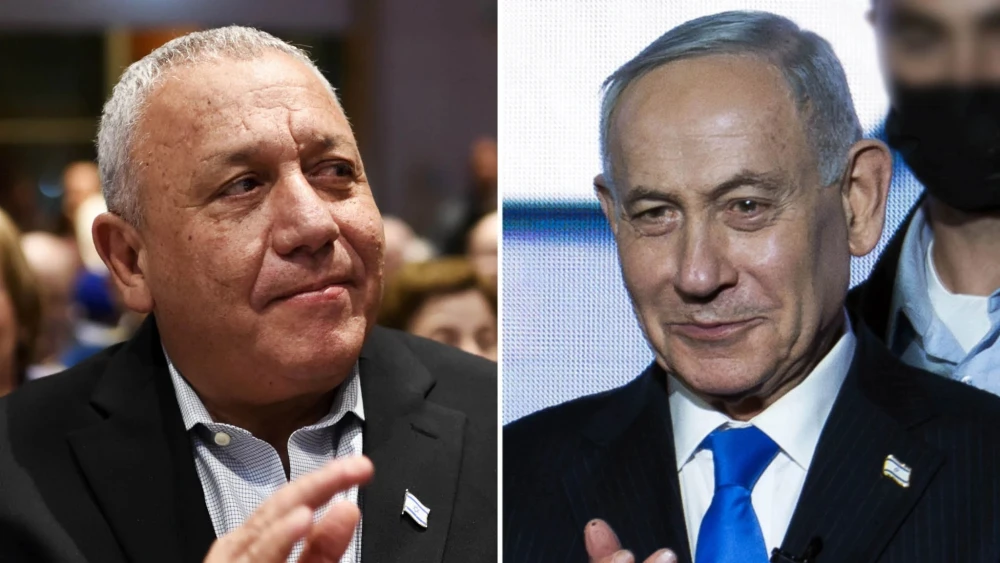

The temperature is extremely high ahead of Israel’s Oct. 27 election. Anything can happen. The war front with Iran remains hot, but even hotter is the domestic front against Prime Minister Benjamin Netanyahu and his Likud Party, led primarily by Gadi Eisenkot and his Yashar Party.
The Knesset has 120 seats, and 61 are needed to govern. Neither of the two blocs appears to reach that threshold; both hover only a little above 50 seats in many polls.
The parties aligned with Eisenkot—those led by Naftali Bennett and Yair Lapid, Yair Golan and perhaps Yoaz Hendel—are bound together above all by one overriding idea: Bibi must go.
It is a remarkably thin political glue.
These are politicians with different histories, ideologies and constituencies, united by the conviction that Netanyahu is responsible for virtually every Israeli misfortune. The anti-Bibi slogan has become not merely a political position but, at times, a substitute for a political program.
There is no traditional left wing of the kind Israel once knew. There is instead war fatigue, anger over the catastrophe of Oct. 7, 2023, and a determination among Netanyahu’s opponents to place ultimate responsibility for it on him.
But elections require arithmetic as well as anger.
If the anti-Netanyahu parties cannot reach 61 seats, they may need the support of Arab parties to form a government. That prospect raises profound questions after Oct. 7, particularly regarding parties whose representatives have struggled to offer an unequivocal reckoning with the Hamas massacre and the continuing threats facing the Jewish state.
Yair Golan, leader of the Democrats, remains among the prominent Jewish political leaders advocating a Palestinian state. His party could win about nine seats.
Without Arab support, however, the opposition may have no path to a government.
That is why another possibility, still uncertain but no longer unimaginable, has begun to hover over the campaign: some form of national unity government. Polling suggests that such an arrangement appeals to significant numbers of Israelis in both camps, although the identity of the prime minister would immediately become the central obstacle.
The personal contest remains unsettled. Some polls have shown Eisenkot ahead when Israelis are asked whom they prefer as prime minister; others have produced different results.
Eisenkot is a serious military man, solid and disciplined. But charisma is not his most obvious political weapon.
Netanyahu, meanwhile, appears to understand the difficulty of the campaign. He has become increasingly visible in Israeli television interviews, stepping outside the protective aura that has surrounded him for years and once again deploying the verbal agility, combativeness and political instinct that have made him the dominant figure in Israeli politics for a generation.
Yet this is no ordinary election.
There is comparatively little discussion of the economy, education or even the military as an institution. The campaign keeps returning instead to what happened, who was responsible and what Israel has become since then: memory, war, bereavement, intelligence failures, hostages, victory and the sound of weapons.
Oct. 7 remains present in almost every Israeli home. Young men and women are still serving in the reserves. Families continue to live with bereavement and trauma. At any moment, another front can erupt.
For Israelis, security is not an abstraction. It is life itself.
And this is where Netanyahu’s case cannot simply be dismissed by repeating the words “Oct. 7.”
He was prime minister when the greatest security catastrophe in Israel’s history occurred. That fact will forever be part of his record, and voters have every right to demand answers.
But what happened afterward is also part of his record.
Netanyahu took command of a country stunned, wounded and humiliated by the Hamas massacre and led it through a war fought on seven fronts. Israel confronted Hamas in Gaza, Hezbollah in Lebanon, the Houthis in Yemen, Iranian-backed militias in Iraq and Syria, terrorism in Judea and Samaria and, ultimately, Iran itself.
The country that appeared terribly vulnerable on the morning of Oct. 7 gradually recovered its military initiative.
Hamas was devastated as an organized military force. Hezbollah suffered enormous blows. Iran’s assumption that it could surround Israel with a ring of fire while remaining untouchable was shattered.
Whatever judgment Israelis ultimately make about Netanyahu, it is difficult to deny the transformation. The Israel that seemed helpless on Oct. 7 once again acquired the image of a country that is formidable, determined and prepared to strike its enemies far beyond its borders.
That achievement came at a terrible price.
Israeli soldiers were killed and wounded. Families were shattered. The hostages endured an unimaginable ordeal. And internationally, Israel paid heavily as images from Gaza fueled hostility toward the Jewish state and an unprecedented political, diplomatic and legal campaign against it.
Netanyahu’s critics see that isolation as evidence of his failure. His supporters see much of it as the unavoidable price of refusing to allow Israel’s enemies—or an increasingly hostile international community—to dictate how the Jewish state may defend itself.
That argument lies at the heart of this election. So does the question of responsibility for Oct. 7.
Political leaders cannot escape it, but neither can Israel’s military and intelligence establishment. The IDF and the Israel Security Agency (Shin Bet) failed catastrophically to understand what Hamas was preparing and to sound an adequate alarm.
The dispute between Netanyahu and former Israel Security Agency director Ronen Bar has become particularly bitter.
Bar has maintained that warnings were given and has accused Netanyahu of attempting to shift responsibility onto the security establishment. Netanyahu offers the opposite account: that Bar and others in the security establishment advocated a policy of accommodation toward Hamas, misread the enemy and failed to provide the warning that mattered when the country was approaching disaster.
This is not a minor quarrel between two men. It goes to the heart of the national investigation Israelis still demand: Who misunderstood Hamas? Who believed deterrence was working? Who failed to act on the information available? And who bears responsibility for the assumptions that collapsed at 6:29 a.m. on Oct. 7?
The election campaign shouts these questions more often than it answers them.
It is also a campaign marked by an extraordinary intimacy with death.
Israeli journalist Amit Segal has noted that roughly one in 10 members of the next Knesset could come from a family that suffered a wartime bereavement.
Eisenkot lost his son, Master Sgt. Gal Meir Eisenkot, in Gaza in December 2023 and a nephew, Sgt. Maor Cohen Eisenkot, a day later. Shira Shapira, running with Yashar, lost her son Aner, who was killed while protecting others from Hamas terrorists at a roadside shelter near Re’im on Oct. 7.
The same reality reaches across the political divide. Politicians and candidates on the right have sons, cousins, grandchildren and friends who fought, were wounded or were killed.
This is not a political class debating a distant war. The war has entered its homes.
Perhaps that is why this campaign so often seems to shout rather than discuss.
How could Oct. 7 have happened? Who bears responsibility? Who understood the threat and who failed to understand it? Who can prevent another catastrophe?
And then there is the question Netanyahu wants Israelis to ask: Who, after the catastrophe, proved capable of fighting back?
His opponents would prefer the election to remain centered on the failure of Oct. 7. Netanyahu wants it centered on everything that happened after Oct. 7.
That distinction may decide the election.
Outside Israel, the vote is being watched with extraordinary intensity. The Jewish state has become the focus of a global political obsession, often accompanied by anti-Zionism, ignorance and antisemitism. Red flags, green flags, Islamist movements and pro-Palestinian banners have converged in demonstrations across Western capitals.
Russia and China pursue their interests cynically in the background. Iran remains an enemy whose ambitions have not disappeared. Israel’s military says it is prepared for every eventuality.
Meanwhile, Israelis still have ordinary lives to live. They worry about housing, food prices, schools, jobs, travel and their children’s futures.
But beneath all those concerns lies a more elemental one.
Can the state protect them?
Netanyahu asks Israelis to judge him not only by the terrible morning on which the state failed, but by the three years in which Israel fought its way back from that abyss. His opponents ask them to remember that the abyss existed in the first place.
On Oct. 27, Israelis will decide which argument weighs more heavily.
These are the elections of one of the smallest countries in the world. But after Oct. 7 and three years of war, the choice Israel makes will resonate far beyond its borders.