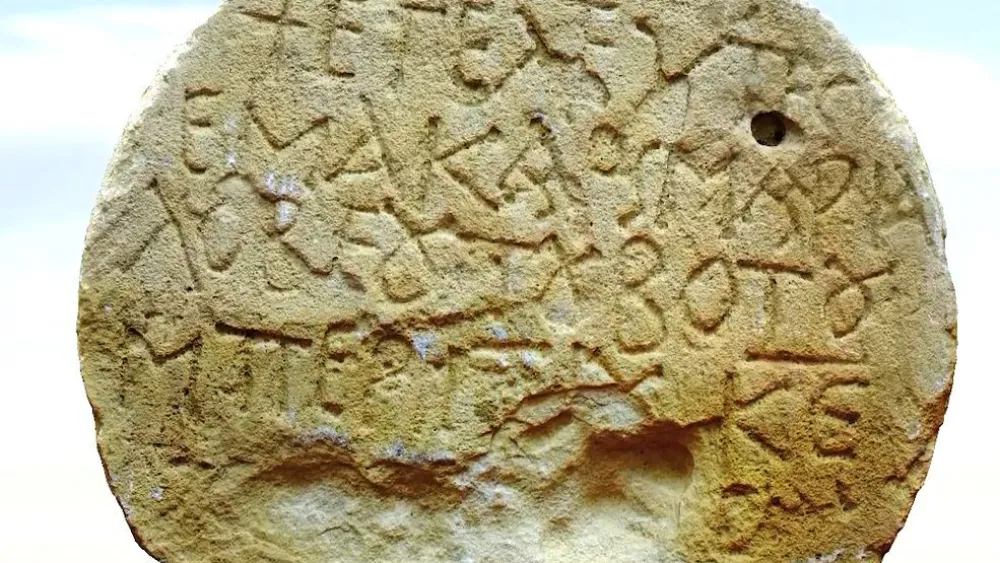
A stone bearing a Greek inscription from the end of the Byzantine period was discovered last weekend in the Nitzana National Park in the Negev, the Israel Antiquities Authority announced on Wednesday.
The flat, round stone was used as a tombstone in one of the cemeteries surrounding the ancient settlement, the IAA said.
It was found by Nitzana Educational Village director David Palmach, who came upon it while clearing hiking paths in the park. According to the IAA, Palmach noticed an inscription on the stone, which was later deciphered by Leah Di Segni of the Hebrew University in Jerusalem as referring to “Blessed Maria, who lived an immaculate life.”
The stone, which is being transferred to the National Treasuries Department, dates from the late sixth–early seventh centuries C.E.
“Nitzana is renowned as a key site in research into the transition between the Byzantine and the Early Islamic periods. During the fifth and sixth centuries C.E., Nitzana acted as a center for the villages and settlements in the vicinity,” said the IAA’s Tali Erickson-Gini.
“Among other things, it had a military fortress as well as churches, a monastery and a road station that served Christian pilgrims traveling to Santa Katarina, which believers regarded as the site of Mount Sinai,” she said.
According to Erickson-Gini, “Nitzana was founded in as early as the third century BCE as a Nabatean road station on a major trade route, and the place was inhabited intermittently for about 1,300 years, until it was abandoned in the 10th century C.E. and its name was forgotten.”
The burial stone, naming the deceased as Maria, is among other unearthed stones commemorating Christians buried in the churches and cemeteries around Nitzana.
“Unlike other ancient towns in the Negev, very little is known about the burial grounds around Nitzana. The discovery of ... [inscriptions] such as this may improve our definition of the cemeteries’ boundaries, thus helping to reconstruct the boundaries of the settlement itself, which have not yet been ascertained,” said IAA Southern District archaeologist Pablo Betzer.