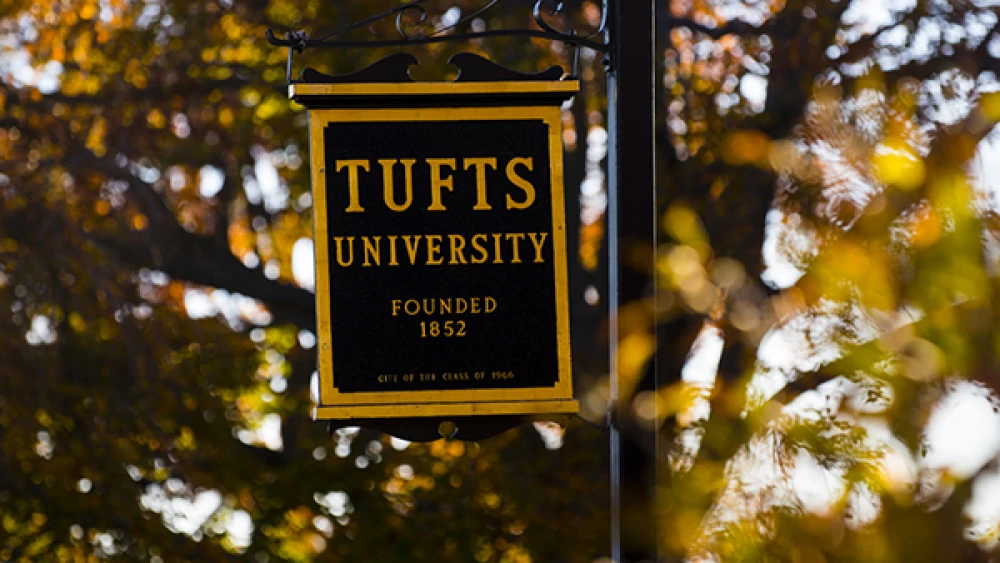
Despite pushback from students and several Jewish organizations, Tufts University is standing by a controversial new course it plans to offer this fall titled “Colonizing Palestine.”
“As we have stated previously, Tufts is committed to the free exchange of ideas and provides students with access to a broad spectrum of courses that enable them to become familiar with a variety of perspectives on important and complex issues,” Tufts spokesperson Patrick Collins told JNS, which first reported the story on Aug. 15.
“We support all faculty members’ right to academic freedom, while understanding that support does not imply endorsement of any particular point of view that a faculty member might espouse,” he continued. “We recognize that there are a variety of viewpoints and beliefs within the Tufts’ community, and we embrace opportunities to foster improved understanding and engagement across divergent perspectives.”
According to the class description, the course proposes to “explore the history and culture of modern Palestine and the centrality of colonialism in the making of this contested and symbolically potent territory.”
Tufts Friends of Israel group says the class violates a statement by the Office of the President that reads, “While members of our community vigorously debate international politics, Tufts University does not adopt institutional positions with respect to specific geo-political issues.”
“By blindly condoning this course under the guise of the ‘free exchange of ideas,’ Tufts is explicitly endorsing a parochial narrative that rejects Jewish indigeneity to the land of their origin,” the student group said.
Outside criticism of the course came from groups such as the Anti-Defamation League.
“We support academic freedom but @TuftsUniversity must ensure that classes examining the complex Israeli-Palestinian conflict are not one sided [sic] platforms for propaganda that demonize Israel & empower anti-Israel activists. Political bias is best left out of the classroom,” ADL CEO Jonathan Greenblatt, who just so happens to be a Tufts alumnus, wrote on Twitter.
Asaf Romirowsky, executive director of Scholars for Peace in the Middle East and a fellow at the Middle East Forum, panned the course on what he said is “faux scholarship.”
“What the course illustrates is a clear lack of balance,” he said, adding that it represents an “ongoing one-sided conversation regarding the Arab-Israeli conflict, and in particular, the Israeli-Palestinian dynamic. This kind of course illustrates that.
“In general, in the humanities, there has been a hijacking of what I would consider to be a ‘Palestinianization’ of the humanities,” he continued, “where Palestinians can do no wrong, and the Israelis can do only wrong as far as the David-and-Goliath metaphor.”