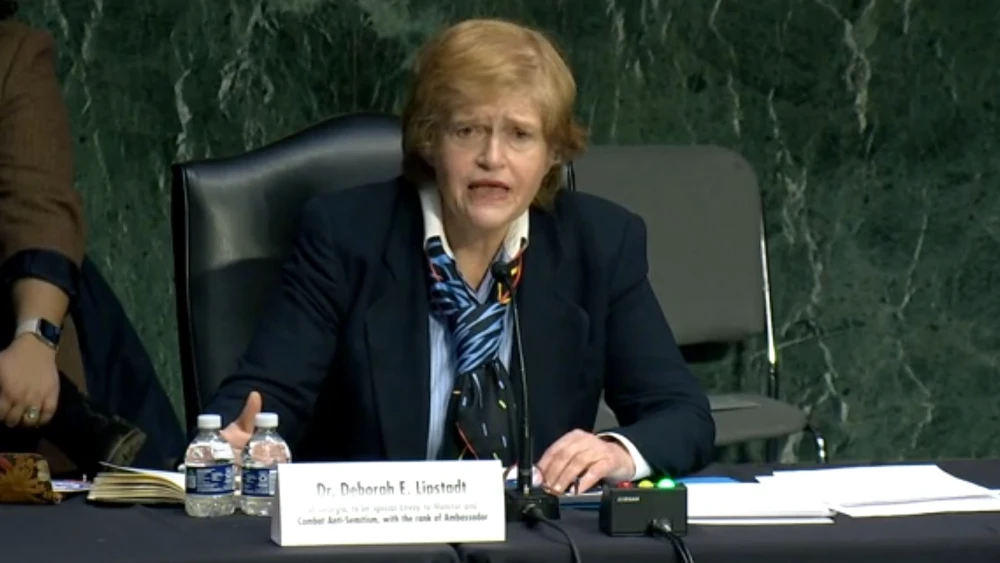
The Biden administration’s nominee Deborah Lipstadt to lead the U.S. State Department’s office that monitors and combats anti-Semitism appeared in the Senate on Tuesday for her confirmation.
Appearing before the Senate Foreign Relations Committee, Lipstadt made the case that anti-Semitism is on the rise.
“Increasingly, Jews have been singled out for slander, violence and terrorism,” she said. “Today’s rise in anti-Semitism is staggering.”
Her confirmation has been delayed for several months reportedly over concerns raised by Republicans of her past tweets, including one labeling a specific statement by Sen. Ron Johnson (R-Wis.) as “white supremacy.” During a radio interview last year, he stated that he was not concerned by the mostly white insurgents at the U.S. Capitol on Jan. 6, but would be concerned if former President Donald Trump had won the election and those rioting at the Capitol were Black Lives Matters protesters or members of Antifa.
At her hearing during her questioning by Johnson, Lipstadt apologized to the senator, saying, “While I may disagree with what you said specifically—and I think that’s a legitimate difference—I certainly did not mean it, and I’m sorry if it was taken and I’m sorry if I made it in a way that it could be assumed to be political.”
It was only a commitment on the nominee’s part to make such an apology that convinced Republicans on the committee to grant her a hearing. Johnson said he would still vote against Lipstadt.
She has also been criticized for appearing in a 2020 ad where she likened Trump’s rhetoric to that of Nazi Germany.
An author, premier Holocaust historian and the Dorot Professor of Modern Jewish and Holocaust studies at Emory University, Lipstadt was nominated by U.S. President Joe Biden on July 30. Since then, Jewish groups have written numerous letters to the committee in support of her nomination, especially in the wake of last month’s attack on a synagogue in Colleyville, Texas.
‘The sky is falling’
On Tuesday, B’nai B’rith International urged the Senate to swiftly confirm Lipstadt.
“Lipstadt is eminently qualified for this critical role, having actively engaged in the fight against anti-Semitism through her long, distinguished career as a historian and a professor,” said B’nai B’rith International President Seth J. Riklin and CEO Daniel S. Mariaschin. “The delay of Lipstadt’s confirmation has left a vacuum, with no one serving in this vitally important role of anti-Semitism special envoy. In the face of a surge of anti-Semitism globally, the United States must continue to assume a leadership position in the fight against this hatred through the person of the special envoy.”
In her hearing, Lipstadt dismissed partisanship, saying she has called out anti-Semitism on both sides of the aisle. She acknowledged, however, that some of her posts had not been “as nuanced” as she would have liked.
If confirmed, Lipstadt’s role would be to focus on reporting on global anti-Semitism and pressing governments to adopt measures to mitigate it. While the position does not primarily focus on domestic concerns, she will likely be seen as the Biden administration’s voice on the issue.
One important issue will be to work to apply the International Holocaust Remembrance Alliance’s (IHRA) working definition of anti-Semitism, which equates anti-Zionism with anti-Semitism. The Biden administration has supported the IHRA definition, despite criticism by some on the left claiming the definition equates criticism of Israel with anti-Semitism. The definition itself states that ‘Denying the Jewish people their right to self-determination, e.g., by claiming that the existence of a State of Israel is a racist endeavor’ is anti-Semitism, but that ‘criticism of Israel similar to that leveled against any other country cannot be regarded as antisemitic’.”
“I think it’s very important to be nuanced there because, you know, it’s sort of [like] ‘Chicken Little’ [repeating], ‘The sky is falling,’ ” she said. “If you call everything anti-Semitism, when you have a real act of anti-Semitism, people aren’t paying attention.”
Nevertheless, Lipstadt said she believes that Colleyville was “not an isolated incident” and that more needs to be done to combat anti-Semitism.
“If confirmed, I shall fight anti-Semitism worldwide, without fear or favor, and with that one goal emblazoned before me to make a difference,” she vowed.