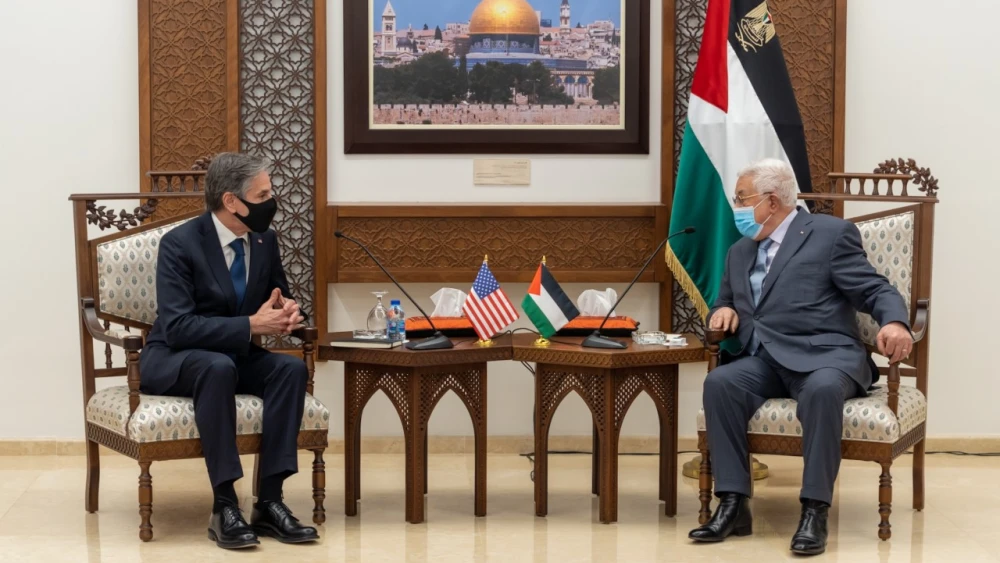
U.S. Secretary of State Antony Blinken met with Palestinian Authority leader Mahmoud Abbas on Tuesday in Ramallah, where he promised him the that United States would reopen the Jerusalem consulate for the Palestinians.
“As I told both Prime Minister [Benjamin] Netanyahu and President Abbas, the United States will go forward with the reopening of its consulate in Jerusalem. This is an important step,” said Blinken. “That’s an important way for our country to engage with and provide support to the Palestinian people.”
The U.S. consulate in Jerusalem, which handled affairs between America and Palestinians, was merged with the U.S. embassy when it relocated to Jerusalem from Tel Aviv in May 2018. It now operates as the Palestinian Affairs Unit within the embassy.
The secretary of state also told Abbas that the United States is working with the international community to assist in the relief and recovery efforts in Gaza.
“The United States will notify Congress of our intention to provide $75 million in additional development and economic assistance for the Palestinians in 2021,” said Blinken. “We’ll also provide $5.5 million in immediate disaster assistance for Gaza and a little over $32 million for UNRWA’s emergency humanitarian appeal.”
The secretary of state said that in total, the United States will provide more than $360 million in support for the Palestinians and that America will “work with partners to ensure that Hamas does not benefit from these reconstruction efforts.”
The secretary also spoke out against either side—Israelis or Palestinians—taking “unilateral provocation actions” that could spark more violence.
“Whether that is settlement activity, whether that is home demolitions, annexation of territory, incitement to violence, compensation for individuals imprisoned for acts of terrorism, any unilateral action that undermines the prospects for genuine progress and genuine peace is something we will continue to oppose,” he stated.
Finally, Blinken reaffirmed the United State’s commitment to the “historic status quo” on Jerusalem’s Haram al-Sharif/Temple Mount.
“Palestinians and Muslims from around the world must be able to pray in peace on the Noble Sanctuary, now and eternally. In Jerusalem and across Israel, Christian and Muslim Palestinian families deserve the same right to worship, build and thrive as their Jewish cohabitants.”
Abbas thanked Blinken for his support.
“We thank the American state for the support it has given to the State of Palestine,” he said. “We hope that the future is full of diplomatic activities led by the United States and the Quartet, so as to reach a just, comprehensive solution based on international law.”
Blinken, along with Deputy Assistant Secretary Hady Amr, also met with Palestinian civil society leaders, where he reaffirmed that part of his mission to the region was to “renew ties between the United States and the Palestinian people and to build on those ties going forward.”