


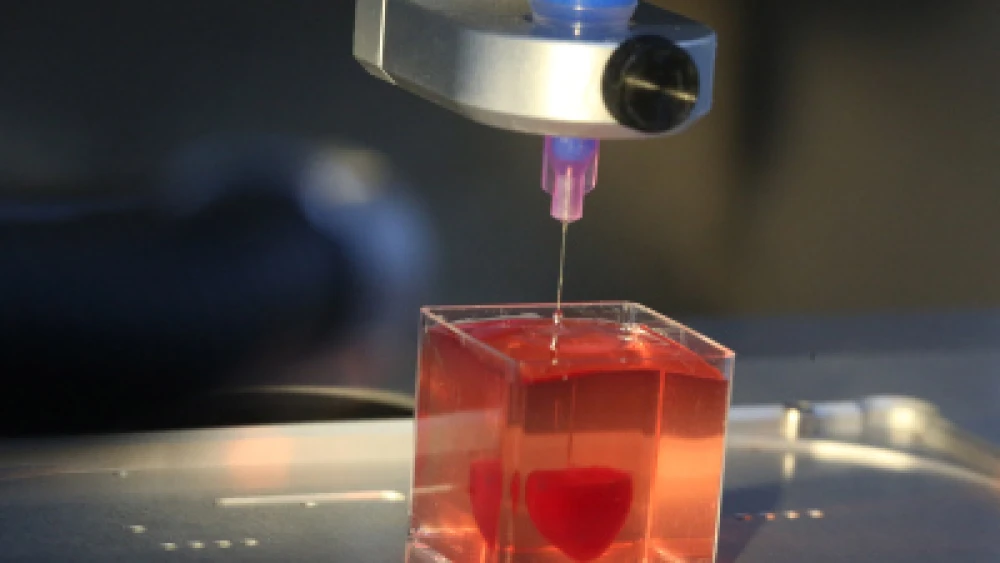
Tel Aviv University has printed human heart tissues on a 3D-printer to be used to test the cardiotoxicity of experimental drugs, as part of a collaboration between the university’s tech-transfer company, Ramot, and German pharmaceutical giant Bayer.
It was undertaken in TAU Professor Tal Dvir’s Laboratory for Tissue Engineering and Regenerative Medicine.
“We are excited to start this new collaboration with Tel Aviv University, which will address a new area of early assessment of safety and tolerability of drug candidates,” said Eckhard von Keutz, head of Translational Sciences at Bayer. “We already have a global network of partners, and this new project will enable Bayer to expand its open innovation activities to Israel, which provides a dynamic ecosystem for innovation in biotech and medical research.”
Last April, Dvir’s lab successfully produced the first-ever 3D-printed heart using tissue extracted from a patient. Such technology could revolutionize drug screening.
Drug candidates go through several stages of screening: First, the new compound is tested on human tissue cultures in Petri dishes. Next, it is administered to lab animals. Then the drug is approved for human clinical trials.
The 3D-printed tissues could make the process faster, cheaper and more efficient, said the university.
“In a Petri dish, all the cells line up in 2D, and it’s only one type of cell,” explained Dvir. “In contrast, our engineered tissues are 3D-printed, and therefore better resemble real heart tissues. Our printed tissues contain cardiac muscle, blood vessels and the extracellular matrix that connects the different cells biochemically, mechanically and electrically. Moving away from Petri dishes to 3D-printed tissues could significantly improve drug tests, saving precious time and money with the hope of producing safer and more effective medication.”
He added that “our end goal is to engineer whole human hearts, including all the different chambers, valves, arteries and veins—the best analog of this complex organ–for an even better toxicological screening process.”
According to a press release by Bayer, Ramot licensed the technology to a spin-off company, Matricelf, whose first focus is on engineering personalized spinal-cord implants to treat paralyzed patients.
This article first appeared in Israel Hayom.



