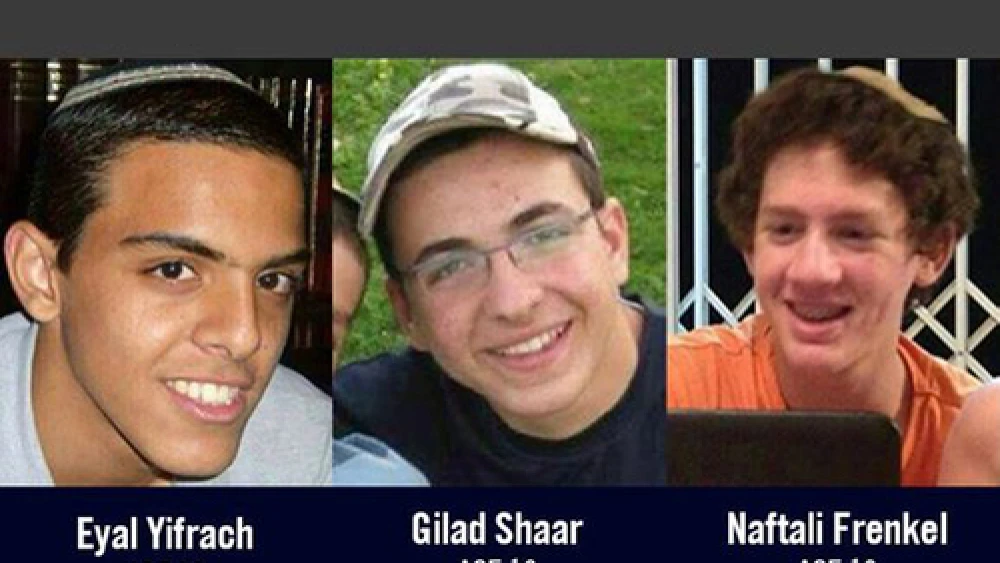
The families of three Israeli teenage boys who were abducted and murdered by Hamas terrorists in Judea and Samaria in June 2014—sparking “Operation Protective Edge” later that summer—filed a lawsuit against the terrorist group on Sunday morning, seeking NIS 520 million ($155 million) in damages.
According to the families of Naftali Frenkel, Gilad Shaar and Eyal Yifrach, who are represented by attorneys Nitsana Darshan-Leitner, Avi Segal and Avi Gaz from the Shurat HaDin-Israel Law Center, the purpose of the lawsuit is to stop the Palestinian Authority, which controls parts of Judea and Samaria, from transferring money to Hamas, the terrorist organization that rules the Gaza Strip.
The lawsuit partly relies on a study conducted by Lt. Col. (res.) Alon Eviatar, formerly an adviser on Palestinian affairs at the Coordinator of Government Activities in the Territories, which found that the P.A. transfers between $50 to $100 million per month to Hamas.
“The funds are transferred to Hamas’ government offices in Gaza and to various bodies in the Gaza Strip that are controlled by Hamas,” Shurat Hadin said in a statement. “In actuality, all the funds that reach one of Hamas’ wings—the military wing, political wing or social wing—are considered Hamas funds and can be confiscated on behalf of a lawsuit against Hamas.”
The statement also said that Hussam Qawasmeh, the leader of the terrorist cell that carried out the abduction and murder, “confessed in his interrogation that he was the brains behind the [terrorist attack], and even received funding for the attack from Hamas. He purchased the weapons used in the attack and transferred them to Marwan Qawasmeh, another terrorist in the cell, and also bought a vehicle for them. He also confessed to helping the murderers after the attack bury the boys’ bodies, remove evidence from the burial site and evade Israeli security forces. Additionally, Hamas’ military wing, the Izzadin al-Qassam Brigades, officially claimed responsibility for the abduction and murder.”
A statement issued by the families of the three boys said that “the purpose of this lawsuit, of course, is not to heal our pain, reduce our sorrow or diminish our yearning for our children. If the lawsuit can deter, even slightly, these forces of evil, it would be a victory.”
Darshan-Leitner, the president of Shurat Hadin, said “this is an unprecedented lawsuit. For the first time, P.A. funds will be confiscated because of a terrorist attack perpetrated by Hamas. If the P.A. refuses to honor a seizure order and continues funding Hamas despite the order, we will sue for the sum to be extracted from the tax funds Israel collects on behalf of the P.A.”
Darshan-Leitner continued, “Either way, the P.A. will pay for its support of Hamas—and the victims of terror will be able to receive justice. Where the state [of Israel] has failed—in stopping the hundreds of millions of dollars funneled to Hamas from the P.A.—the victims of terror will succeed.”
This article first appeared in Israel Hayom.