Twelve years ago, Israelis across the country joined together in prayer and hope during the search for three kidnapped teenagers—Eyal Yifrach, Gilad Sha’ar and Naftali Fraenkel.
Following their murder by Hamas terrorists in June 2014, the Jerusalem Unity Prize was established by their families together with former Jerusalem mayor and current Economy and Industry Minister Nir Barkat to preserve the spirit of solidarity that swept across Israel and Jewish communities around the world during those difficult weeks.
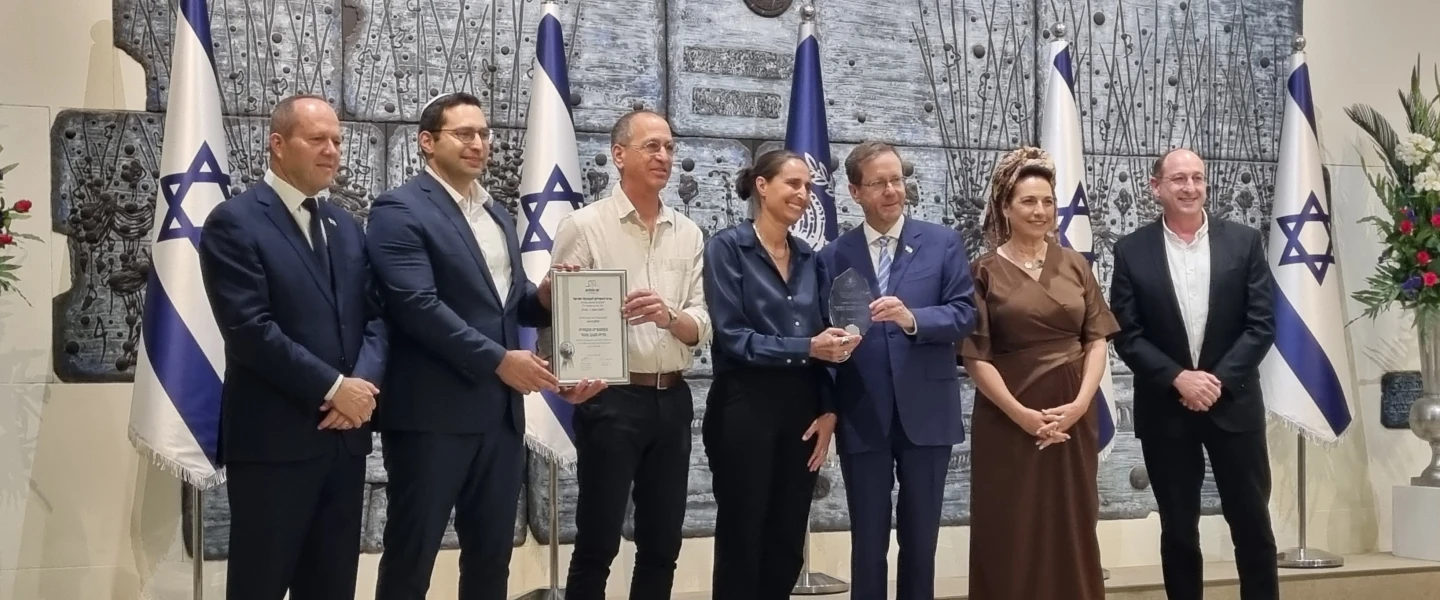
At the 2026 Jerusalem Unity Prize ceremony held Sunday at the President’s Residence in Jerusalem, that spirit of unity remained the central theme as organizations and individuals dedicated to bridging divides within Israeli society and strengthening connections with world Jewry were honored.
President Isaac Herzog hosted the annual event, stressing the importance of preserving human dignity, mutual responsibility and social cohesion during one of the most challenging periods in Israel’s history.
This year’s national Jerusalem Unity Prize was awarded to Edat HaTzofim, the Religious Division of the Israeli Scouts Movement, for its efforts to cultivate leadership, volunteerism and social responsibility among young Israelis from diverse backgrounds through educational and community initiatives.
“The things that unite us are much greater than the things that divide us,” Barkat told attendees, echoing the message that inspired the prize’s creation more than a decade ago.
Among the most prominent honorees was Brit HaNegev VeHa’ar (the Negev-Hebron Hills Covenant Initiative), which received the local-category award. The initiative was founded following the Hamas-led massacre of Oct. 7, 2023, by residents of Western Negev communities—including Kibbutzim Be’eri and Nir Oz—and members of Gush Etzion, the bloc of Jewish communities south of Jerusalem in Judea.
Its founders seek to create meaningful dialogue between Israelis from different ideological backgrounds while preserving their distinct identities and values. Leaders of the initiative say Israel’s recovery depends on rebuilding trust and shared responsibility across ideological and geographic divides. Members of Brit HaNegev VeHa’ar are currently promoting a social charter for the repair of the State of Israel and Israeli society, which all Israeli citizens are invited to sign.
“For many residents of the Western Negev, the Oct. 7 massacre was the first destruction of the Zionist home,” said Itay Zidenberg, former secretary-general of Hashomer Hatzair and one of the initiative’s founders and co-CEOs. “The State of Israel on which we grew up ceased to exist on that day. The sacred imperative of ‘Never Again,’ upon which the state was founded, drowned in rivers of blood that flooded a magical piece of land.”
Zidenberg said one of the turning points came when residents of Gush Etzion joined rallies organized by the displaced community of Nir Oz in Karmie Gat calling for the release of hostages held in Gaza.
“It made me realize that I, too, must step out of my comfort zone and turn my colleagues from Religious Zionism into strategic partners for the profound change required in Israeli society,” he said.
Dr. Yochanan Ben Yaakov of Kfar Etzion, a former secretary-general of Bnei Akiva and another founder of the initiative, said the group’s success lies in its willingness to engage despite fundamental disagreements.
“We know what we cannot agree on, and we know how to seek consensus,” he said. “Whether on a Jewish and democratic state, Jews and Palestinians in the State of Israel, or other core issues of Israeli society.”
Ruti Doron of Tekoa, a social entrepreneur and co-CEO of Brit HaNegev VeHa’ar, reflected on the challenge facing Israelis after the war.
“On Oct. 7, we all entered the tank together, and then the slogan ‘Together We Win’ was born,” she said. “The question that arises from this whole story is whether this slogan can be transformed into a unity of ‘Together We Live,’ without overpowering one another and with deep respect for each other’s distinct and coherent views. Only in this way can we build the next floor of Israeli society.”
The international Jerusalem Unity Prize was awarded to the Straus-Amiel Institute, part of the Ohr Torah Stone network founded by Rabbi Shlomo Riskin. Established in 1998, the institute trains Religious Zionist rabbis, educators and emissaries who serve Jewish communities around the globe.

Under the leadership of Rabbi Eliahu Birnbaum, the program prepares couples and educators for communal leadership roles through training in pastoral counseling, Jewish education and community building before placing them in Jewish communities throughout Europe, Latin America and beyond.
Rabbi Kenneth Brander, president and rosh yeshiva of Ohr Torah Stone, said the award reflected the institute’s decades-long commitment to strengthening ties between Israel and Diaspora Jewry.
“This is an amazing event celebrating the best of what special individuals are doing to bring the Jewish people and Israeli society together,” Brander told JNS. “Straus-Amiel has 300 emissaries around the world serving in more than 80 cities.”
The Netur Integration Beit Midrash received the prize in the educational institutions category for fostering dialogue and shared learning among students from diverse religious and social backgrounds. The Municipality of Eilat was recognized in the local authorities category for initiatives promoting communal resilience and partnership among residents.
Two special certificates of merit were also presented.
Rabbi Yonatan Reiss, founder of the Chedvata network of haredi hesder yeshivot, was honored for advancing the integration of ultra-Orthodox young men into meaningful national service and Israeli society while maintaining strong religious observance. What began as a small initiative has grown into a network serving hundreds of students in tracks ranging from combat preparation to cyber and technology studies.

The final honoree, Sheikh Muwafaq Tarif, spiritual leader of Israel’s Druze community, received a standing ovation for his longstanding efforts to strengthen relations between the Druze community and broader Israeli society and to promote shared life among Israel’s diverse populations.
“The Druze community has always been a bridge between communities and a partner in building Israeli society,” Tarif said. “Our shared life is based on mutual respect, partnership and responsibility for the future of the State of Israel.”