


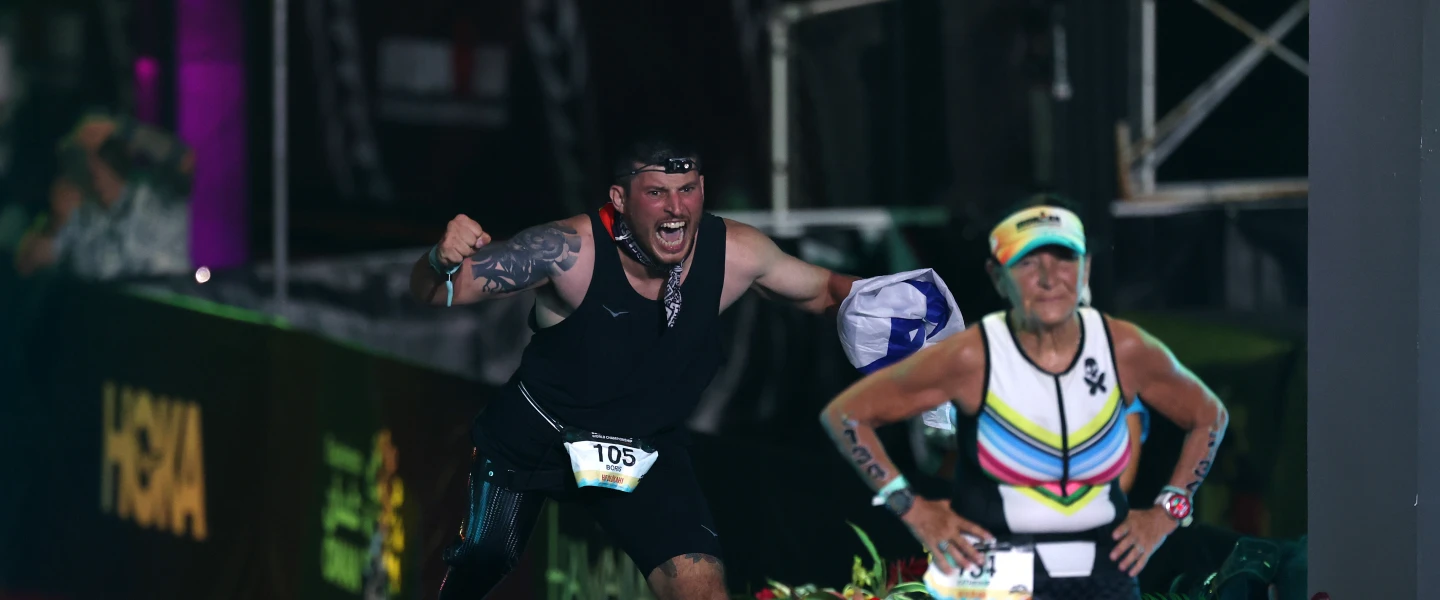
“If I want to climb Mount Everest, I will. There are no limits,” Israeli soldier Boris Shtonda, who lost his right leg while fighting in Gaza in November 2023, told JNS on Sunday.
On Nov. 1, Shtonda, 29, a reservist in the Israel Defense Forces’ Duvdevan undercover commando unit, completed the New York City Marathon.
Shtonda told JNS that he was injured twice, the second time in an explosion at the entrance to a tunnel in Beit Hanun, in the northeastern Gaza Strip. The blast caused him to lose a significant amount of blood and killed four of his friends, while six others were wounded, some seriously. Shtonda lost his leg and was evacuated to Shaare Zedek Medical Center in Jerusalem, where he underwent 19 surgeries and nearly died twice.
Boris Shtonda lost his leg in Gaza.
— Yaakov Langer (@jacklanger) November 2, 2026
That didn’t stop him from running the NYC Marathon. pic.twitter.com/mW0oRM70tP
Shtonda said regaining his freedom of movement was essential to his recovery.
“You can’t really move; you need crutches and for someone to help you. I didn’t like that at all. All my life, I had been very independent,” he told JNS.
Shtonda said he first had to learn to stand on one leg.
“You need to find your balance, and then they throw you a ball to see if you are stable. After half a year, I got my prosthesis and started to learn how to walk from scratch,” he said.
On Oct. 10, Shtonda completed Ironman World Championship in Kailua-Kona, Hawaii, competing in a division for athletes with disabilities. The competition consisted of a 2.4-mile (3.8-kilometer) swim, a 112-mile (180-kilometer) bicycle ride and a full marathon (26.2 miles/42.2 kilometers). Shtonda said training for the Ironman was his biggest challenge, because of the frequency of the workouts and the demands of the training.
“I learned everything from scratch. I started by learning to swim. I couldn’t swim 50 meters at first. Then I started accumulating distance. I went on to cycling. I started to cycle on one leg,” he said.
“I needed to train every day, a few times a day, and there was also work. I was studying for my master’s degree. My wife was pregnant. It was the biggest challenge, training every day for a year. I believe the process rehabilitated me completely,” he added.
The key to success, Shtonda said, is believing in one’s ability to overcome challenges.
“I always believed in myself, and I think it’s also the most important thing, as well as keeping your eyes on the objective. Today, I think there is nothing I can’t do,” he said.
Shtonda said that confronting smaller challenges in the aftermath of his injury and succeeding in overcoming them gave him the determination and confidence to tackle bigger hurdles.
The goals he envisioned gave him a reason to get up in the morning and believe in something.
“In the end, I think God gave me the strength, mentally and physically, to meet these challenges,” he told JNS.
Shtonda said he plans to take part in more marathons, including the remaining races in the Abbott World Marathon Majors, as well as the 20 Bridges Swim around the island of Manhattan.
To others facing similar challenges, Shtonda advised taking things one day at a time.
“Every day is a win, and every day one needs to take on small challenges. Let’s focus on what needs to be accomplished today, tomorrow or the day after,” he said.


