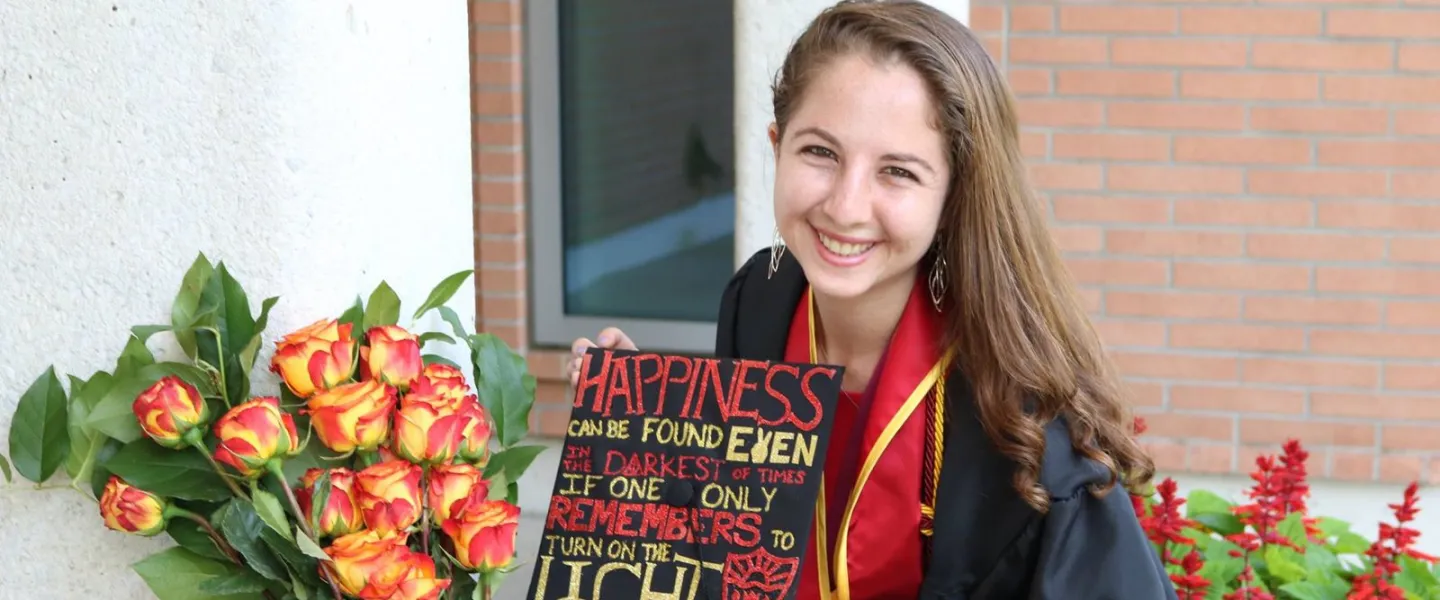
In her new book, Digital Warrior: Inside Israel’s Battle for the Narrative After October 7, former Israel Defense Forces spokeswoman Rachel Lester argues that Israel’s fight for global public opinion has become as critical to its security as the war on the battlefield.
The Los Angeles native, who made aliyah in 2017 and served four years in the International Branch of the IDF Spokesperson’s Unit, has spent much of the war since the Hamas massacre of Oct. 7, 2023, producing viral videos viewed by millions around the world. In her opinion, Israel still has much to learn about winning the digital war.

“I’ve believed that the information war is just as critical as the war on the ground since ‘Operation Protective Edge,’” Lester told JNS in a recent interview, referring to Israel’s 2014 military campaign against Hamas in the Gaza Strip. “The battlefield and the information war aren’t separate fronts anymore—they’re the same war. That’s the story I wanted to tell in Digital Warrior.”
Lester, 31, traces her conviction to years of watching Israel lose ground online, beginning during her college years in the United States after leaving what she described as a strongly pro-Israel environment.
She said the turning point came during ‘Operation Guardian of the Walls’ in 2021, when international criticism led to U.S. pressure on Israel to end its military campaign.
“I saw how a series of PR nightmares led [former] U.S. President Joe Biden to pressure Israel to stop fighting, and Israel had no choice but to comply,” she said. “That was, I think, a turning point for the higher-ups in the IDF—they saw that international perception shaped our freedom to operate militarily.”
But it was the Hamas massacre of Oct. 7, 2023, and its aftermath that convinced her the information war had become inseparable from military operations.
She pointed to the explosion at Gaza City’s Al-Ahli Hospital on Oct. 17, 2023, initially blamed on Israel before evidence showed it had been caused by a misfired Palestinian Islamic Jihad rocket.
“For about four hours, the international news was reporting that an IDF strike had killed 500 people,” she recalled. “The reaction of the world was immediate and extreme.”
“It didn’t matter what the truth turned out to be,” she said. “Whoever shapes the first narrative shapes public opinion, diplomatic pressure and ultimately the strategic environment in which military decisions are made.”
Hollywood meets ‘hasbara’
Lester credits her upbringing in Los Angeles and her education at the University of Southern California’s School of Cinematic Arts with teaching her how to communicate Israel’s story to audiences unfamiliar with the Middle East.
While still a student, she created a viral YouTube video titled “Harry Potter and the Threats to Israel,” using scenes from the film series combined with real news reports to explain Israel’s security challenges.
“I realized that there was a vacuum in the world of hasbara [public diplomacy] in explaining the Israeli-Palestinian conflict in ways that would actually resonate with young Americans’ emotions, rather than rely on them to process facts,” she said.
That lesson shaped the hundreds of videos she later produced for the IDF’s official social media channels.
One of her most successful videos after Oct. 7 began with the line, “We need to talk about civilians in Gaza.” Rather than focusing on Israeli victims, Lester said she highlighted Hamas’s cruel treatment of Gaza’s own civilian population.
“The video performed so well because I was talking about a subject the world actually cared about,” she said. “You have to frame and reframe your narrative in ways that your audience will want to hear—otherwise, you’re just preaching to the choir.”
Advice for students
Lester also addresses the challenges facing Jewish and pro-Israel students on North American campuses, many of whom feel overwhelmed by anti-Israel content online.
She encourages them to research issues they do not fully understand rather than becoming discouraged.
“Once I actually understand all the facts, I no longer feel overwhelmed,” she said. “I feel empowered to help change the narrative.”
Looking back some 1,000 days after Oct. 7, Lester believes Israel still misunderstands several key aspects of the information war. First, she argued, facts alone are not enough.
“Facts don’t win the digital war, emotions do,” she said. “We need to change our strategy on a national level to appeal to people’s emotions.”
She also called for a broader range of Israeli voices to represent the country internationally.
“There should be more young, Black, Arab, Druze, Muslim people representing Israel in the media and on social media,” she said. “If I could make one thing happen in the Ministry of Foreign Affairs, I would set up a program to teach English to cohorts of diverse Israelis so that people in the West can relate to Israelis on a more human level.”
Finally, Lester warned that Israelis must better understand how individual actions can affect the country’s international standing.
“When enough politicians say despicable things and enough soldiers post videos of themselves doing horrible things on social media, Israel gets brought to the International Court of Justice on the charge of genocide,” she said.

“The IDF must punish soldiers who act inappropriately more severely (and publicly), and do a constant, widespread information campaign about social media etiquette,” she added.
Lester said the initial response to her book has been overwhelmingly positive, with interview requests arriving from media outlets around the world. The book has drawn praise from prominent pro-Israel voices, including Lt. Col. (res.) Jonathan Conricus, a former international spokesman for the IDF, and journalist Emily Schrader, both of whom endorsed it on the back cover.
She plans to spend the coming months speaking on college campuses across the United States to promote Digital Warrior and share her journey from being a lone soldier in the IDF to fighting Israel’s battle for the truth on social media.
“I look forward to bringing my personal story to every community and audience eager to hear it,” she said.