


Deborah Lipstadt has spent much of her life confronting people who hate Jews. She has exposed Holocaust deniers, defeated one of them in a landmark British libel trial and served as the United States’ special envoy to monitor and combat antisemitism.
Yet she opposes laws that criminalize Holocaust denial. She condemns the intimidation of Jewish students on American campuses but believes the Trump administration has gone too far in its response. And while she has become increasingly convinced that anti-Zionism is a form of hatred in its own right, she warns against labeling every criticism of Israel as antisemitic.
“If I call everything antisemitism, nothing is antisemitism,” she told JNS in an exclusive interview.
After decades spent studying the Holocaust and fighting antisemitism, Lipstadt refuses to let either define her own Jewish identity.
“I know who I am. I know what my tradition teaches. I have a Jewish community around me. I celebrate Shabbat,” she said.
“I’m not a Jew because of antisemitism. I’m a Jew af al pi, despite antisemitism. Be Jewish because it’s your heritage. Be Jewish because it’s an amazing thing. Be Jewish because of the wisdom it has.”
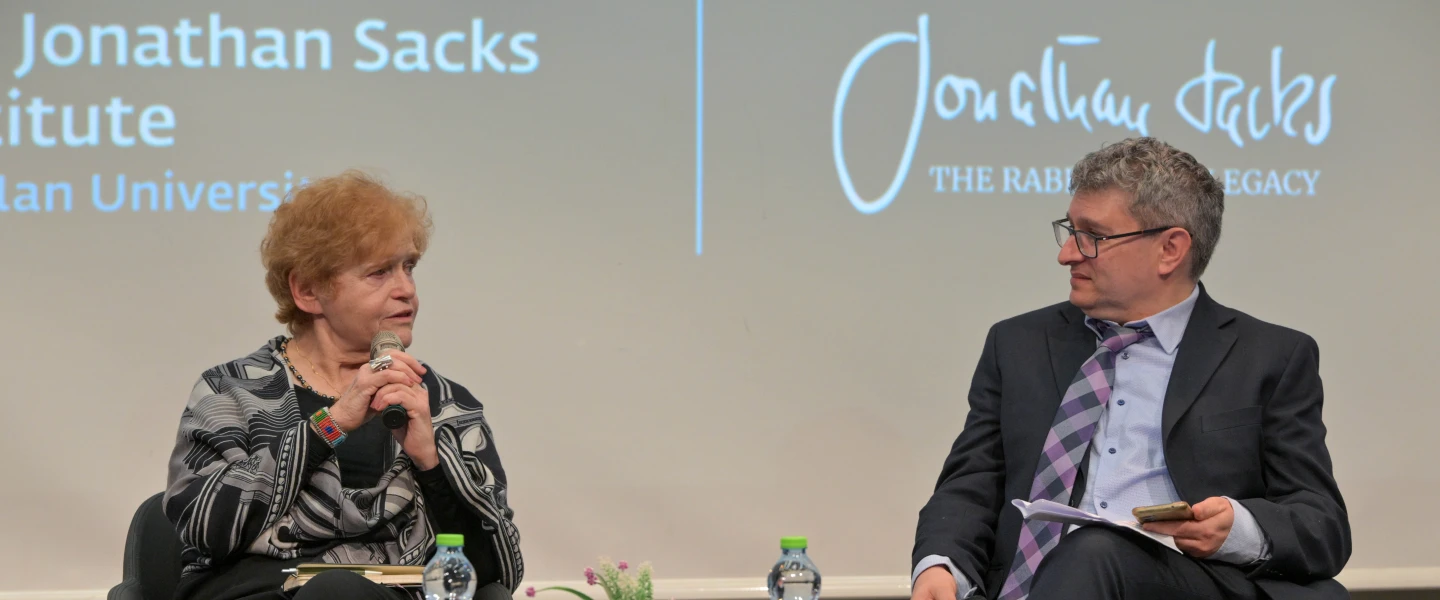
On Nov. 9, Lipstadt received the 2026 Jonathan Sacks Institute Prize for Outstanding Achievement as a Public Intellectual at Bar-Ilan University. The ceremony took place on the 88th anniversary of Kristallnacht, the Nazi pogrom of Nov. 9-10, 1938, when synagogues were burned, Jewish homes and businesses destroyed, and thousands of Jews arrested across Germany and Austria.
The prize, carrying an award of 100,000 shekels, was established by the Gewurz family in memory of Samuel Gewurz to honor individuals whose work reflects the intellectual and moral vision of Rabbi Lord Jonathan Sacks.
Bar-Ilan University President Prof. Arie Zaban described Lipstadt as embodying “the intellectual excellence, moral conviction, and commitment to truth that defined Rabbi Lord Jonathan Sacks’ legacy.”
“Through her pioneering scholarship on the Holocaust and antisemitism, and her courageous leadership in combating antisemitism, she has demonstrated the power of academic scholarship to inform public discourse and confront some of the most pressing challenges of our time.”
Lipstadt said of Rabbi Sacks: “He had a unique ability to bridge between Jewish and non-Jewish society, to speak to the world at large with an eloquence that was really unmatched.”
Asked what Sacks would have thought about the alarming rise of antisemitism around the world today, she replied: “I think he would have been utterly distressed. He was the type of voice we needed in times like these. Now, it’s a voice that’s sorely missed.”
Fighting antisemitism without sacrificing free speech
In 2000, Lipstadt won a landmark libel case brought against her and her British publisher, Penguin Books, by Holocaust denier David Irving, who sued after she accused him in her book Denying the Holocaust of deliberately distorting historical evidence.
Under British libel law at the time, the burden fell on Lipstadt and her defense team to prove that their allegations were substantially true. After examining extensive historical evidence, the High Court in London ruled against Irving. The ruling was widely regarded as a major victory against Holocaust denial.
Yet Lipstadt has consistently opposed laws criminalizing Holocaust denial, maintaining that the answer to historical falsehoods lies in evidence, not censorship.
That same commitment to free expression extends to Jewish and Israeli students on American campuses.
“There clearly was a McCarthyism of the left on many campuses, not all campuses, but many campuses,” she said.
She described instances of faculty members harassing Israeli and Jewish students.
“That’s very disturbing; it has no place on a college campus.
“Academic freedom goes both ways, to the faculty and the students.
“When you ask an Israeli or someone who self-identifies as a Zionist to leave a room, that’s not freedom of speech. That’s denying them the freedom of speech.”
Lipstadt believes universities already have the tools to address intimidation and harassment without compromising freedom of expression. The responsibility, she argued, lies with university administrators to enforce their own rules consistently rather than allowing disruptive behavior to go unchecked.
But she is equally concerned about government overreach.
“I applauded this administration at the beginning when it took this very seriously, but I think in too many areas it’s gone overboard,” she said of the Trump administration’s response to campus antisemitism.
She cited the detention of a Tufts University student who had written critically about Israel and American foreign policy.
“That’s not what America’s about.
“When you say the government should control what’s taught, when you take away funding for scientific research, then it looks like you’re not really fighting antisemitism, you’re fighting the universities in the name of fighting antisemitism.”
When anti-Zionism becomes hatred
“Criticism of Israeli policies is absolutely fine,” Lipstadt said, noting that hundreds of thousands of Israelis have demonstrated against their own government’s decisions.
But she draws a distinction between opposing Israeli government policies and rejecting Israel’s right to exist.
“I used to often say anti-Zionism is just an offshoot or a way of antisemitism,” she said. “But I’m increasingly convinced that it’s grown into its own form of hatred.”
Opposition to Israel’s existence, she argued, cannot be separated from the implications for the millions of Jews who live there. Even when anti-Zionism is not antisemitic in intention, she believes its consequences can be antisemitic.
What Oct. 7 exposed
Looking back at the worldwide reaction to the Hamas massacre of Oct. 7, 2023, Lipstadt recalled how quickly public attention shifted away from the atrocities.
“I was not surprised by the expression of antisemitism, but I was taken aback by the speed with which the narrative was changed.
“This wasn’t organic,” she said. “What we saw coming from the other side, whether it was on campus, whether it was on the streets of London, Paris, whatever, this had been planned, this had been programmed.”
Asked what shocked her most, she replied: “I was taken aback by the willingness, the glee, the dismissiveness of the gender-based violence of the women.
“That women’s groups, feminist groups at best kept silent, at worst said, ‘Oh, this didn’t happen or it’s justified.’”

Why today is not Nazi Germany
Despite the resurgence of antisemitism, Lipstadt rejects attempts to equate the present with Nazi Germany.
“I refuse to make the 1930s analogy. I think that’s glib.”
The historical circumstances are different, particularly the role governments played in promoting antisemitism in the 1930s. Today’s hatred, however, can spread with unprecedented speed.
“There’s a delivery system, social networks, social platforms, internet that we never had before.”
At the Nov. 9 ceremony, Prof. Jonathan Rynhold, academic director of the Jonathan Sacks Institute at Bar-Ilan University, spoke of the wider implications of antisemitism.
“Rabbi Sacks understood that antisemitism threatens both the security of the Jewish people and the health of democracy itself,” he said. “The surge in antisemitism since Oct. 7 has made that warning more urgent than ever.”
The ceremony was followed by the annual Jonathan Sacks Conversation, during which Rynhold and Lipstadt discussed antisemitism, Holocaust denial, freedom of speech and the threats hatred poses to democratic societies.
Joanna Benarroch, president of the Rabbi Sacks Legacy, also shared a discovery: Handwritten notes recently uncovered in Sacks’s archives at the National Library of Israel described Lipstadt as a “modern-day daughter of Zelophehad.”
The reference is to the five biblical sisters who challenged the prevailing inheritance laws and successfully argued their case before Moses.
The Gewurz family, whose generosity established the prize, also spoke about Sacks’s influence on their lives. Brenda Gewurz recalled how his writings were a regular feature of the family’s Shabbat table, inspiring discussions about faith, wisdom and moral responsibility. Zev Gewurz spoke of the importance of recognizing individuals whose commitment to truth and moral courage has a positive impact on society.
The danger of normalizing antisemitism
Asked what she fears about the future, Lipstadt said: “What worries me greatly is that we will have a generation of Jewish kids that will think that antisemitism is normal.”
She recalled a British security volunteer whose 9-year-old daughter was astonished to learn that children at other schools did not have security guards.
“Now that broke my heart,” Lipstadt said. “Because this little girl is growing up thinking it’s normal when I go to a Jewish event, I’m going to be checked and be thankful for it.”
Lipstadt fears that antisemitism could become the defining experience of Jewish identity for a new generation.
“We have to be very careful, particularly with young people, not to let their Jewish identity be rooted in the desire to say, ‘I’ll show them. I’ll be Jewish.’”
During a recent visit to the British Museum in London, Lipstadt stopped before the ancient Assyrian reliefs depicting King Sennacherib’s conquest of Lachish in the eighth century BCE.
The stone carvings, taken from his palace at Nineveh, depict the destruction of the Judean city and the exile of its inhabitants.
“Had he destroyed Jerusalem,” she said, “that would have been the end of Jewish history.”
Sennacherib’s empire disappeared centuries ago. The Jewish people survived.
“Who today even knows Sennacherib?” Lipstadt asked. “If you want to know about Sennacherib, you have to go to room 10A or B, whatever, room 10 in the British Museum. On the other hand, we, the Jews – we are still here.”


