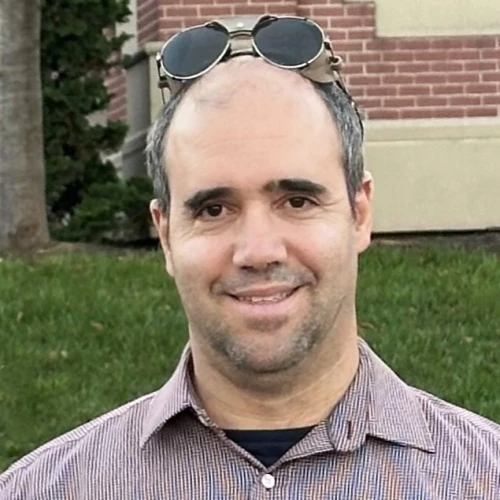
When it comes to resettling parts of Gaza and reestablishing Gush Katif, Yesh Atid lawmaker Debbie Biton told JNS she would support the move, provided that the communities are established legally.
“If those parts of Gaza can be ours, let them be ours. They used to operate as a bloc and that’s okay with me. But if we sign agreements, we need to respect them,” she said.
On July 19, the Israel Defense Forces declared parts of the Western Negev a closed military zone ahead of a planned march toward the Gaza border by activists calling for the rebuilding of Jewish communities in the enclave.
The event, dubbed the “March of Thousands,” was organized by several right-wing groups.
A mother’s determination
A resident of the southern Israeli city of Sderot, Biton was born two weeks after her parents immigrated to Israel from Morocco. Raised in a traditional household, she said her mother gave birth at 18 and did not work outside the home, while she chose a different path.
A lawyer and former nurse, Biton, 61, is married and has three daughters, two of whom are blind.
“When my first daughter, Mor, was born, I was 21 and I needed to learn to deal with everything. When we came back from the hospital after they told me she was 95% blind, I made a promise that she would be the happiest girl even without her sight,” Biton said.
Biton recalled the challenges children with disabilities faced in Israel’s education system at the time.
“They would concentrate all the children with disabilities in one classroom without really understanding. I went to the head of the school and asked her, ‘Why should my daughter be here? She doesn’t see. Why should she be in a class with children with cerebral palsy?’” Biton said.
“The principal said something that stays with me to this day. She told me, ‘Your daughter is blind, but clearly you are the one who can’t see.’ It is also because of that sentence that I decided to join the Knesset,” she added.
Biton insisted that Mor attend a mainstream school and took on the challenge of helping her daughter’s teacher adapt.
At the end of her second pregnancy, Biton gave birth to Ziv, who was also born blind. She said it was easier the second time because she had already gone through the experience once.
During her third pregnancy, at age 40, the gene responsible for both daughters’ blindness was identified. She later gave birth to Noam, who was born with sight.
Noam was born around the time that Hamas began targeting Sderot with rocket attacks. As a result, Biton sent her to school in Sha’ar HaNegev because she did not want her to grow up with trauma.
Today, Noam is an IDF officer. Mor is a lawyer who lives in Kibbutz Kfar Aza and survived the Hamas-led Oct. 7 massacre. Ziv is a social worker.
From Sderot to the Knesset
Before entering the Knesset, Biton enjoyed a successful professional career. She began as a nurse before helping introduce Mey Eden mineral water to the Israeli market in 1992, promoting healthier drinking habits.
After her sister went through a divorce and faced steep legal fees, Biton decided to study law. After receiving her license, she focused on representing women in divorce proceedings and at-risk youth through the public legal system. She said she takes particular pride in helping preserve families through shlom bayit (domestic reconciliation), whenever possible.
In 2013, Biton, a long-time Likud voter, started exploring other political parties and eventually met Yair Lapid, chairman of the Yesh Atid Party. During one of their conversations, Lapid received a phone call from his wife about their daughter, Yaeli, who has autism.
“When I saw the tears in his eyes, I knew he was the right person,” Biton said.
Biton was placed 21st on the Yesh Atid list for the 2022 elections, and the party won 24 Knesset seats.
“I arrived on the first day and there was no work. I understood that if I did not initiate, there would be no work for me,” she said.
She highlighted three pieces of legislation she considers especially significant. The first freezes the inheritance rights of anyone indicted for murdering a relative. The second ensures that child victims seeking civil compensation for sexual abuse do not have to confront their alleged abuser in court. The third, which she described as her most important achievement, prevents employers from dismissing the immediate family members of fallen soldiers or murdered civilians during the first year of mourning.
“Beyond the fact that their livelihood is taken away, these people need a reason to wake up in the morning and continue living,” she told JNS.
On Oct. 7, Biton, who lives near the police station in Sderot, watched terrorists on her security cameras as they opened fire near her home. Some of the police officers killed were her friends, while others she knew through her legal representation of at-risk youth.
“People from the city sent me pictures of murdered Israelis in the streets and asked for my help. They said, ‘You are a lawmaker. Help us.’ I couldn’t help myself. I couldn’t help my daughter and my grandchildren. It was complete chaos,” she said.
Biton spoke about her own post-trauma, recalling the fear for her life and the emotional debate over how to commemorate the victims.
“I was sitting in a Knesset committee session on commemorating Oct. 7 with bereaved parents from the Supernova Music Festival and communities in the south. A man from Kibbutz Be’eri came to me and said he did not want to see the roadside bomb shelters anymore on his way to work because they reminded him of the massacre. But a mother whose child was killed there refused to let us move them,” she said.
“It’s time for Israeli society to start healing. Whoever is in the Knesset needs to work for everyone,” she continued. “True, there are voters to please. But when a politician works for the good of the entire society, the whole society will choose that person again, because they will see that he or she is the right choice.”