When IDF reservist and father of four Moti Malka returned home to Netanya for a much-needed 24-hour break from reserve duty, his wife had one request: Help their 10-year-old son prepare for an English exam the next day.
Realizing the task was daunting, Malka turned to a tool he knew well from his day job developing AI-based solutions for companies.
“I said to my son David, ‘Let’s create a game using AI to prepare for the exam,’” Malka recalled.
The result surprised them both.
“After two minutes, it created a website and a game,” he said. “When I saw his eyes, this was the moment I realized we needed to make AI accessible for kids.”
That moment became the inspiration for Yuvi Lab.

The AI-powered platform is designed to move children away from passive gaming and toward creating their own applications, games and digital projects. Malka originally planned to name the startup “You Be,” but after discovering the name was unavailable, he settled on Yuvi.
Working alongside a close colleague and his son, Malka built Yuvi Lab as a shared father-and-son project.
“We combined creativity with education, building something we would genuinely want our own children to spend time on,” he said.
Since launching in March this year, the free platform has attracted more than 2,000 active users, who have collectively created more than 6,000 projects. Available in English, Hebrew, Russian and Arabic, the platform allows children to create educational games and interactive learning modules while earning rewards through daily challenges and long-term missions.
Yuvi Lab is designed to teach children how to create with technology rather than simply consume it.
“We wanted to create a new way of learning, what we call ‘Vibe Coding,’ that speaks the language of today’s generation,” Malka said. “Children aren’t just playing; they’re building, experimenting and thinking creatively.
“In an AI-driven world, children need real skills. They should know how to use these tools creatively, safely and confidently. Our vision is to help children become not just users of AI, but creators—giving them the tools to think long-term, solve problems and innovate.”
Partnering with teachers
The platform also supports educators. Teachers in Israel are currently piloting the technology as both an extracurricular and in-class learning tool. The system adapts to each child’s level, language and learning style, while a built-in “smart assistant” remembers preferences and interests over time.
“Yuvi is a co-pilot for teachers, not a substitute,” Malka said. “It helps educators turn learning into active practice and creation, making it easier to engage students and support those who struggle with independent learning.”
Teachers, he added, often lack the time to focus on each student individually. AI can help them create lessons and assignments tailored to each child.
Malka and his team are also helping teachers use the platform to teach critical thinking.
“We know AI isn’t 100% accurate because of the sources of information, which are usually public sources,” he said. “It is important that teachers teach children critical thinking, to cross-check and ask questions, so that we don’t take an answer for granted and instead keep thinking ahead.”
Parents are also encouraged to take an active role in their children’s learning experience. They can track progress across different subjects and receive assurances regarding the platform’s safety measures.
Built according to “Privacy by Design” principles, Yuvi Lab stores no personally identifiable information. All AI-generated content undergoes safety filtering before reaching users, and the platform operates under Microsoft’s ethical AI framework.
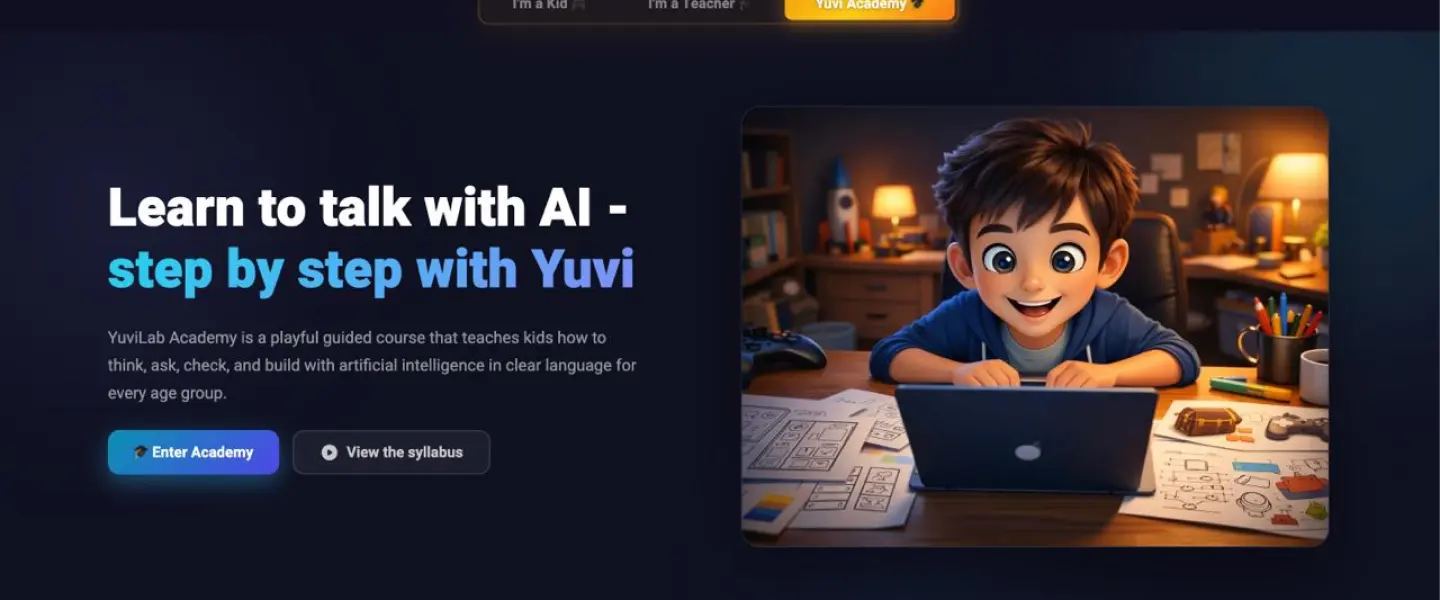
Malka recommends that new users begin with the 20-module Yuvi Lab Academy, which he describes as “a playful guided course that teaches kids how to think, ask, check and build with artificial intelligence in clear language for every age group.”
Each module includes both instructional and interactive gaming components.
Growing interest across Israel
Yuvi Lab was recently approved for inclusion in the Israeli Education Ministry’s “Summer Preparatory 2026” catalog as part of the national artificial-intelligence initiative known as “Realistic Israel.” The initiative is administered by the Israel Innovation Authority, the primary governmental arm responsible for promoting technological innovation in Israel.
Municipalities and educational organizations across Israel are now exploring broader use of the platform beyond the summer program.
Part of the interest may stem from concerns about student achievement. Results from the 2024 Program for International Student Assessment (PISA), the OECD’s global evaluation of 15-year-olds in reading, mathematics and science, showed declining performance among Israeli students, particularly in STEM subjects.
Malka, who taught himself coding, credits both his ultra-Orthodox upbringing and the IDF with helping shape the skills that led to Yuvi Lab’s creation.
“In Haredi yeshivas, you spend a lot of time learning Gemara, and you learn how to learn by yourself,” he said.
When he discovered an IDF program that offered Haredi recruits training in English, mathematics and computer skills, he eagerly joined.
“I have to give a big thank you to the army for everything,” Malka said.
Today, he continues to serve as a reserve officer in the IDF Home Front Command while working to equip the next generation with the tools to thrive in an AI-driven world.
Yuvi Lab can be accessed at https://yuvilab.ai/.