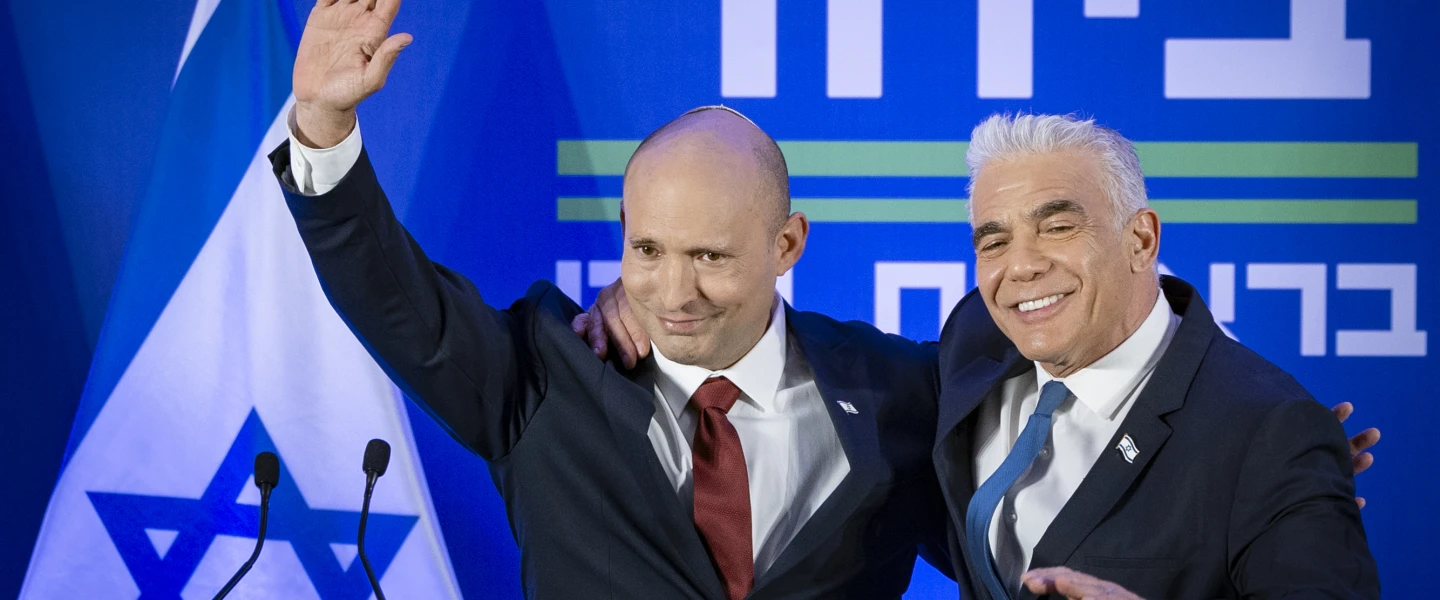
Two former prime ministers who previously joined forces to remove Benjamin Netanyahu from office are now asking voters to elect them on the same ticket. Together, “Beyachad” in Hebrew, approaches the Oct. 27 election under Naftali Bennett’s leadership, with Yair Lapid as his main partner.
The movement
Bennett’s political roots lie in the religious-nationalist right. Elected chairman of Jewish Home in 2012, he left with Ayelet Shaked in 2018 to establish the New Right, later leading Yamina. Lapid followed a different path, founding the center-left Yesh Atid in 2012. Their cooperation culminated in a diverse coalition formed in June 2021, with Bennett serving first as prime minister and Lapid succeeding him after it collapsed the following year.
That coalition included the Islamist Ra’am, reversing Bennett’s campaign pledge not to govern with the party. He has acknowledged breaking that promise while defending the decision as preferable to another cycle of elections.
Bennett sat out the 2022 election and registered a new party in 2025, subsequently joining Yesh Atid in their first shared electoral list. Their agreement places Bennett first and Lapid second, with Bennett seeking a full premiership term without rotation.
The party’s ideological pitch emphasizes political collaboration and administrative efficiency. The slate similarly combines an established parliamentary organization with recruits from public administration, security, business and civil society. Under the parties’ agreement, Yesh Atid receives 40% of the seats. Former ministry directors-general Keren Turner and Liran Avisar Ben-Horin join parliamentary figures such as MK Merav Ben-Ari and MK Merav Cohen, alongside retired Maj. Gen. Noam Tibon. Bennett presents this mix of legislative and managerial experience as the basis for a government ready to implement its program upon taking office.
The platform
Together’s security program calls for a larger military and earlier action against enemy rearmament. In Gaza, it proposes striking Hamas’s training and weapons buildup, followed by an ultimatum to disarm once military and diplomatic preparations are complete. Alongside military force, it advocates stronger regional alliances and expanded normalization of relations with Muslim states.
On the Palestinian question, Bennett opposes statehood and envisages Israeli sovereignty over Area C, the portion of Judea and Samaria under full Israeli control, with Palestinian autonomy in Areas A and B. He supports Israeli-authorized settlement on state land while opposing unauthorized outposts and construction on private Palestinian property. Lapid, on the other hand, has said that he does not support a Palestinian state in the coming years but supports a two-state solution in the long term.
Military manpower connects that security agenda to one of Together’s central domestic commitments: extending service obligations to haredi Israeli men. Bennett emphasizes financial pressure on those refusing to serve. “I will not put them in prison, but they will not receive a shekel from the state,” he told a Ynet conference. The program identifies yeshivah stipends, municipal-tax discounts and childcare subsidies among the funding streams it would withdraw.
Conversely, military and national-service graduates would receive funded undergraduate education and childcare assistance. Under Together’s plan, eligible active IDF reservists without a home would receive a million-shekel (around $325,000) discount on a first apartment in state-promoted projects.
The party proposes financing service benefits through budget reallocation from haredi subsidies and the housing discount through reduced state land revenue.
Education policy applies a similar principle of tying public funding to shared requirements. Schools would have to teach the full core curriculum, including mathematics and English, while principals and local authorities would gain greater administrative authority.
On religion and state, Together proposes local decisions over Shabbat public transportation, civil-union registration granting marriage-equivalent rights, and recognition of international kosher certification.
Its economic program focuses on competition and market concentration. Together advocates for restricting large suppliers’ control across multiple food sectors, simplifying imports through accepting European standards and a single Food Authority, and gradually reducing agricultural tariffs while providing direct subsidies to farmers. These measures underpin its campaign target of cutting supermarket-basket prices by 30% within three years.
Institutionally, Together promises a state commission of inquiry into Oct. 7 and its aftermath, an eight-year limit on the premiership and a constitution grounded in the 1948 Declaration of Independence. It seeks broad agreement on the status of Basic Laws and judicial review, although its published governance summary does not specify how judges would be appointed or when courts could overturn legislation.
The partners
Together’s principal prospective partners are Gadi Eisenkot’s Yashar, Avigdor Liberman’s Yisrael Beiteinu and Yair Golan’s The Democrats. On Sept. 26, their leaders joined Bennett and Lapid at Lapid’s home and signed a declaration committing to coordinate voter-turnout efforts, avoid attacks on one another and develop principles for the next government. Together and Yisrael Beytenu have also signed a surplus-vote agreement, allowing them to cooperate in the allocation of remaining Knesset seats after the initial distribution.
Cooperation has not resolved the question of leadership. Bennett remains Together’s candidate for prime minister, while Eisenkot argues that the largest party should supply the bloc’s nominee. The September declaration adopted no selection rule, leaving Bennett’s ambitions dependent on his electoral performance and negotiations with his partners.
Beyond that group, Bennett has rejected serving under Netanyahu and ruled out another coalition with Ra’am, neither in a coalition agreement nor in a minority government.
His position on the haredi parties is less categorical. Bennett did not explicitly exclude them, but insisted on universal service and withdrawing state support from those evading it. Alongside his education and employment proposals, those requirements create substantial policy obstacles to an agreement with Shas or United Torah Judaism.
The parliamentary arithmetic illustrates the difficulty. A Maariv poll published Oct. 2 gave Together 13 seats, compared with Yashar’s 21, The Democrats’ 10 and Yisrael Beiteinu’s nine. Together, the four lists reached 53 seats, eight short of a majority.
That survey is a snapshot, but it identifies the two unresolved tests facing Bennett and Lapid: securing support for Bennett’s leadership within their own camp, and assembling a governing majority compatible with their campaign commitments.