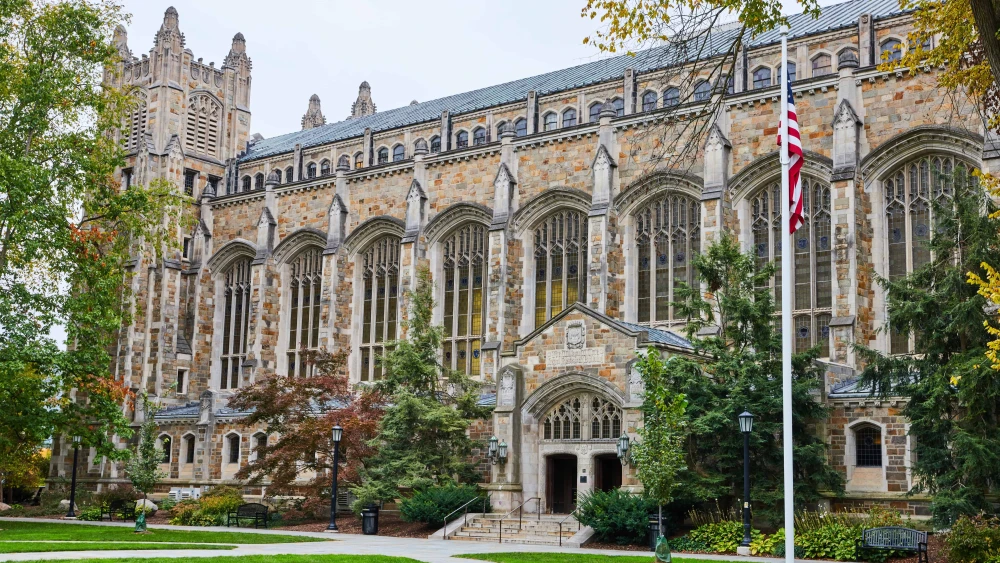
The University of Michigan Hillel made a “local, programmatic decision that does not impact or govern any other Hillel” when it opted last month to sever ties with groups that lobby or organize politically, including pro-Israel groups, a spokesman for Hillel International told JNS on Thursday.
The decision of the Hillel on the public Ann Arbor, Mich., campus was first reported in Jewish Insider, which suggested that it made the decision to separate itself from J Street U, an arm of J Street.
The leader of the group, which calls itself pro-Israel, has said that he had “been persuaded rationally by legal and scholarly arguments that international courts will one day find that Israel has broken the international genocide convention.”
“Consistent with the Hillel movement’s leading role in Israel engagement, Michigan Hillel remains committed to substantial Israel programming, education and travel experiences,” the Hillel international spokesman told JNS.
Asked if local Hillels could set their own policies about affiliating with anti-Israel groups, the Hillel International spokesman directed JNS to its Israel guidelines, which state that Hillel won’t “partner with, house or host organizations, groups or speakers that as a matter of policy or practice deny the right of Israel to exist as a Jewish and democratic state with secure and recognized borders,” among other anti-Israel actions.
Cindy Hughey, interim executive director of the University of Michigan Hillel, announced its policy in September.
J Street U was the only advocacy group affected at the time, but the restriction now applies to future affiliations with national advocacy organizations, according to Jewish Insider.
Rabbi Asher Lopatin, director of community relations at the Jewish Federation of Greater Ann Arbor, told JNS that “while in general I am in favor of Hillel having as big a tent as possible, I leave it up to the Hillel professionals and the Hillel student leadership to determine the size of that tent and whether national advocacy organizations should be within it.”
Other Hillels publicly list J Street U among their supported student groups, including the George Washington University Hillel and Brandeis University Hillel.
“Although the Hillel says it will continue Israel education and cultural programming, it has drawn a new line between engaging with Israel and publicly defending it,” Seth Mendel, campus editor at CAMERA, told JNS.
“Pro-Israel groups have also effectively been pushed outside Hillel’s institutional structure,” Mendel said. “The result is that students confronting anti-Zionist hostility are increasingly expected to build the infrastructure for their own defense, while the central Jewish institution on campus steps back from advocacy—a core part of the students’ needs.”
Mendel told JNS that the policy is “administrative retreat” and that the Michigan Hillel must decide “not whether it has the right to narrow its mission but whether doing so actually serves the students who depend on it.”
“If Michigan Hillel wants to remain the center of Jewish life on campus, it cannot retreat from one of the central and challenging parts of being Jewish there,” he said.