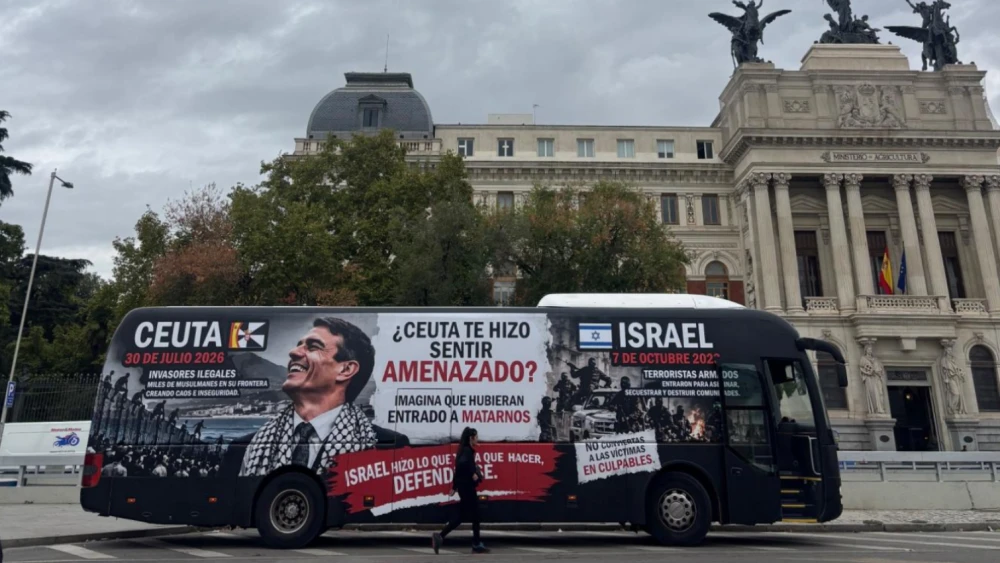
On the third anniversary of the Oct. 7 massacre, a prominent Spanish pro-Israel group launched a billboard campaign in Madrid, drawing a comparison between the Hamas-led attack on Israel and a mass border breach in Spain’s North African enclave of Ceuta.
“Did Ceuta make you feel threatened? Imagine they’d come in to kill us. That was 7 October in Israel,” read one message on buses that traveled throughout Madrid on Oct. 6 and 7 as part of a campaign by Action and Communication on the Middle East.
On July 30 and 31, tens of thousands of migrants crossed into Ceuta from neighboring Morocco, overwhelming local authorities and prompting Spain to deploy additional police and military personnel. Spanish authorities initially estimated that about 50,000 people crossed. Later estimates put the number at roughly 72,000. Most subsequently returned to Morocco. At least 72 people died during the crossings, according to Spanish authorities.
ACOM said its campaign featured two fully wrapped buses that traveled Madrid’s major streets for 10 hours a day. Other messages included: “Israel did what it had to do: defend itself” and “Don’t confuse the victim with the culprit.”
The buses traveled near landmarks including the Agriculture Ministry in Atocha, the KIO Towers in Plaza de Castilla and Plaza de Cibeles. ACOM estimated that the campaign generated between 160,000 and 280,000 street impressions over the two days.
The Ceuta migrants “did not come in to murder families or to massacre a festival,” ACOM stated. The juxtaposition, the organization’s founder and CEO Angel Mas told JNS, was to “underline for Spanish audiences the threat Israel faces and the scale of the Oct. 7 invasion.”
The campaign also criticized Spanish Prime Minister Pedro Sánchez’s government for what ACOM described as singling out Israel and contributing to hostility toward Jews in Spain.
JNS contributor Monica Vidal, a dual Spanish-U.S. citizen and investment professional, welcomed the campaign.
“It uses a recent Spanish experience to make the events of Oct. 7 feel less distant and abstract,” she said. ”It asks Spaniards to consider the instinctive reaction they had when their own border felt threatened, and then imagine the vastly more extreme reality Israelis faced: armed terrorists entering communities to murder and kidnap civilians.”