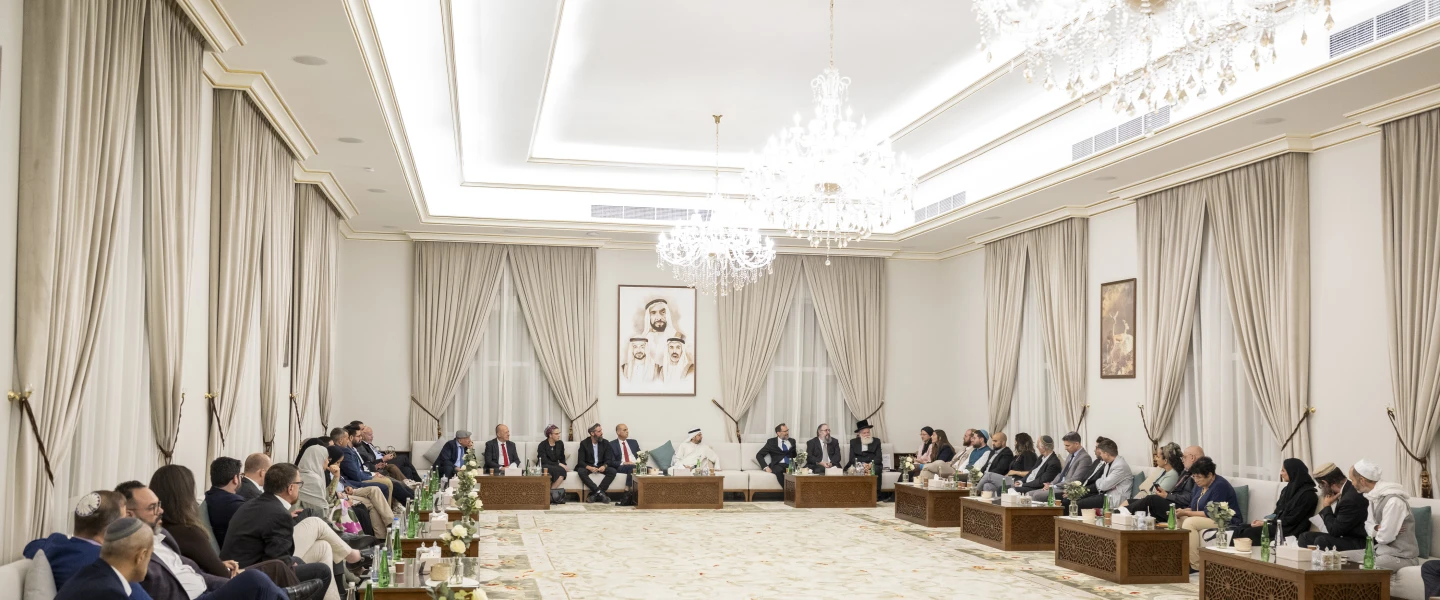
More than 30 Israeli leaders representing organizations engaged in interfaith diplomacy traveled to the United Arab Emirates in early June for high-level meetings and an international conference aimed at strengthening Jewish-Muslim cooperation and advancing the Abraham Accords.
The delegation, led by the Jerusalem Interfaith Center with support from Israel’s Ministry of Regional Cooperation, participated in the Third International Dialogue of Civilizations and Tolerance Conference in Abu Dhabi and met with senior Emirati officials, religious leaders, educators and civil society representatives.
Organizers said the mission was the largest Israeli interfaith delegation ever to visit the UAE and the first since the outbreak of the war with Iran.
Participants said the visit underscored the growth of a network of Israeli organizations committed to regional cooperation and working with partners throughout the Middle East to deepen relationships established through the Abraham Accords.
The timing of the trip carried particular significance, delegation members said, as they chose to travel during a period of heightened regional tensions to express solidarity with their Emirati partners and demonstrate their commitment to continued engagement.
“As an official partner of the Third International Dialogue of Civilizations and Tolerance Conference, the delegation sought to send a clear message that the Abraham Accords are here to stay and remain the most promising path toward regional stability, prosperity and cooperation,” the Jerusalem Interfaith Center said in a press release on Monday.

Joint Jewish-Muslim declaration
A highlight of the conference was the presentation of a joint Jewish-Muslim declaration emphasizing the importance of cooperation in promoting regional stability, moderation and resistance to religious and political extremism. Members of the delegation addressed the gathering alongside Qadi Dr. Iyad Zahalka, president of Israel’s Sharia Courts.
Dr. Ali Rashid Al Nuaimi, chairman of the Defense Affairs, Interior and Foreign Affairs Committee of the UAE Federal National Council and chairman of the Manara Center for Coexistence and Dialogue, described the accords as fundamentally people-centered.
“The Abraham Accords are not primarily a security or political agreement. They are meant to create connections among people, communities and nations,” Al Nuaimi said. “Unfortunately, parts of our region have been hijacked by forces promoting narratives of division, hatred and mistrust. That is why we need champions of peace to build bridges and speak publicly and clearly about the importance of these relationships.”
He added, “The connection between the UAE and Israel is a strategic one, rooted not only in shared interests but also in a shared vision for a better future for our region. We must continue strengthening this partnership for the sake of future generations.”
Dr. Firas Habal, president of the Emirates Scholars Center, said education remains central to efforts to transform the region.
“We realize that the key to changing the Middle East is education, and this is why we have decided to concentrate on this field strategically and scientifically,” Habal said. “We see this partnership as a significant bridge for reconciliation and for having a long-lasting impact on the region in the spirit of tolerance and mutual understanding.”
Gilad Shadmon, director-general of Israel’s Ministry of Regional Cooperation, said the delegation sent “a clear message at a critical moment.”
“The Abraham Accords are here to stay, and they are the key to stability and prosperity in the Middle East,” Shadmon said. “The productive meetings with senior Emirati government and education officials demonstrate a genuine civic desire to deepen regional partnership and move relations to the next stage.”
Besides meeting with government officials, leaders of international organizations and prominent religious figures, the delegation also visited the Crossroads of Civilizations Museum in Dubai, which houses the first permanent Holocaust memorial and exhibition in the Arab world.
The role of religion
Rabbi Yakov Nagen, president of the Jerusalem Interfaith Center, said the visit demonstrated that religion can play a constructive role in regional diplomacy.
“This unique delegation provided yet another demonstration that religion can—and must—be part of the solution,” Nagen said. “We learned that beyond our shared security interests lies a deeper connection rooted in common identity, heritage and history.”
Rabbi Dr. Aharon Ariel Lavi, CEO of the Jerusalem Interfaith Center, said bringing together nearly all of Israel’s major interfaith organizations created a foundation for more coordinated engagement with regional partners.
“The delegation’s significance lies in its ability to bring together nearly all of Israel’s major organizations active in the field,” Lavi said. “It laid the groundwork for more coordinated, professional and effective engagement with the UAE and other regional partners.”
The visit marked another milestone in the development of Israel’s interfaith diplomacy sector as a component of the country’s broader regional engagement strategy.
Organizers said another Israeli delegation, composed of educators and educational leaders, is expected to visit the UAE in the coming months as part of an ongoing effort to expand regional cooperation and strengthen people-to-people ties across the Middle East.