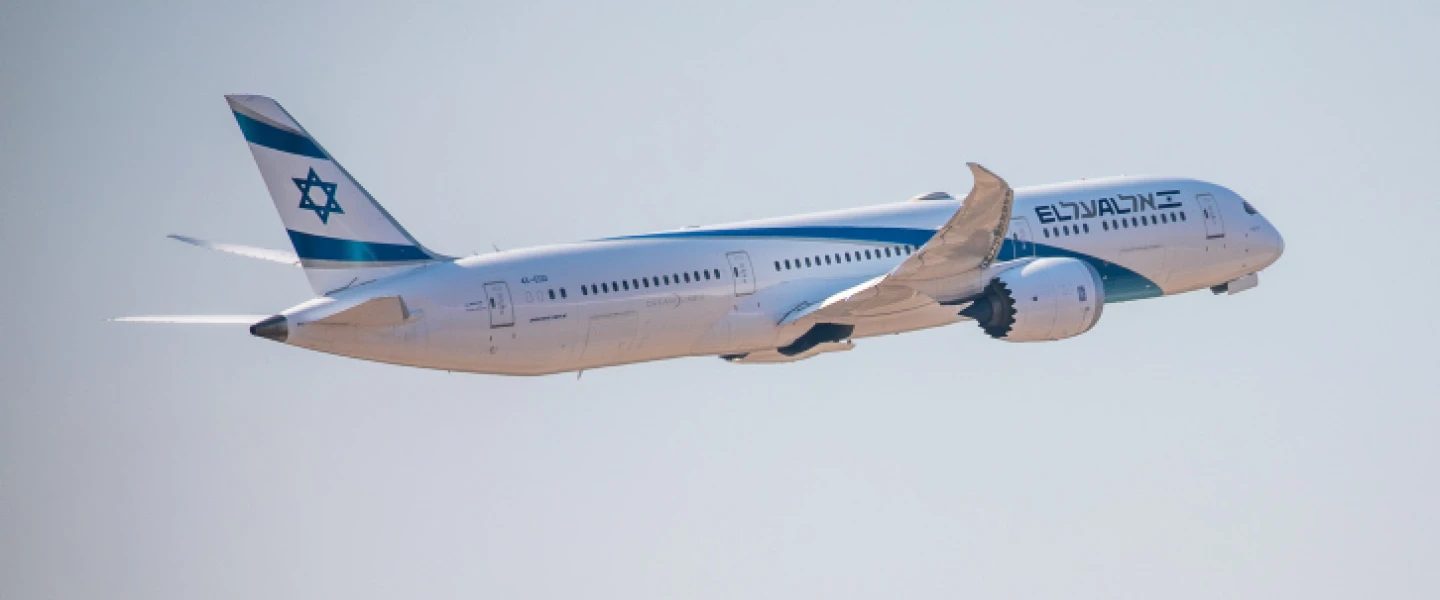
Oman’s announcement last week that it will allow Israeli civilian flights to traverse its airspace has been hailed as a step towards the sultanate joining the Abraham Accords, but experts JNS spoke with sounded a note of caution.
Oman’s Civil Aviation Authority announcement on Thursday that “the Sultanate’s airspace is open for all carriers that meet the requirements of the Authority for overflying” did not mention Israel by name, yet this new policy was broadly seen as a step in strengthening diplomatic ties between Muscat and Jerusalem. The development comes on the tail of a similar decision by Saudi Arabia, which opened its airspace to Israeli flights last July, right before U.S. President Joe Biden visited the country.
Israeli Foreign Minister Eli Cohen called the move by Oman a “historic decision” on Thursday. “Special thanks to our friend, the Sultan of Oman, and our friends in the United States who supported us throughout the entire process,’' he added.
Israeli Prime Minister Benjamin Netanyahu also released a video message hailing the announcement. According to Netanyahu, work on opening Oman’s airspace began in 2018 when he made a secret trip to Muscat. He said he had received commitments from then-Sultan of Oman Qaboos Bin Said to open Omani airspace to Israeli aircraft, but that those agreements were later reneged on by the current sultan, Haitham Bin Tariq.
Ephraim Inbar, president of the Jerusalem Center for Strategy and Security, noted that the opening of Oman’s airspace had implications over and above advancing normalization with Israel.
“This is a very significant step. It has great meaning for Israeli companies, for Israeli exports and for the Israeli economy,” Inbar told JNS. “We will have smaller planes with lower fuel costs and greater range, able to fly to important destinations,” he added.
Access to Oman’s airspace means cutting up to four hours off flight times from Israel to popular destinations such as Bangkok and Sydney. The prices of flights are also likely to drop significantly due to lower fuel costs.
According to Foreign Minister Cohen, the move will transform Israel into “the central transfer point between Asia and Europe.”
Expanding the Abraham Accords
Israel’s new government has clearly set expansion of the Abraham Accords as one of its central policy goals. The Foreign Ministry has actively been pursuing normalization with multiple Arab countries, including Sudan and, most importantly, Saudi Arabia. (Netanyahu said in a statement last week that normalization of relations with the Saudis would constitute a “quantum leap” towards broader Middle East peace.)
According to Inbar, Oman’s decision was a harbinger of better things to come.
The move, he said, was a “clear extension of the Abraham Accords, and was likely done with Saudi support.” He further noted that “with this development, Oman showed that they are not afraid of Iran and are willing to move towards Israel.”
However, not everyone agrees.
“Oman tries to talk to everyone, whether it’s the Iranians or the Saudis or the United States, but they never really want to commit to one side,” said Avi Melamed, a former Israeli intelligence officer and founder and CEO of Inside the Middle East. The sultanate is like a “middle eastern United Nations,” he added.
“Their opening of airspace by no means indicates that peace is around the corner. They’re likely more in the Saudi camp than the Iranian one, but they’re still playing all the sides,” he said.
In Melamed’s view, Oman’s move was likely designed to appease the United States, which has strongly criticized Muscat regarding its diplomatic interactions with Syrian dictator Bashar al-Assad, whom the sultanate recently hosted.
Moran Zaga, an expert on the Gulf region from The Israeli Institute for Regional Foreign Policies, further commented that Oman’s current sultan “is much more cautious in his foreign policy because of his inexperience, and his preference is to sit on the fence.”
Supporting Zaga and Melamed’s take on the matter, following its announcement on Thursday, Oman assured Palestinian Authority leader Mahmud Abbas that it would not pursue normalization with Israel despite opening its airspace.
Furthermore, according to Iran International, the sultan of Oman is scheduled to visit Tehran in the coming days to offer his mediation in the nuclear talks between Iran and the United States.
Oman also expanded its anti-Israel boycott law in late December, further signaling that it is not interested in fully normalizing relations with Israel.