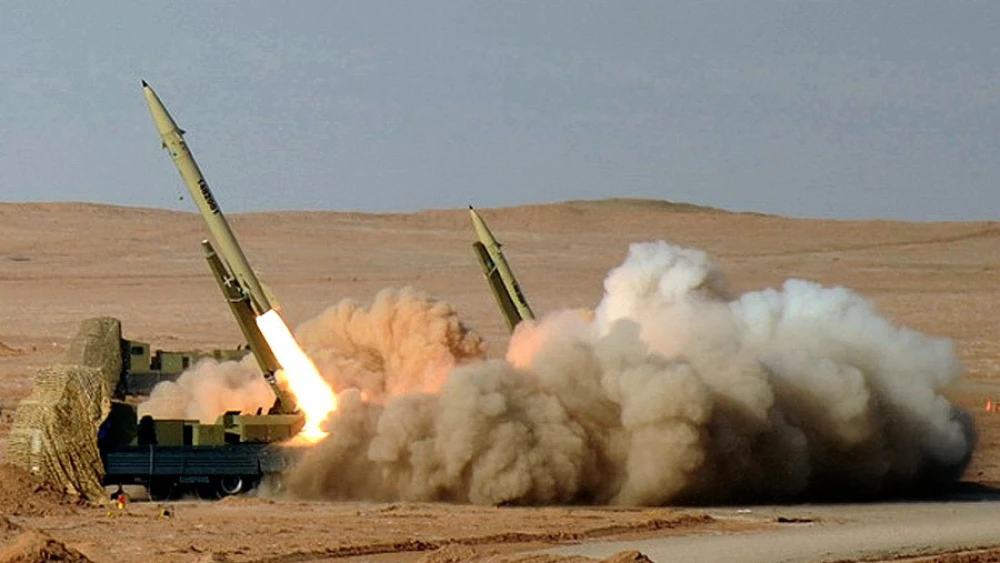
Iran could fire missiles at Israel like the ones it sent flying at Saudi Arabia last week, IDF Military Intelligence’s Research Division head Brig. Gen. Dror Shalom told Israel Hayom in a special Rosh Hashanah interview.
According to Shalom, the military’s working assumption is that Maj. Gen. Qassem Soleimani, commander of Iran’s elite Quds Force, would be the one to oversee a missile attack of that type, which Shalom said could be launched from Iraqi territory.
“In the end, when he [Soleimani] takes a hit to the nose, he wants to hit back, and he has taken some blows recently. So my working assumption is that it’s only a matter of time until he tries,” said Shalom.
Such an attempt could involve not only missiles, but also long-range drones.
“It could be in the form of a surface-to-surface missile, cruise missiles or long-range UAVs [Unmanned Aerial Vehicles]. He has UAVs that can fly 1,000 to 1,200 kilometers, which he has used in the Persian Gulf,” said Shalom.
He expressed major concern about the progress Iran is making with its nuclear program, saying Military Intelligence might be forced to divert resources to address the issue.
“I’m a lot less easy today. We’ve gotten into a gray area ... which requires us to be a lot more sensitive. Will we know [about an attack]? The Iranians are a very sophisticated enemy, and it bothers me,” he said.
According to Shalom, the chance of a major escalation between Israel and Iran is higher now than in the past.
“We’re living in a much more complicated reality, which is only getting worse. We are starting to approach the level of war,” he warned.
Shalom also said the same volatility existed on Israel’s other fronts, although Iran remained the biggest threat.
“We’re in a dangerous round with Iran, and we need to keep a strong grip on the wheel,” he said. However, he added, Israel has room to maneuver, although that room should be used “with great caution.”
He also thinks that if Israel adheres to a tough policy on Hezbollah’s precision-guided missile project, the organization might give it up, even though it would come at the price of battles against Hezbollah.
Shalom characterized Hezbollah’s missiles as a “serious strategic threat,” but stressed that Hezbollah does not currently have precision missiles in Lebanon.
This article first appeared in Israel Hayom.