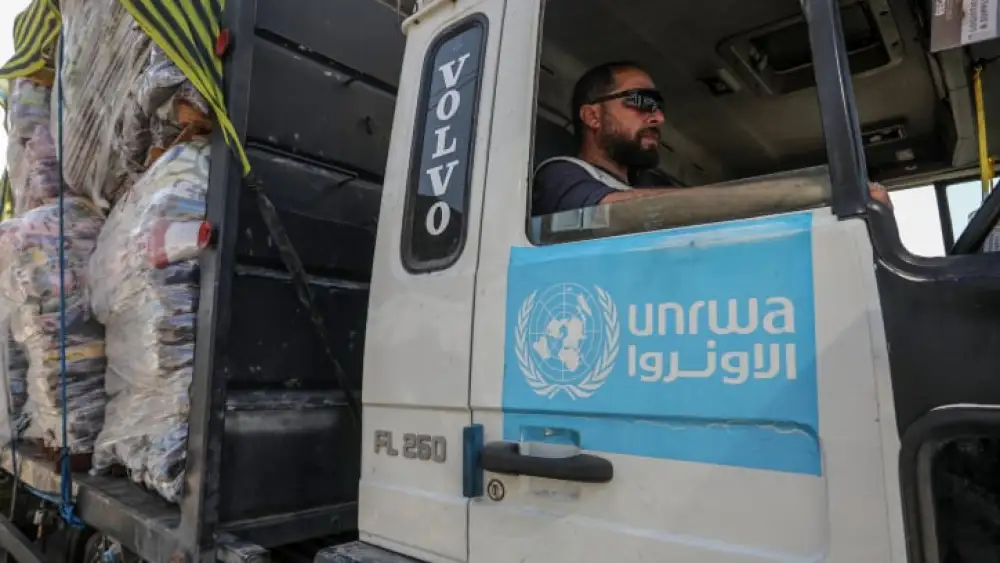
Fifteen thousand trucks carrying $1 billion in humanitarian aid have entered the Gaza Strip since the start of the current Israel-Hamas war.
The trucks carried 184,500 tons of food, 25,240 tons of water and 18,400 tons of medical equipment, Channel 12 reported on Tuesday.
The U.S. has donated the most assistance, about $180 million worth. Germany is the second-largest donor at $150 million, followed by Switzerland ($102 million), Canada ($100 million), the European Union ($99 million) and the United Kingdom ($76 million).
Most of the funds went through U.N. agencies, including the embattled UNRWA, the United Nations Reliefs and Works Agency, under investigation for its ties to Hamas.
U.S. Vice President Kamala Harris, in a meeting with Israeli War Cabinet member Benny Gantz at the White House on Monday, expressed the administration’s desire for an increase in the flow of humanitarian assistance into Gaza.
Average Israelis have expressed opposition to aid given that hostages seized by Hamas on Oct. 7 have been kept under the most inhumane conditions. According to a Feb. 20 Israel Democracy Institute poll, 68% of Israel’s Jewish public oppose the transfer of aid to Gaza, even if delivered by international institutions other than UNRWA.
Tzav 9 (“Order 9”), a grassroots group that has sprung up, has attempted to block aid trucks entering Gaza from Israel.
Delivering aid safely and effectively has been an ongoing problem. Hamas has been stealing around 60% of the supplies, Israeli security officials estimate.
In a March 2 background call with journalists, U.S. officials said distribution is an issue with one noting that “criminal gangs are taking it, looting it, reselling it. They’ve monetized humanitarian assistance.”
On Saturday, U.S. planes, assisted by the Royal Jordanian Air Force, dropped pallets containing water and more than 38,000 Meals Ready-to-Eat (MREs).
The move followed an incident on Feb. 29 when dozens of Gazans were reportedly killed during a riot that erupted following the entry of aid trucks into the northern Gaza Strip.
While Hamas blamed Israel for the deaths, an Israeli review found that no strike was carried out on the convoy by the IDF, as was alleged, with the majority of Palestinians killed or injured as a result of a stampede.
Israel’s military said it will try new methods to deliver humanitarian aid to Gazans this week.
According to the plan, trucks carrying supplies bound for the parts of Gaza already conquered by Israeli forces will enter via the Karni cargo crossing near Gaza City, which was closed in 2011 after terrorist attacks there.
By using the Karni crossing, the aid will enter through areas Israel has already conquered.