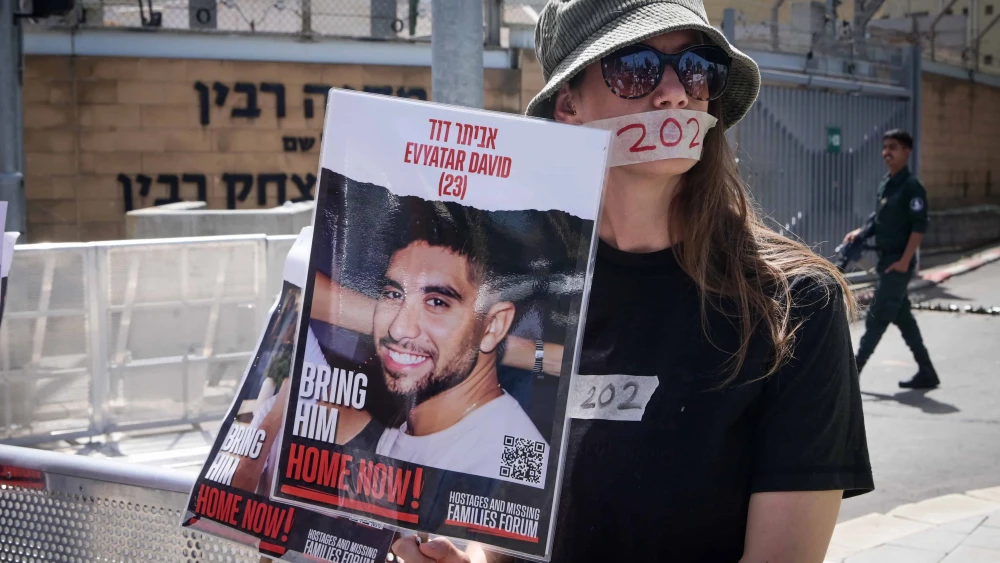
U.S. President Joe Biden and 17 other world leaders issued a joint statement on Thursday calling on Hamas to immediately free all of the hostages the terrorist organization is still holding in the Gaza Strip and to accept a ceasefire.
“We strongly support the ongoing mediation efforts in order to bring our people home,” the leaders stated. “We reiterate our call on Hamas to release the hostages, and let us end this crisis so that collectively we can focus our efforts on bringing peace and stability to the region.”
Signatories to the statement include the leaders of France, Germany, the United Kingdom, Thailand and Colombia, all of whom have citizens known to be held in Gaza or who have been missing since Oct. 7. Israel was not one of the 18 signatories.
A senior Biden administration official speaking to reporters on background on Thursday before issuing the joint statement said the White House had previously tried and failed to get these leaders to sign on to an official call to release the hostages.
“An effort was tried earlier in the crisis, and actually, we were not able to get it done given some of the disagreements, but we were able to get a unanimous sign-on to this statement today, largely because of the current situation with the hostages,” the senior official said. “We have now discussed with all of these capitals the elements of the deal on the table, and there is a deal on the table that would bring a ceasefire immediately to Gaza simply with the release of women, wounded, elderly and sick hostages.”
“That is ready to go, and we have worked it out in meticulous detail, and Hamas has rejected that,” the official added.
The Biden administration has previously issued statements suggesting that Israel was at least partly responsible for the failure to achieve a breakthrough ceasefire-for-hostages deal in the months-long negotiations in Cairo and Doha. On April 4, the White House released a readout of a phone call between Biden and Israeli Prime Minister Benjamin Netanyahu that “urged the prime minister to empower his negotiators to conclude a deal without delay.”
‘He needs to come out’
On Thursday, however, the senior administration official placed the failure to achieve a deal squarely on Hamas’s leader inside Gaza—Yahya Sinwar—and contrasted his rejections with the messages coming from Hamas leaders outside Gaza who are negotiating the deal.
“There have been a number of times where the negotiations have made significant progress outside, with Hamas leaders living in fancy hotels, but Sinwar is the ultimate decision-maker,” the official said. “Sinwar is living deep, deep underground as Gaza above him is a warzone, and as Gazans are suffering, and the question goes for him, ‘Will we agree to release this vulnerable category of hostages to secure a ceasefire and relief for Gazans?’ and the answer that comes back from Sinwar personally is, ‘No.’”
The official said that one impetus for the joint statement was news about the hostages over the past week, including Hamas’s release on Wednesday of a proof-of-life video of 23-year-old dual U.S.-Israeli citizen Hersh Goldberg-Polin.
“He needs to come out,” the senior administration official said of Goldberg-Polin. “And Sinwar has made the decision he’d rather hold him and others rather than securing a ceasefire in Gaza—I mean, that’s just the truth of the situation.”
Hamas’s leadership outside of Gaza has suggested to negotiators that their repeated rejections of the deal are not final; however, the official said that Hamas’s latest counterproposals have been “totally non-constructive” and that Hamas might just be “stringing things out.”
“We hear things from leaders of Hamas outside that do not reflect the Hamas leadership inside, which seems determined to simply sit underground, holding hostages,” the official said.
“Hamas leaders on the outside say all sorts of things, and it’s Hamas that we are dealing with here,” the official added. “They also acknowledged they’re not decision-makers, and the decision-makers are inside Gaza—again, living deep, deep underground and holding hostages, and oftentimes are with the hostages. The whole situation is just so totally outrageous when you kind of step back from it.”