Newsletter
Newsletter Support JNS

Four more peace deals on the way, says Netanyahu

The Israeli prime minister rules out forming a government with Arab parties, despite reports about his ties with Mansour Abbas of the United Arab List.

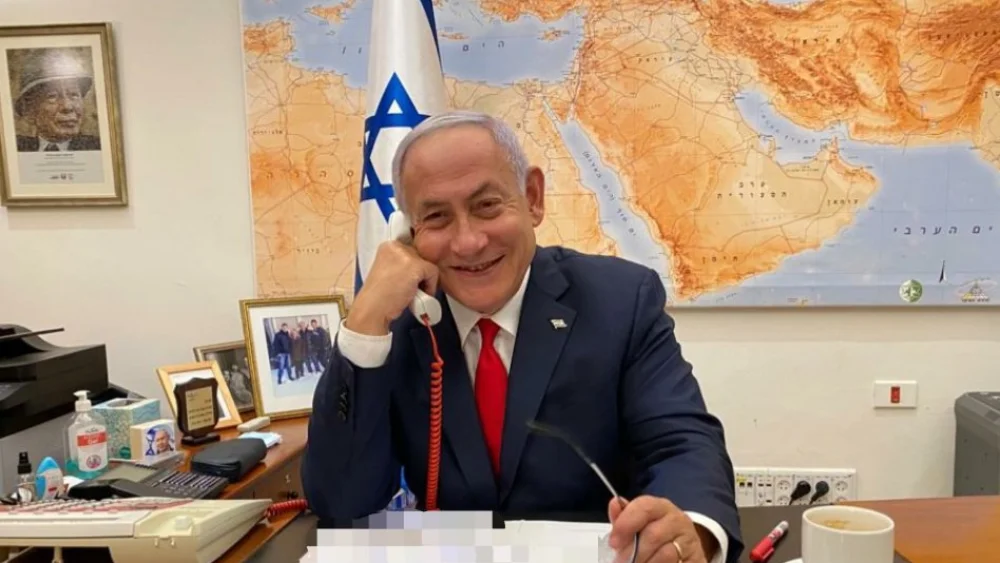
Israeli Prime Minister Benjamin Netanyahu speaking by phone with U.S. President Joe Biden. Source: Israeli Prime Minister/Twitter.

Israel is working on four more peace deals with countries in the Middle East, Israeli Prime Minister Benjamin Netanyahu said on Tuesday.

“There are four more peace agreements on the way. And the people come to us because they know that this is the real thing,” Netanyahu told Ynet in an interview.

“I delivered peace for peace,” he said, referring to the normalization agreements with the United Arab Emirates, Bahrain, Morocco and Sudan.

The prime minister also ruled out forming a government with Arab political parties, despite his reported ties to Mansour Abbas of the United Arab List Party, the political party of the Islamic Movement’s southern branch.

Abbas raised eyebrows and angered some of his fellow Arab lawmakers after seeking to improve ties with Netanyahu.

The Israeli prime minister also dismissed a Ynet report that members of his Likud Party had been in touch with Palestinian Authority head Mahmoud Abbas to talk about gaining his support for Netanyahu in the upcoming Israeli elections.

“I don’t need Abbas, who wants to bring me down, or the Joint List Party or Mansour Abbas,” said Netanyahu. “We will establish a strong right-wing government that will forge its own path and make Israel into an international powerhouse.”

“There’s not a day that I don’t try to consult with him, and with my father,” the Israeli prime minister said, half a century after the counter-terror operation in Uganda.
“You start off a campaign with one thing, and then as you bargain, you have to face the realities of where you are,” Grant Miner, president of Student Workers of Columbia, told the university’s student newspaper.
Managua accuses Berlin of aiding Israel’s alleged violations in Gaza, while Germany argues that the U.N. court lacks jurisdiction and that the claims are inadmissible.
The three-year initiative will examine the historical roots of Jew-hatred, expand research into online antisemitism and convene scholars and policymakers from around the world.
“This is long overdue,” Columbia Jewish and Israeli Students said of the three-year delay.
The Rabbinical Assembly approved nine new halachic rulings allowing greater rabbinic involvement with interfaith families while reaffirming its ban on rabbis officiating at interfaith weddings.
