


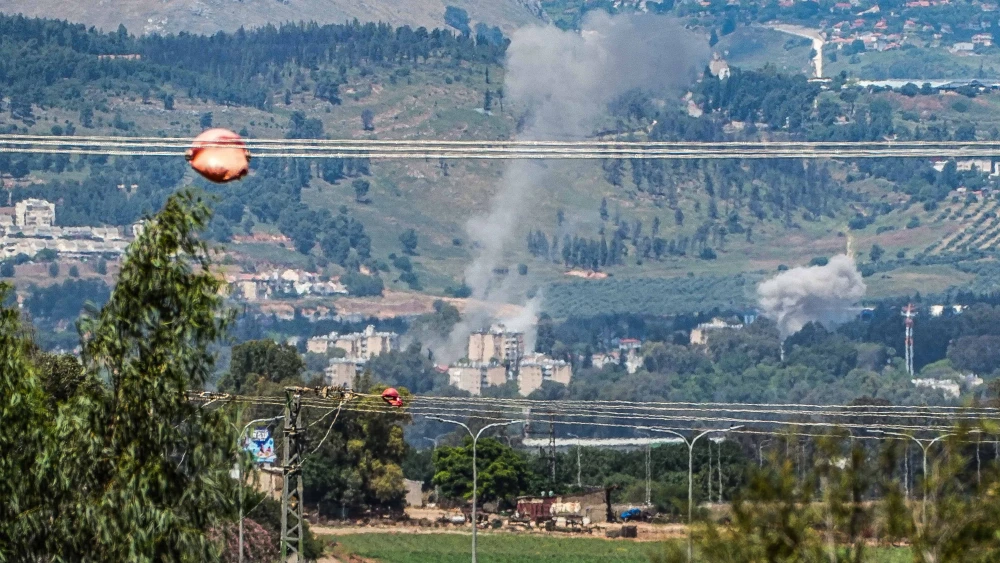
An Israeli man was lightly wounded in a Hezbollah rocket barrage on the Upper Galilee city of Kiryat Shmona on Sunday.
The victim, 65, was treated on the spot by Magen David Adom paramedics whose ambulance was also hit by rocket shrapnel.
Rockets struck across the largely evacuated city, with hits reported on residential buildings and parked vehicles.
“Police are currently handling several scenes where rockets fell around the city of Kiryat Shmona,” the Israel Police said in a statement, adding that forces, including bomb sappers, were working to secure the area.
In a statement, Hezbollah said it fired dozens of rockets at Israel in response to a deadly IAF strike on Mis al-Jabal in Southern Lebanon.
עדכון לאזעקות בגזרת קרית שמונה.
— מגן דוד אדום (@mda_israel) May 5, 2024
חובשים ופראמדיקים של מד"א מעניקים במקום טיפול רפואי לגבר כבן 65 במצב קל בהכרה מלאה שנפגע מרסיסים. בנוסף, ניידת טיפול נמרץ של מגן דוד אדום נפגעה מרסיסים. עדכון בהמשך במידת הצורך.
צילום: תיעוד מבצעי מד"א pic.twitter.com/l8A3VKbAeM
Shortly after the attack on Kiryat Shmona, another 40 rockets were fired towards Israel’s northern communities, in what local media described as one of the largest Hezbollah barrages in recent months. Some of the rockets were intercepted, and no injuries were reported in the attacks.
The International Fellowship of Christians and Jews, which provides aid to Holocaust survivors and other Israelis in need, said one of its soup kitchens in Kiryat Shmona took a direct hit from a rocket on Sunday.
“It’s a miracle that the volunteers left to distribute the meals, and the chef made it to shelter in time. No one was hurt,” Yael Eckstein, the organization’s president and CEO, said in a statement.
Hezbollah has carried out near-daily attacks on northern Israel from the Land of the Cedars since joining the war against the Jewish state in support of Hamas a day after the latter’s Oct. 7 massacre.
Tehran’s terrorist proxy has killed nine civilians—Israelis and one foreign worker—and 11 IDF soldiers since it began its current round of attacks.
Israel has threatened a major military offensive in Southern Lebanon to push Hezbollah north of the Litani River—some 18 miles from the border—if a diplomatic solution is not found. Efforts to calm tensions, including those of the U.S. and France, have been unsuccessful.
Last week, two Israelis were lightly wounded when a Hezbollah anti-tank missile from Lebanon scored a direct hit on their vehicle. Responding to an air-raid siren, the victims were able to leave the car and seek shelter before the missile hit.


