Human Rights Watch (HRW) demonstrates a double standard when it comes to the use of cluster munitions, Jerusalem-based NGO Monitor said on Sunday.
Normally vocal in its denunciation of the use of cluster munitions, HRW has nothing to say when Iran uses them, according to the organization.
“HRW’s deafening silence on Iran’s targeting of Israeli civilians with cluster munitions highlights their hypocrisy,” NGO Monitor President Gerald Steinberg told JNS.
“Human rights are only important when they can be weaponized to demonize the Jewish state. HRW’s highly selective version of international law exposes the immoral objectives behind the principled facade,” he said.
Cluster munitions carry warheads that burst into smaller bomblets, or “submunitions” that can cause widespread and indiscriminate harm when used against civilians.
A search of “cluster munitions” on HRW’s website brings up 1,019 results. It’s a “central campaign” for the group, according to NGO Monitor. “The org regularly calls for a ‘global ban on cluster munitions,’” said Steinberg.
In a Feb. 9 release, HRW criticized plans by the United States Department of Defense to purchase cluster munitions from Israel, a move it claimed would “further weaken global norms that protect civilians from the widely banned weapons.”
According to NGO Monitor, in general, “HRW’s publications reflect the absence of professional standards, research methodologies, and military and legal expertise, as well as a deep-seated ideological bias against Israel.”
HRW did not respond to JNS’s request for comment by time of publication.
.@HRW has spent years campaigning against cluster munitions: publishing reports, lobbying gov't, & supporting an int'l treaty.
— NGO Monitor (@NGOmonitor) March 15, 2026
But when Iran uses cluster munitions against 🇮🇱 civilians, @HRW has has been silent.
🧵Some facts about HRW’s double standard on cluster munitions. >> pic.twitter.com/lFKKjKdWr2
On Feb. 28, the Israel Defense Forces’ international spokesman accused Iran of intentionally firing cluster munitions at Israeli population centers. “Iran goes to great lengths in trying to maximize harm to Israeli civilians. Directing attacks at civilians is a war crime,” said Lt. Col. Nadav Shoshani.
The New York Times reported on March 11 that Chief Superintendent Doron Lavi, head of the Israel Police’s bomb disposal unit, said more than 10 such missiles had been launched since the conflict began on Feb. 28.
Legal experts told the Times that using cluster weapons near civilians may violate international humanitarian law because the bomblets
cannot be targeted and can leave “unexploded duds,” remnants that remain dangerous long after fighting ends.
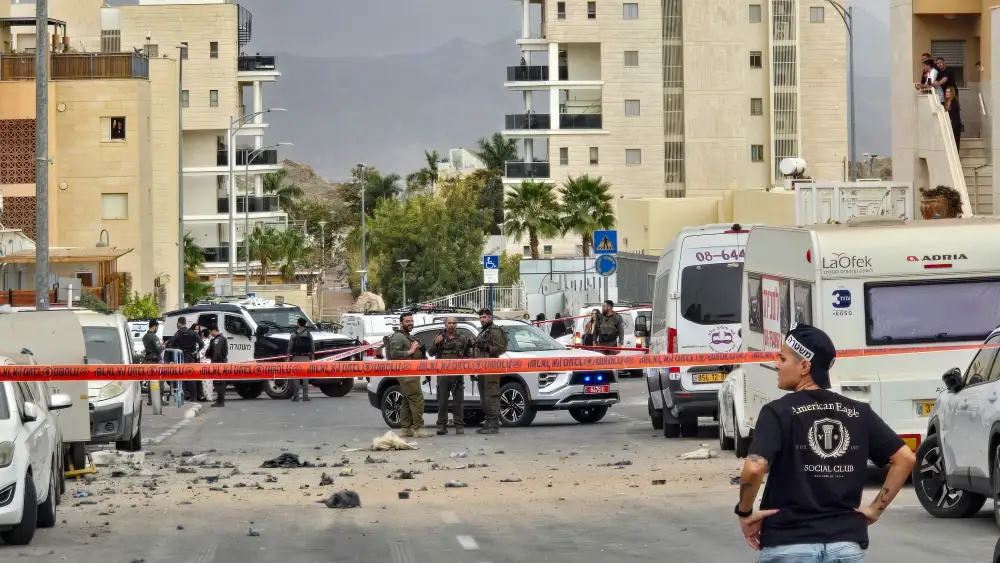
A cluster munition warhead lightly wounded two civilians in the southernmost city of Eilat on Saturday.
Two men were killed when a cluster munition fell at a construction site in the central Israeli city of Yehud on March 9. One of the men, critically wounded, died at the hospital the next day. A third man was seriously wounded in Or Yehuda.
Breaking:‼️
— LTC Nadav Shoshani (@LTC_Shoshani) February 28, 2026
Iran intentionally fired missiles that contained cluster sub-munitions at a densely populated civilian area in Israel. Cluster weapons are designed to disperse over a large area and maximize the chances of a harmful strike. Iran goes to great lengths in trying to… pic.twitter.com/tgtYJ7M8dU