


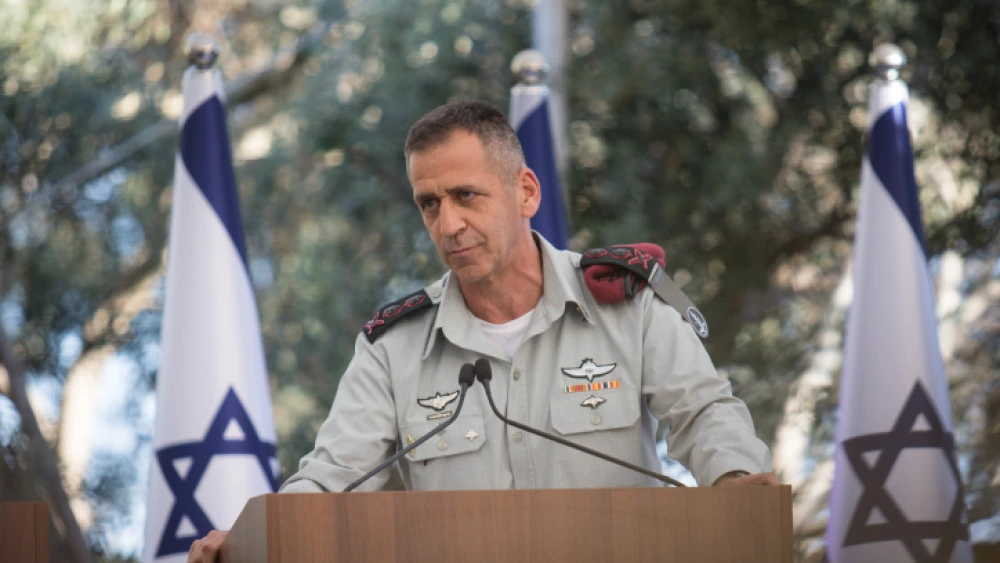
The terrorist threat facing Israel has changed in recent years, requiring the Israel Defense Forces to adapt, IDF Chief of Staff Lt. Gen. Aviv Kochavi said on Thursday.
Speaking in Zichron Yaakov near Haifa at a memorial ceremony honoring fallen IDF soldiers, Kochavi said Israel is now facing organized “terrorist armies” that use civilians as “living flak jackets.”
“The enemy is organized in brigades and platoons, armed with missiles, rockets and advanced weaponry, and is operating from inside densely populated urban areas, with a civilian population that it sees as living flak jackets,” he said.
The changed nature of the terrorist threat Israel faces demands “that the IDF make changes and adjust its forces and methods of warfare, so urban areas cannot shield the enemy,” said Kochavi.
“The firepower the enemy will encounter in the next war will be unprecedented,” he added, and any country that “allows terrorism to entrench itself in its territory will be seen as responsible for it, and suffer the consequences.”
The missile arsenals possessed by groups like Hezbollah and Hamas mean that the IDF has a moral obligation to use great force to eliminate the threat to Israel’s home front, said Kochavi.
“The IDF has a moral obligation to defend the nation’s citizens against the armies of terrorism that surround them. When the Israeli home front is under threat by thousands of missiles and rockets, we won’t hesitate to strike a massive blow to eradicate those threats.”
The IDF will preserve its values, he said, but added that “a main tenet of those values is the need to protect our citizens.”
The fallen were remembered, said Kochavi, but so were Israel’s missing and captive soldiers and citizens, including Artillery Corps Staff Sgt. Guy Hever. Israel has an obligation to secure the return of all missing and captive soldiers and citizens, he said.
“We will not cease our efforts to fulfill that obligation and I am holding the hands of the families in pain. That is a goal for the entire IDF and the Artillery Corps in particular, which plays a key role in war,” said Kochavi.
Artillery Corps commander Brig. Gen. Aviram Sela addressed the bereaved families at the ceremony.
“Time does not blunt or ease [pain]. Pain hurts, and the longing never stops. Our legacy is our strength—the glorious legacy our heroes left us.”
This article first appeared in Israel Hayom.



