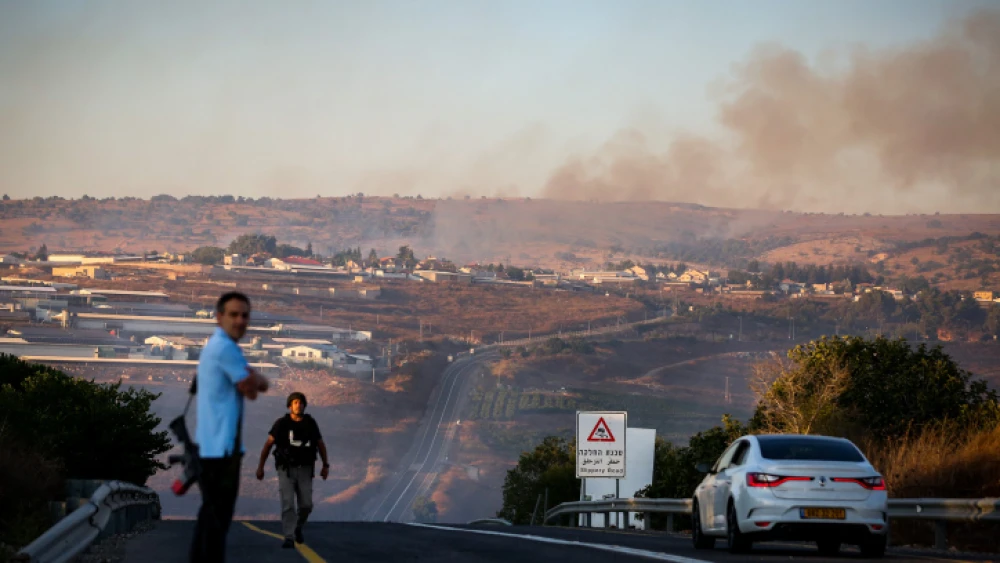
Egypt, the United States and France warned Israel not to continue its retaliatory strikes against Hezbollah targets following the terrorist organization’s Sunday attack on northern Israel, a senior Israeli security official said Monday. The official added that Lebanese Prime Minister Saad al-Hariri understands that his country is at risk if Hezbollah leader Hassan Nasrallah continues to provoke Israel.
When asked if he thought Hezbollah would consider Sunday’s missile attack a sufficient response to last week’s alleged drone strikes in Beirut, which reportedly embarrassed Nasrallah, the official said, “We are preparing for every scenario. If he keeps this up, he knows what awaits him.”
The official explained that Israel’s security and defense priorities, as laid out by Prime Minister Benjamin Netanyahu, are preventing Iran from obtaining nuclear weapons, preventing Hezbollah from obtaining precision missiles and preventing Iran from further entrenching itself in the region, including in Syria, Lebanon, Iraq, Yemen and elsewhere.
“We are making diplomatic and operational efforts in a number of fields and areas to prevent these three things. Each has a detailed action plan. We are carrying out a lot of actions. You only see the very tip of the iceberg. There are a lot of covert actions by the IDF and the Mossad, as well as diplomatic measures being taken to address these three goals,” said the official.
“We are working with determination combined with responsibility. We don’t act on a whim—it’s part of a complete strategy. We have goals we want to achieve,” he added.
Addressing recent developments on the northern border, the official said Israel was handling developments there “with caution, even in the past few days.”
“In the past few days, we were surrounded on multiple fronts. We needed to take action on a few different fronts within a 24-hour period. We operated with precision, just like we planned to. If we hadn’t taken those actions, we could have wound up fighting a war we don’t need,” the official said.
As part of Sunday’s clash with Hezbollah, the IDF reportedly staged an evacuation to make Hezbollah think Israeli soldiers had been wounded in the attack. In fact, there were no casualties.
“I’m surprised at the public discourse about [the fake evacuation],” said the official. “Commanders in the field are instructed to use deception when fighting. I’m not going to discuss whether there was or was not a ‘fake-out.’ We do everything possible to prevent casualties. If the army uses deceptive tactics, that’s good. We do everything we can to prevent casualties. In Israel, it’s impossible to hide casualties, when there are any.”
Referring to Hezbollah leader Nasrallah’s televised speech on Monday addressing the Sunday attack, the official said “the man in the bunker will give a lot more speeches.” (Hezbollah leader Nasrallah has been in hiding since the 2006 Second Lebanon War.)
“I don’t care about that,” the official concluded, “as long as we can continue to achieve our goals.”
This article first appeared in Israel Hayom.