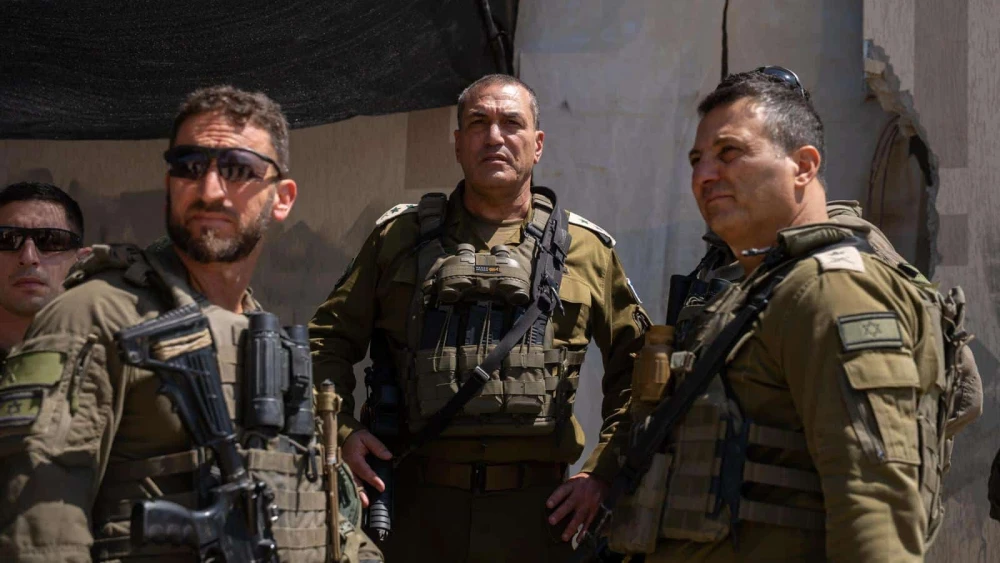
Israel Defense Forces Chief of Staff. Lt. Gen. Eyal Zamir focused on the contributions of reservist soldiers during a field tour Wednesday with senior commanders in the Gaza Strip, saying that they “embody the deepest expression of Israeli solidarity and of commitment to the future of the state.”
He praised the commitment and sacrifice of reservist and regular army soldiers, stressing their essential role in achieving current operational goals, particularly the ongoing campaign in Gaza City aimed at defeating Hamas, securing the return of hostages and preventing future attacks like Oct. 7.
“Thanks to the reservists, Israel stands tall against every enemy; your sacrifice is an inspiration to us all. Conscripts, career soldiers and tens of thousands of reservists are answering the call and sacrificing their personal lives, along with their families, for the security of the state,” Zamir said.
“We will do everything to create stability and to reduce the burden on the reservists, with the understanding that this is a precious national resource,” he added.
During the tour, Zamir was briefed on recent activities of the 6th Reserve Infantry “Etzioni” Brigade and the largely reservist 6643rd Territorial “Katif” Brigade—the Gaza Division’s Southern Brigade—in the Strip. He spoke with the troops and commanders of the Etzioni Brigade, whose reserve duty has been extended as part of the developments in the campaign, and emphasized his appreciation for their activity in Gaza.
Zamir called for full enlistment from all sectors of society.
“Against the backdrop of challenges across all arenas, Israel’s security requires the full partnership of all parts of the nation. This is a civic duty and a national imperative. I call on everyone to enlist and contribute their share equally; this is the call of the hour,” Zamir said.
His statements come against the backdrop of tensions over mandatory IDF service for Haredi men, who have been historically exempt. Amid intensified efforts to recruit ultra-Orthodox men and a legislative impasse, the conscription crisis is polarizing Israeli society.
“We cannot accept a situation in which not all parts of society bear the burden,” Zamir emphasized.
The ongoing Gaza campaign
Israeli forces continue operations against terrorists throughout the Gaza Strip, killing several and destroying infrastructure in the south, including structures used by Hamas operatives in Khan Yunis, according to an IDF update on Thursday.
עשרות מטרות טרור שהושמדו: כוחות צה"ל ממשיכים לפעול ברחבי רצועת עזה אל מול ארגוני הטרור
— צבא ההגנה לישראל (@idfonline) August 28, 2025
כוחות צה"ל בפיקוד הדרום, בהכוונת אמ"ן ושב"כ, ממשיכים בלחימה נגד ארגוני הטרור ברחבי רצועת עזה.
בדרום הרצועה, צוות הקרב של חטיבת גולני הפועלים תחת אוגדה 36 חיסל מספר מחבלים והשמיד מספר תשתיות… pic.twitter.com/LR0XBbwZjb
The IDF reported progress in securing the Magen Oz Corridor, a strategic axis dividing eastern and western Khan Yunis, through which soldiers have dismantled key facilities and exerted increasing operational control in the area.
Meanwhile in northern Gaza, troops targeted terrorists and underground enemy infrastructure. The IDF said it killed three terrorists in Jabalia after identifying them near their position, directing air support to strike swiftly. Several underground routes used by Hamas were also destroyed over the past 24 hours.
Zamir meets with World food Program chief
Zamir met on Wednesday with UN World Food Program Executive Director Cindy McCain—the widow of U.S. Sen. John McCain (R-Ariz.)—to discuss humanitarian operations in Gaza, the military said.
📦IDF Chief of the General Staff, LTG Eyal Zamir, met with @WFP Executive Director, Ms. Cindy McCain.
— Israel Defense Forces (@IDF) August 27, 2025
The meeting was attended together with COGAT MG Ghassan Alian, and
focused on advancing the humanitarian aid effort for Gaza. LTG Zamir emphasized that the IDF is committed to… pic.twitter.com/Nl8F0wj3mo
Maj. Gen. Ghassan Alian, the coordinator of government activities in the territories, joined the meeting, which focused on Israeli efforts to stabilize the humanitarian situation and facilitate direct aid to civilians, as opposed to the theft of supplies by the Hamas terrorist group. COGAT presented key initiatives aimed at countering food insecurity and outlined plans for future aid, highlighting what officials called tangible improvements on the ground.
Zamir reiterated Israel’s commitment to preventing famine and ensuring continued humanitarian access, emphasizing the military’s intention to bypass Hamas and deliver assistance directly to Gaza’s population.
The IDF announced on Thursday afternoon that the construction of two additional Gaza Humanitarian Foundation aid distribution centers in the southern Strip is expected be completed “in the coming days.
“Once the work is completed, a total of five food distribution centers will be operating by the GHF,” the army said. They will replace the Tel al-Sultan center, “improving both the response and safety of aid distribution.”
The Israeli military “will continue to enable humanitarian assistance in Gaza while operating to ensure the orderly distribution of food to the residents of Gaza, not Hamas,” according to Thursday’s statement.
📦Two additional humanitarian aid centers will be established in southern Gaza
— Israel Defense Forces (@IDF) August 28, 2025
In the coming days, the construction of two new humanitarian aid and food distribution centers in southern Gaza will be completed, thanks to the efforts that the U.S administration and the American… pic.twitter.com/mLfyvp2zJD