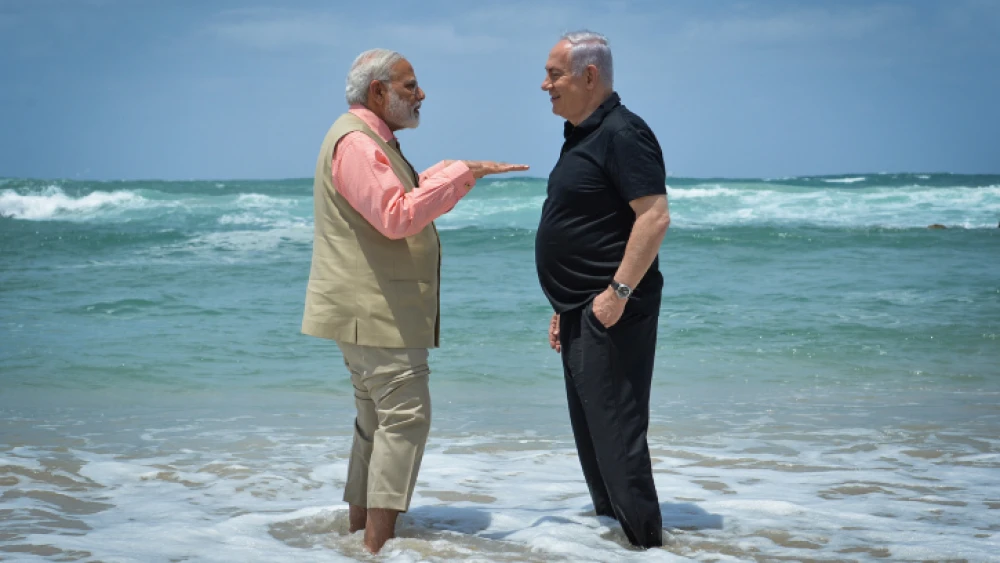
Indian Prime Minister Narendra Modi is scheduled to visit Israel on a two-day trip next week, according to reports in Indian media.
The visit, Modi’s second in eight years, underlines Israel’s deepening ties with India amid attempts to isolate the Jewish state in Europe and tensions in its relations with China.
Israeli Prime Minister Benjamin Netanyahu first announced Modi’s visit while addressing the Conference of Presidents of Major American Jewish Organizations in Jerusalem on Sunday, but did not elaborate on the program.
Modi is expected to address the Knesset during his visit, which is scheduled to begin on Feb. 25, according to the Press Trust of India news agency, citing sources in Modi’s office.
Netanyahu, during his Conference of Presidents announcement, lauded the “tremendous alliance between Israel and India,” adding: “We are going to discuss all sorts of cooperation. Now, you know, India is not a small country. It has 1.4 billion people. India is enormously powerful, enormously popular.”
Modi’s first visit in 2017 was also the first ever by an Indian premier to the Jewish state. He and Netanyahu famously walked barefoot together on a beach to inspect a desalination facility. Netanyahu reciprocated the following year with a six-day visit to India.
In 2020, India abstained for the first time on a U.N. resolution condemning Israeli actions in Gaza. Indian officials now openly refer to Hamas as a terrorist organization—a term they once avoided.
Israeli Finance Minister Bezalel Smotrich visited India last year as the strategic partners built up momentum to sign a free trade agreement. Smotrich was accompanied by Israeli Tourism Minister Haim Katz, Economy and Industry Minister Nir Barkat and Agriculture and Food Security Minister Avi Dichter.
India’s External Affairs Minister Subrahmanyam Jaishankar visited Israel in December, meeting Netanyahu, Israeli President Isaac Herzog and Foreign Minister Gideon Sa’ar.
In November, India and Israel inked a landmark agreement to enhance defence, industrial, and technological cooperation, enabling the sharing of advanced technology to promote co-development and co-production.
Following his election in 2014, Modi has transformed the country’s stance from Cold War-era alignment with the Arab world to a more pro-Israel one.
Under Modi, India and Israel have significantly deepened their strategic, economic, and defense ties, cooperation driven by shared security concerns and technological collaboration. Bilateral trade has surged, more than doubling since 2013 to a record-breaking $5 billion in 2024. The volume of trade shrank in 2025 to $3.6 billion.
Israel’s minister of innovation, science and technology, Gila Gamliel, acknowledged the rapprochement in a 2025 speech, advocating a “full strategic partnership” with India. She noted that Beijing has “closer ties with Iran” and that the United States views China as a “strategic threat.”
The Israel-India relationship is poised for another leap forward through the India-Middle East-Europe Economic Corridor (IMEC), a U.S.-backed initiative to link India with Europe via the Middle East.