


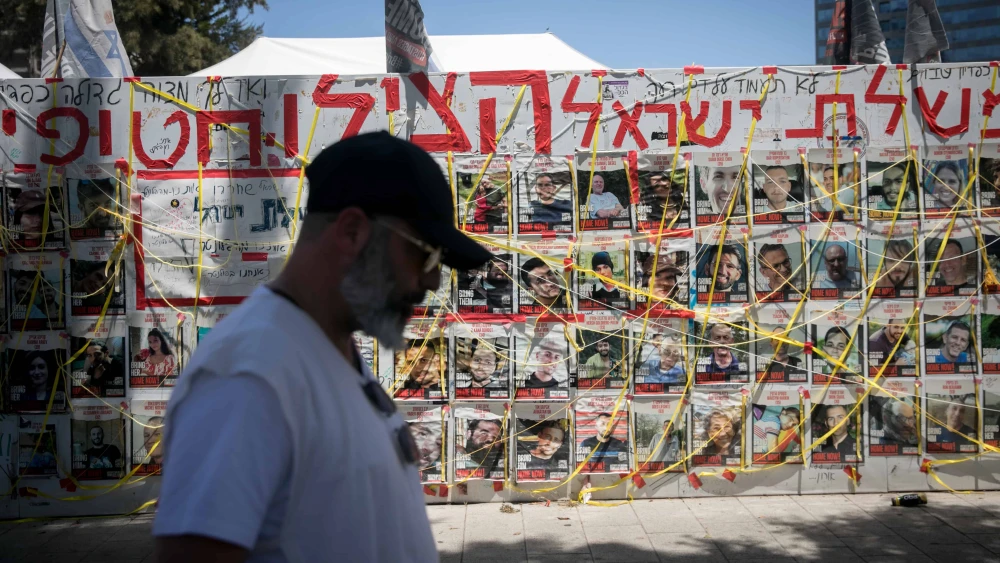
The Israeli negotiating team has received Hamas’s proposed changes to the hostages-for-ceasefire framework outlined by U.S. President Joe Biden in May, the Israeli Prime Minister’s Office said late Wednesday.
The United States, Qatar and Egypt—the mediators—have conveyed “Hamas’s remarks on the outline of the hostages deal,” said Israeli Prime Minister Benjamin Netanyahu’s office in a joint statement with the Mossad.
“Israel is evaluating the remarks and will convey its reply to the mediators,” added the brief statement from Jerusalem.
An anonymous senior Israeli official subsequently told the U.S.-based Axios news outlet that while “important progress has been made, there is still a significant way to go with serious challenges.”
Even if Israel and Hamas enter into further negotiations, “it will be tough and not short,” the official said, adding that it could take “several weeks to reach an agreement if we move to detailed negotiations.”
According to the report, the Israeli negotiating team is expected to hold discussions with Netanyahu and Israeli Minister of Defense Yoav Gallant in the “coming days” to formulate a stance to Hamas’s response.
The Israeli government immediately accepted Biden’s proposal, which Netanyahu has claimed does not call for a permanent end to the war that started with Hamas’s Oct. 7 massacre of more than 1,200 people in communities in southern Israel on Oct. 7, the wounding of thousands and kidnapping of as many as 250 others. The government says 120 hostages remain in Gaza.
However, an Israeli official said on June 17 that in its initial reply to the proposal, the terrorist group made “substantial changes” to the outline, which the U.N. Security Council had formally approved a week earlier.
Hamas demanded an end to the war and the full withdrawal of Israeli forces, the official said, adding that Jerusalem’s goals for the war still stand—the defeat of Hamas as a military and ruling power, the return of all hostages and the guarantee that Gaza cannot pose a threat to Israel.
‘Working very hard to find a formula’
Last week, a U.S. official confirmed for the first time that Hamas’s official response to the ceasefire bid amounted to a rejection. “They came back several weeks ago and rejected the proposal that was on the table,” said U.S. State Department spokesman Matthew Miller on June 26
While Miller was the first U.S. official to characterize Hamas’s June 11 reply as a rejection of the terms, U.S. Secretary of State Antony Blinken had previously said it included changes that were “not workable.”
“A deal was on the table that was virtually identical to the proposal that Hamas made on May 6—a deal that the entire world is behind, a deal Israel has accepted. Hamas could have answered with a single word: ‘Yes,’” the top diplomat stated at a June 12 press conference in Doha.
Earlier this week, Axios reported that the Biden administration had proposed a change to Article 8 of the deal, which deals with talks regarding a “sustainable calm” in Gaza, set to commence after the implementation of the first stage of the three-stage agreement.
Jerusalem wants to retain the right to raise the demilitarization of Gaza and “other issues” during this stage, per the Axios report. Hamas, however, demanded that these talks focus solely on the number and identity of Palestinian terrorists to be released from Israeli jails in return for every living Israeli soldier or male hostage held in Gaza.
“The U.S. is working very hard to find a formula that will allow reaching a deal,” a source with direct knowledge of the talks told Axios, adding that the effort is being coordinated with Qatari and Egyptian mediators.



