


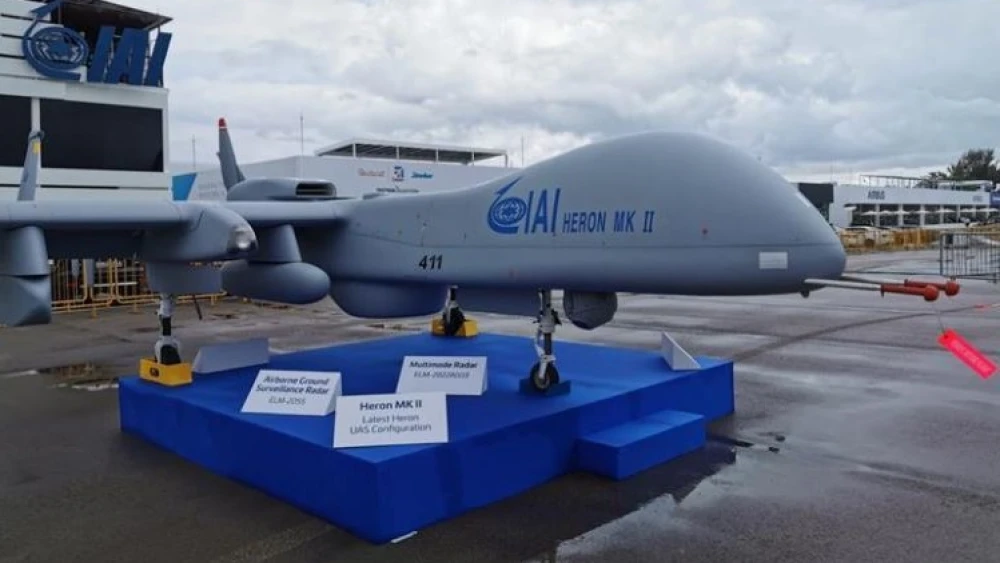
The Israel Defense Forces has doubled the number of its UAVs over Lebanon to better detect launch attempts by Hezbollah, Israel’s Army Radio reported on Sunday.
The terror group launched a number of drones into Israeli airspace from Lebanon on Saturday, causing fires in open areas and damage to one building.
Israel still expects a more dramatic retaliatory strike against it for the assassination of Hamas leader Ismail Haniyeh in Tehran on July 31, and is engaged in intensive preparations that could include pre-emptive strikes.
Iran and its Hezbollah proxy have vowed to avenge both the assassination of Haniyeh, head of Hamas’s political bureau, and of Fuad Shukr, a senior member of Hezbollah’s Jihad Council, whom Israeli defense officials have described as the organization’s chief of staff.
Iran’s arsenal includes ballistic, cruise missiles and drones capable of targeting critical military and civilian infrastructure within Israel.
Iran’s attack on April 14, consisting of 300 projectiles, (120 of which were ballistic missiles), demonstrated Tehran’s reach. The vast majority of the projectiles and UAVs were intercepted by Israeli and allied air defense systems and fighter jets.
U.S. President Joe Biden on Saturday said “don’t” when asked by reporters what his message to Iran was regarding the possibility it might attack Israel.
Ahmed Bahsheesh Ardestani, a member of the National Security Committee of the Iranian Parliament, said on Saturday that “the air operations of the Islamic Republic against Israel may last for three to four days,” according to the London-based Iran International news agency.
Ardestani added that Tehran “is ready to accept the consequences of such an attack and will be ready for any further developments.”
An Islamic Revolutionary Guard Corps deputy commander, Ali Fadavi, was quoted by Iranian media on Friday as saying that Israel will receive a “harsh punishment” for the Haniyeh assassination.
“The supreme leader’s orders regarding the harsh punishment of Israel and revenge for the blood of martyr Ismail Haniyeh are clear and explicit... and they will be implemented in the best possible way,” he said.
Asked by reporters to respond to Fadavi’s remarks, U.S. National Security Council spokesman John Kirby said the United States was ready to defend Israel.
“When we hear rhetoric like that we’ve got to take it seriously, and we do,” Kirby said.
Should an Iranian attack take place, Jordan will allow Israel to use its airspace to fend off any aerial threats, a Jordanian official told Channel 12 on Saturday.
“We will allow Israel to repel the Iranian attack in our airspace,” the official said, adding that “it stems from a security interest and this is the policy, just as in April Jordan helped Israel stop the Iranian attack. It is ultimately an ally of the United States.”



