


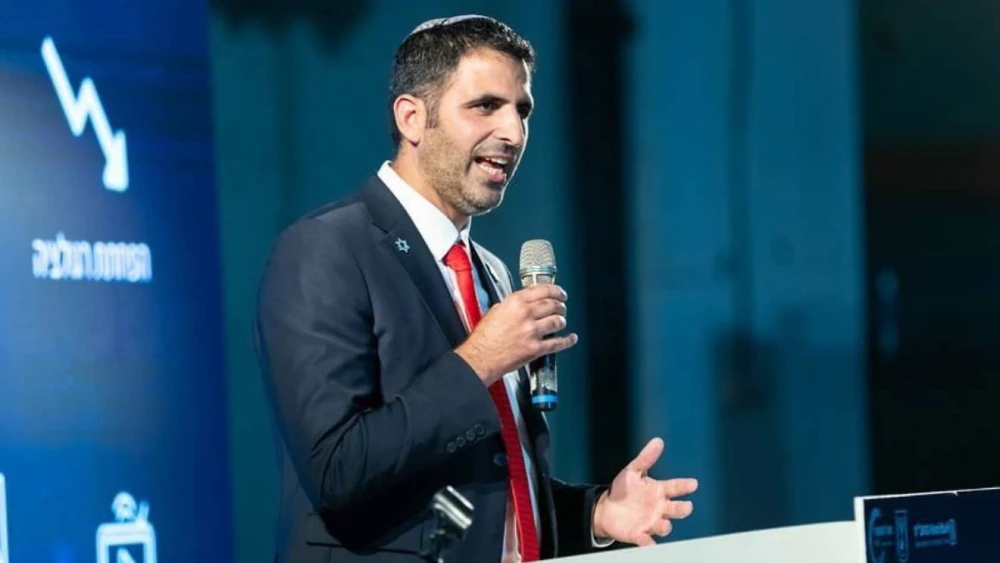
Israeli Minister of Communications Shlomo Karhi has announced a new plan to encourage municipalities to develop advanced cellular infrastructure in their jurisdictions.
The program was introduced at the “Leading in Communications” conference held last week in Sderot in southern Israel. The event brought together senior figures from Israel’s communications sector, executives from local and international technology companies, government and municipal representatives, as well as foreign ambassadors and economic attachés.
“Israel’s strength lies in combining innovation with inclusivity. We are not only building world-class technology, we are making sure it reaches every region, including the Negev, Galilee and Judea and Samaria,” Karhi told JNS on Wednesday.
As of Jan. 1, 2025, 529,704 Israeli Jews lived in Judea and Samaria, amounting to approximately 5.28% of the country’s population.
“For me, what I hope to achieve is also about sovereignty. One of my central platforms has been bringing modern connectivity to every Israeli, in big cities and small communities, especially in Judea and Samaria. Just recently, we inaugurated a new cellular tower in Givat Assaf in Binyamin and in Ma’alot-Chalchul, just outside of Hebron, showing sovereignty in action and improving both security and quality of life,” he continued.
“At the same time, when [French] President [Emmanuel] Macron and other world leaders are set to call for a Palestinian state at the U.N. General Assembly, the Israeli answer should be full sovereignty in Judea and Samaria. I support that by ensuring equal access to advanced connectivity for all Israelis. And this conference played a part in making that vision a reality,” he added.
Local authorities that sign agreements to establish cellular sites in the coming months will receive incentives of 60,000 shekels ($18,000) for each new macro site and 30,000 shekels ($9,000) for each micro site, up to a maximum of approximately 500,000 shekels ($150,000) per municipality.
The government decision allocates up to 23 million shekels ($6.9 million) through the Communications Ministry to encourage local authorities, with the goal of significantly increasing the number of cellular sites on public assets and improving reception quality for residents.
Under the plan, a dedicated budget of at least one million shekels ($300,000) will be allocated to local authorities in the Negev and Gaza Envelope regions. Budgetary approval for the northern region is also under consideration.
Following the conference, Karhi acknowledged the presence of ambassadors and representatives from the embassies of China, Nepal, Vietnam, Russia, Costa Rica, Lithuania, Singapore and the Philippines.
“The conference highlighted Israel’s leadership in telecom, cybersecurity, emergency-response technologies, and 5G/6G readiness, while creating invaluable opportunities for international dialogue and cooperation,” Karhi wrote on X.
“I look forward to continuing to lead the Ministry in strengthening innovation, connectivity, and global partnerships that keep Israel at the forefront of communications technology,” he added.


