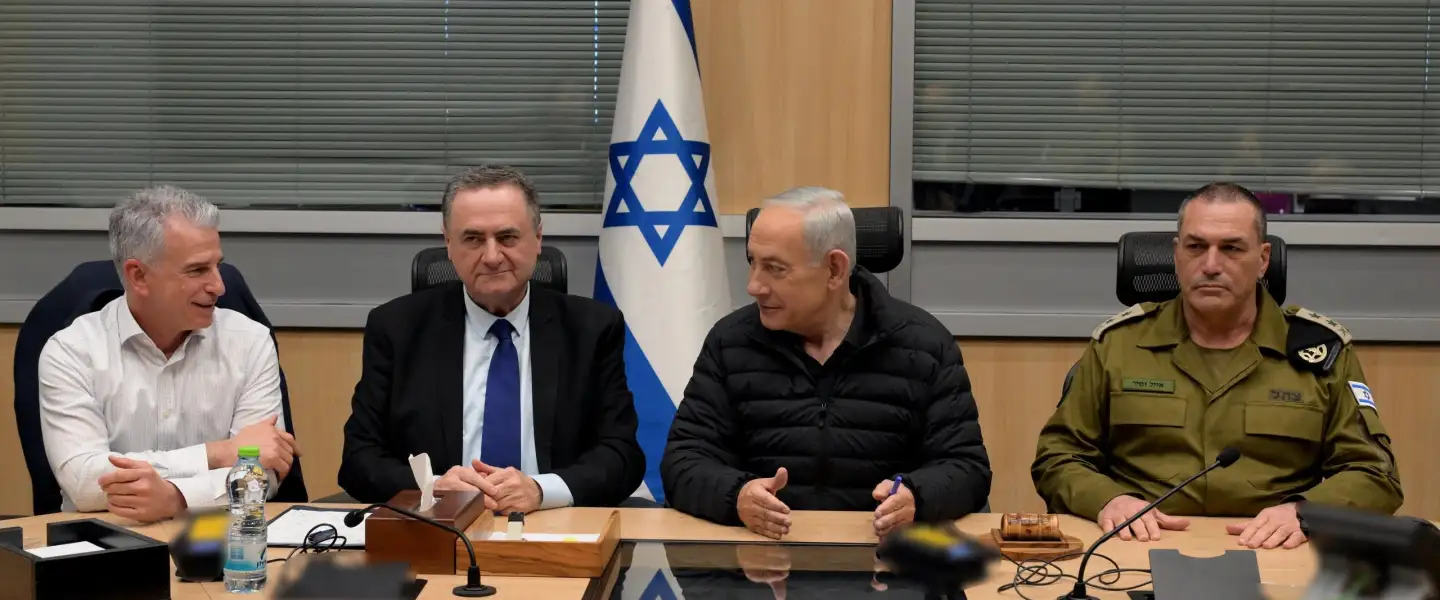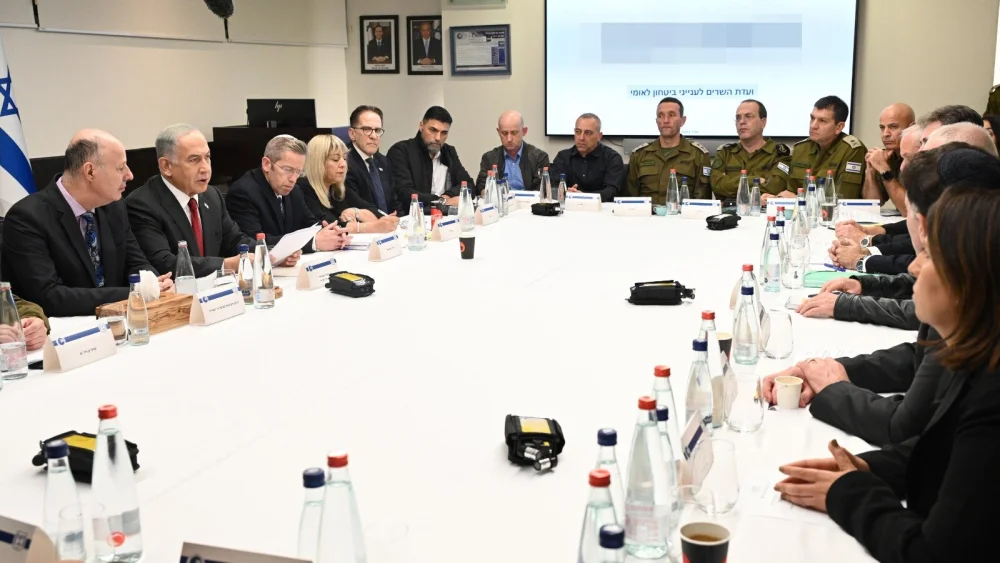
Israel’s Security Cabinet on Sunday voted in favor of a series of economic and defense measures to boost the Palestinian Authority.
Eight members voted yes in adopting the draft decision submitted by Prime Minister Benjamin Netanyahu, with one voting against and one abstention.
“In the absence of a change in the national assessment, Israel will act to prevent the collapse of the Palestinian Authority, while demanding that it cease its anti-Israel activity in the international legal-diplomatic arena, the incitement in its media and education system, the payments to the families of terrorists and murderers, and the illegal construction in Area C,” the Security Cabinet said in a statement following the vote.
The P.A. on Monday rejected those demands, with Prime Minister Mohammad Shtayyeh saying that payments to the families of terrorists and the pursuit of Israel in international forums would continue.
“Yesterday, the Israeli government came out with decisions concerning the Palestinian Authority on the pretext that they want to offer gestures to the Palestinians. On behalf of the Palestinian government, we say that what is required of Israel is to halt its aggression against our people, killings, settlements and the piracy of our money,” Shtayyeh said during the weekly meeting of the P.A. cabinet in Ramallah.
National Security Minister Itamar Ben-Gvir and Finance Minister Bezalel Smotrich, who also serves as a minister in the Defense Ministry, vocally opposed the assistance package, which comes amid the deteriorating security situation in Judea and Samaria.
Before the vote, Ben-Gvir called the proposal “delusional,” and a “shameful decision to grant concessions and benefits to the Palestinian Authority.”
“There is no greater absurdity than the fact that a body that encourages terrorism, pays salaries to terrorists and their families, encourages in the education system incitement in favor of the murder of Jews, takes over territories in Judea and Samaria, will win a basket of rewards from the Israeli government in the midst of a wave of terrorism,” he said.
According to the Israeli government, the P.A. spends between 600 million and 650 million shekels ($170 million to $184 million) each year on stipends for terrorists. Some estimates put that number as high as 1 billion shekels ($283 million). The Israeli government collects 600 million to 800 million shekels ($174 million to $226 million) annually for the P.A., accounting for 65% to 70% of its revenue, not counting foreign aid.
Recent Palestinian polling shows that 87-year-old P.A. chairman Mahmoud Abbas is deeply unpopular, with increasing support for armed terrorist groups.
The P.A. was created as part of the 1994 Gaza-Jericho Agreement, which was a follow-up to the Oslo I Accord.
In an interview with CNN on Sunday, U.S. President Joe Biden warned that the P.A. “has lost its credibility, not necessarily because of what Israel’s done, just because it’s just lost its credibility, number one, and, number two, created a vacuum for extremism.”