Newsletter
Newsletter Support JNS

Netanyahu to meet with Putin in Moscow for talks

The Israeli prime minister has made it “unequivocally clear” to Russian President Vladimir Putin about the continuation of Israeli airstrikes in Syria against Iranian proxies such as Hezbollah.

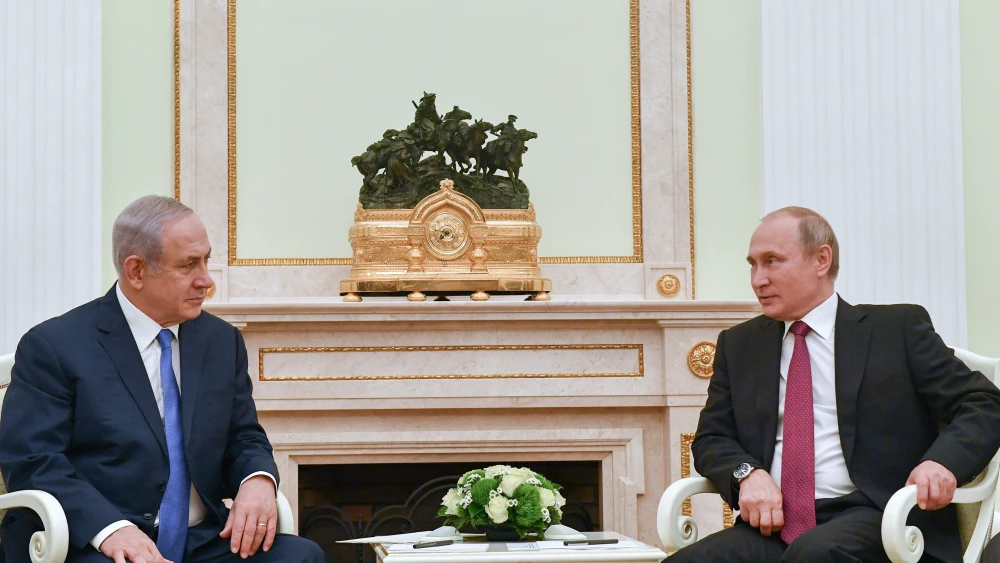
Israeli Prime Minister Benjamin Netanyahu with Russian President Vladimir Putin at the Kremlin in Moscow on July 11, 2018. Credit: Kobi Gideon/GPO.

Israeli Prime Minister Benjamin Netanyahu will meet with Russia President Vladimir Putin in Moscow on Thursday, announced the former’s office on Tuesday.

Netanyahu’s office did not say specifically what matters would be discussed.

The prime minister told reporters on Monday that he talked on the phone with Putin about Syria, about which the two agreed to work together on an exit strategy of forces from the country.

Netanyahu mentioned that he has made it “unequivocally clear” to Putin about the continuation of Israeli airstrikes in Syria against Iranian proxies such as Hezbollah.

“President Putin and I also agreed on a shared goal—the removal from Syria of the foreign forces that came in after the civil war erupted,” Netanyahu told his cabinet.

“We agreed to set up a joint task force which, together with others, will work to advance towards this goal,” he continued, without elaborating.

“We are especially troubled that these issues have persisted despite concerns raised following last year’s annual meeting,” the two groups stated.
“If you believe this is a pathway forward to victory in the Republican Party, I want to make sure that you’re proven wrong,” the senator said.
Kata’ib Hezbollah said Shelly Kittleson’s release was contingent on her immediate departure from the country after nearly a week in captivity in Baghdad.
Police said the suspect made threats of mass harm on a recorded video chat.
The concert hall is reviewing whether to allow a staged reading of the play at a Magen David Adom fundraiser.
Rabbi Shlomo Litvin of the Chabad of the Bluegrass told JNS that expanding the legislation to include any qualifying religious group, not just Chabad, makes it more functional and adaptable.