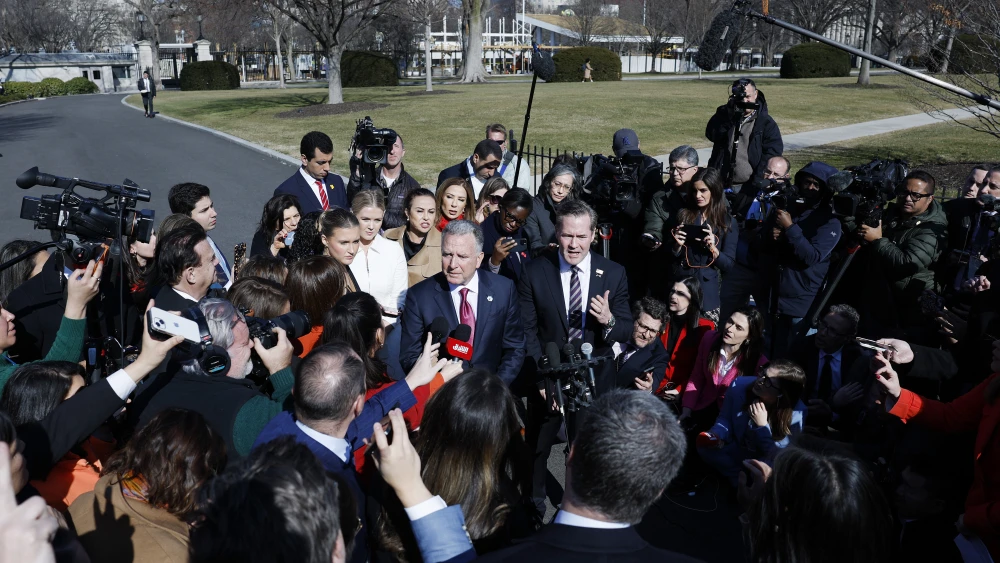
It will take at least a decade to rebuild the Gaza Strip, Mike Waltz, the U.S. national security advisor, told reporters on Tuesday, per the White House pool report.
Asked about U.S. President Donald Trump’s call for Jordan and Egypt to accept Palestinians to “clean out” Gaza—a move that both countries have rejected—Waltz told reporters that “President Trump is looking at this from a humanitarian standpoint.”
“You have these people that are sitting with literally thousands of unexploded ordinance and piles of rubble,” he said. “At some point, we have to look realistically, how do you rebuild Gaza? What does that look like? What is the timeline? A lot of people were looking at very unrealistic timelines. We’re talking 10 to 15 years.”
“Not the five years, and so that’s what we have to work through,” he added. (Phase three of the ceasefire and hostage release deal calls for the resettlement of Gaza within five years.)
Waltz and Steve Witkoff, the U.S. special envoy to the Middle East, spoke with reporters outside the White House for about 10 minutes ahead of Israeli Prime Minister Benjamin Netanyahu’s scheduled meeting with Trump in the Oval Office on Tuesday evening.
“We’re focused on making sure phase one completes exactly as it should complete, that all the hostages including bodies should come home,” Witkoff told reporters.
The U.S. special envoy agreed with Waltz’s elongated timeline for Gazan resettlement. “In any city of the United States of America, if you had damage that was 100th of what I saw in Gaza,” he said. “Nobody would be allowed to go back to their homes. That’s how dangerous it is.”
“There’s 30,000 unexploded munitions,” Witkoff said. “Buildings that could tip over at any moment. There’s no utilities there whatsoever. No working water. Electric. Gas. Nothing. God knows what kind of disease might be festering there.”
‘Everyone’s heart breaks for this war’
When Trump talks about “cleaning” out Gaza, he means making it inhabitable. “This is a long-range plan,” Witkoff said, adding that Washington estimates that it will take three to five years just for disposal efforts in Gaza before even looking beneath the soil and creating a master plan.
“The president is intent on getting it all done correctly,” he said. “To me, it is unfair to explain to Palestinians that they might be back in five years. That’s just preposterous.”
Waltz told reporters that America and its allies in the region are working collectively to solve the problem of what happens to the Palestinians.
“Everyone’s heart breaks for this war, which Hamas started, and what has happened to these people, that Hamas is willing to sacrifice to turn global opinion against Israel,” the U.S. national security advisor said. “I think the president has taken a very common-sense approach.”
Witkoff told reporters that part of the difficulty with the Palestinians is that he and his colleagues have to figure things out within a deal that they didn’t negotiate.
“It wasn’t such a wonderful agreement that was first signed. That was not dictated by the Trump administration,” he said. “We had nothing to do with it.”
“We were able to get to the right place on phase one,” he said. “We’re hopeful we will get to the right place on phase two.” Phase three, the reconstruction, “is not going to go the way that agreement talks about, which is a five-year program,” he said. “Physically impossible.”
“What we’re trying to do is be transparent to these people,” Witkoff said. “You go to Gaza today. I was there. I witnessed it. You see people going there, picking up a tent and literally in some circumstances turning around again because there is nothing left there.”
Waltz told reporters that “rightly, our discussions will be focused on the future of Gaza, the destruction of Hamas, and, of course, getting our folks out.”
“But there are so many opportunities now in the region, largely thanks to Prime Minister Netanyahu and Israeli leadership,” he stated. “Hezbollah destroyed. We have President Aoun, what many people thought was an impossibility, now in charge in Lebanon. You have the dictator Assad gone and hiding in Russia. You have Iran really, in many ways, on its back foot.”
“We need to handle and deal with the issues of the Houthis literally attacking international shipping. That should be an international response—not all of the burden on the United States,” he said.
“There’s a lot of opportunity in the region, and mostly there’s real optimism,” Waltz added, noting that the world is “on the precipice” of the next round of the Abraham Accords. “That’s the goal,” he said.