


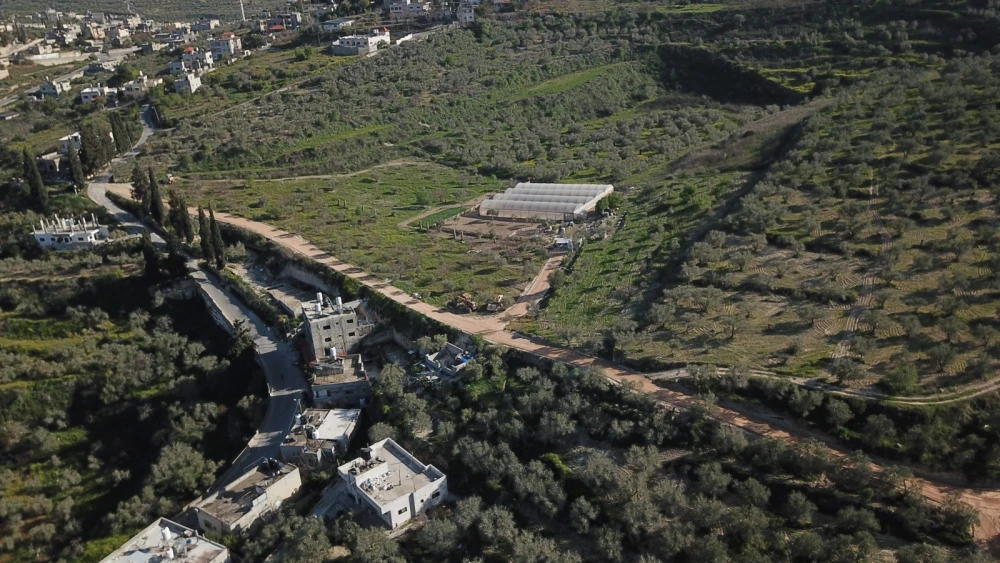
The ancient town of Sebastia, one of the major archaeological sites of the Holy Land which served as the capital of the Kingdom of Israel nearly three millennia ago, has been damaged by Palestinian road construction, Israeli officials said Tuesday.
The destruction at the site highlights the lawlessness in the area and the need for the preservation, upkeep and safeguarding of Israeli archaeological sites in Palestinian-controlled areas after decades of neglect, damage and disrepair.
The site, which has been repeatedly vandalized in the past, is located outside Nablus, near the Arab town of Sebastia, which carried out the work. Over the last three decades, it has fallen under conflicting Israeli and Palestinian jurisdiction as stipulated by the Oslo Accords.
The damage to the site was made public by Shomrim Al Hanetzach (Protecting Eternity), an NGO that seeks to preserve Jewish heritage sites in Judea and Samaria. It discovered that a road had been paved in the heart of the archaeological site, said Moshe Gutman, the group’s chairman.
During the construction work, a wall dating back to the Herodian times (37 BCE-73 CE) was destroyed and burial caves dating back to the Second Temple period (586 BCE-70 CE) were smashed, looted and obliterated, he said.
In addition, carcasses of wild boars were found thrown into the ancient graves.
Cultural and historic
“This is an attempt to systematically and decisively destroy any connection between the State of Israel and the Jewish people, and one of our most important cultural and historic sites,” Yossi Dagan, Samaria Regional Council head, said.
“These are unique remains from the period of the ancient Kingdom of Israel. It’s a disgrace that Jewish history is being destroyed in such a manner and under the very noses of the Israeli government,” he added.
Minister of Heritage Amichai Eliyahu was en route to the site on Tuesday afternoon to inspect the damage, his spokesman said.
Dagan called for the military to safeguard the site around the clock.
The incident comes less than two months after Defense Minister Yoav Gallant pledged that Israel will not allow Palestinians to damage a separate archaeological site nearby that is revered by millions of Jews and Christians as the location where Joshua built an altar.
COGAT, the Israeli defense body that deals with Palestinian civilian affairs and is charged with such supervision, had no immediate comment Tuesday.
The ancient Sebastia served as the capital of the Kingdom of Israel under the name of Samaria in the 8th and 9th centuries BCE. Alexander the Great, King Herod and medieval Islamic rulers have also left their marks on the history-rich site. According to tradition, the town is also the burial place of John the Baptist, revered by both Christians and Muslims.
Meanwhile, in a separate incident, an ancient Jewish settlement in the Jordan Valley that has been the site of illegal Palestinian construction was also damaged when concrete was poured into an underground cavity at the site with the construction of a new structure carried out with European funding, the Shomrim Al Hanetzach NGO said.
The site, Hirbat El Marjim, from the Iron Age II (1000–586 BCE) and located off the Allon Road in the Binyamin region of Samaria, has been designated as an archaeological site. After Israel previously removed a Palestinian shipping container from the site, a structure, designated as a restroom, was built there by the West Bank Consortium Resilience Program with European funding.
“U.N. bodies and the E.U. continue to exhibit contempt in safekeeping natural treasures,” Israel Ganz, the head of the Binyamin Regional Council, said in a statement. “The foothold of these groups—with foreign funding—empowers illegal Palestinian disorder and endangers Israeli settlement in the area.”



