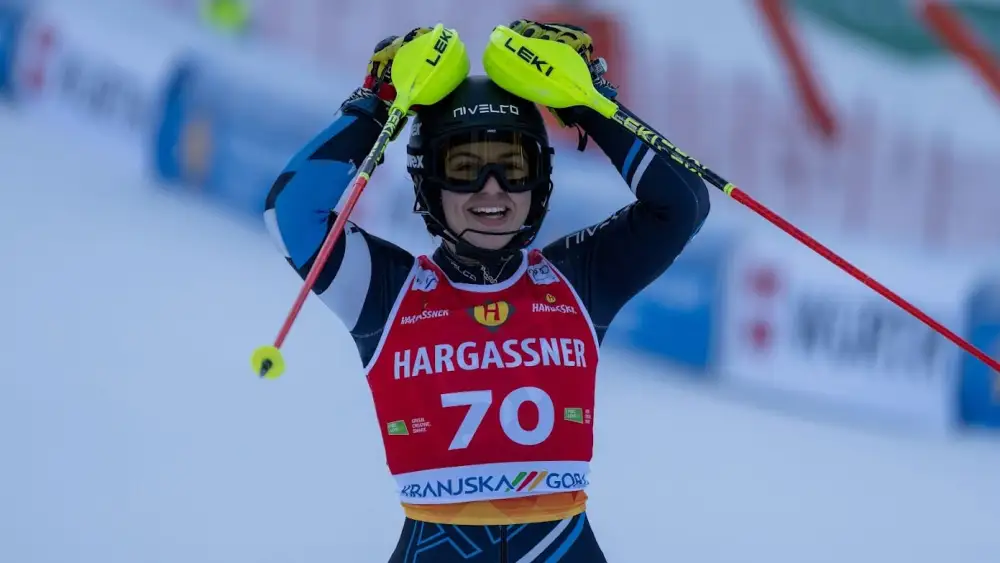
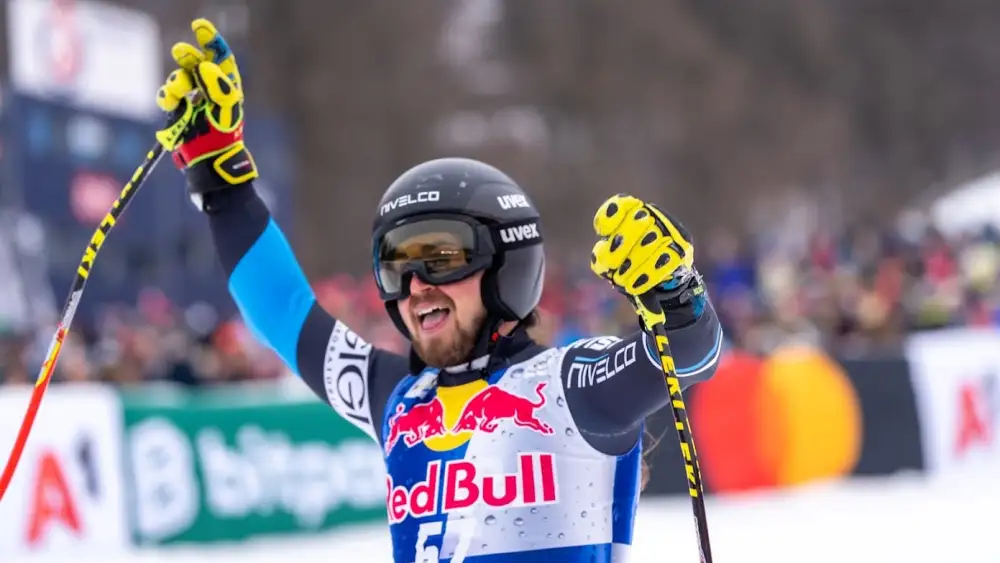
Barnabás (Barni) and Noa Szollos, brother and sister and Team Israel’s representatives on the ski slopes for the 2026 Winter Olympics in Milan, have already cemented their place in Israeli winter sports history.
Noa, 23, became the youngest Israeli to medal at the 2020 Winter Youth Olympics in Lausanne, Switzerland, taking bronze in the super-G (super giant slalom) speed-focused event and silver in combined, an event that features a speed and a technical portion.
Part of her motivation was beating her brother’s personal best, she told JNS from Italy.
“Barni was also at the youth Olympics four years before that, and his best result was seventh in the slalom, so I, of course, really wanted to beat his best result,” she said, with a laugh. “I honestly never thought that it would be possible or that I would not just make one medal, but two.”
Barni Szollos, 27, holds his own records. At the 2022 Olympics in Beijing, he finished sixth in the combined downhill—the best result by an Israeli at the Winter Olympics.
The siblings come from a very competitive household in Hungary. Their father, Peter Szollos, made aliyah and skied for Team Israel in the early 1990s. He coached Barni, Noa, and their older brother, Benjamin.
Peter’s competitive edge and determination have rubbed off on his three children. “I think all of us are a bit like him in that sense,” Noa told JNS. “We all have our own ideas, and it’s very hard for someone else to stop us from doing what we plan to do.”
Peter would even get out of the way when his kids were fighting in the house. Noa said her mother would be the one to break up the siblings’ quarrels, but only once one of them started crying.
“There was not a single calm day in the house,” Noa said.
Peter taught his children to ski when they were young. According to Noa, he originally wanted his children to decide whether to compete for Israel or Hungary when each turned 18. But their father decided that the Israeli program offered his children greater freedom to choose how they would train and where they would compete.
In 2018, Barni and Noa joined the Israeli ski team.
“The Israeli Olympic Committee treats us very nicely, and we feel very honored and very happy that we can represent Israel, because we get much more and better support than we ever got from the Hungarians,” Barni told JNS.
Israel Olympic Committee chair Yael Arad is thrilled to have Barni and Noa on the team.
“The Szollos family is a truly unique family that raised three world-class athletes, who have become part of our Olympic family,” Arad told JNS. She wished Noa and Barni great success.
‘We will get through it’
Noa and Barni didn’t grow up in a religious home, but Noa told JNS that joining Team Israel has strengthened her Jewish identity and connection to Israel.
Her favorite part about Israel is the food, although she still has a soft spot for Hungarian cuisine, she said. She also understands that Jews face surging antisemitism worldwide, which motivates her even more to strive for excellence and to inspire viewers.
“It makes me want to represent Israel in an even better light,” Noa told JNS. “Just to bring good results and to let everyone see that we can really do everything—that no matter how many times they want to try to stop us, we will get through it and we can do everything we set our minds to.”
Israel lacks the facilities and weather for regular winter Olympic training, so the Szollos siblings mainly split their time between Austria and Hungary, with a few visits to Israel in between.
Noa estimates that she skis about 120 days annually and hopes one day to ski Mount Hermon in northern Israel.
Both Noa and Barni faced adversity during their Olympic journeys. Noa recalled the difficulty of training as a child and feeling lonely.
“I used to switch schools all the time between Hungary and Austria,” she told the JNS. “I would spend half a year in Hungary and half a year in Austria, so I was always leaving my friends behind somewhere.”
She began to fall in love with the sport in her skiing-focused high school and forged many close friendships there, and her results improved.
“I think that helped a lot—having friends in skiing and also being with those friends the whole year-round,” Noa said.
Barni suffered a major accident while training at Kitzbühel, Austria, in January 2024. His ski got stuck in a hole, and he twisted his leg and tore an ankle ligament.
“I had a nasty fall there, and since then I’ve been on the way to return to the elite—to the top 150 on the world ranking,” Barni told JNS.
He qualified for the Ski World Cup last year and just a few weeks ago, returned to Kitzbühel and finished the run.
Through the challenges and amid some sibling rivalry, Barni and Noa say that they are rooting for each other and support each other deeply.
“It has gotten us closer,” Noa told JNS. “At the end, we’re all cheering for each other and happy about each other’s results. I think just seeing each other succeed helps us a lot in pushing ourselves as well.”
Barni noted that the men’s and women’s competitions are in different parts of Italy, separated by a four-hour drive. The siblings plan to watch each other on television.
Noa is hoping her Olympic journey will inspire young Israelis to try winter sports.
“Of course, winter sports are not too popular in Israel, but I think with some good results and good role models—though I would never say I’m a role model myself, but trying to bring good results,” she told JNS. “I hope we can bring a bit more winter to Israel and have more visibility for the winter sports.”
She could also see herself coaching after her skiing career is over, though she thinks she has plenty of years left in the tank.