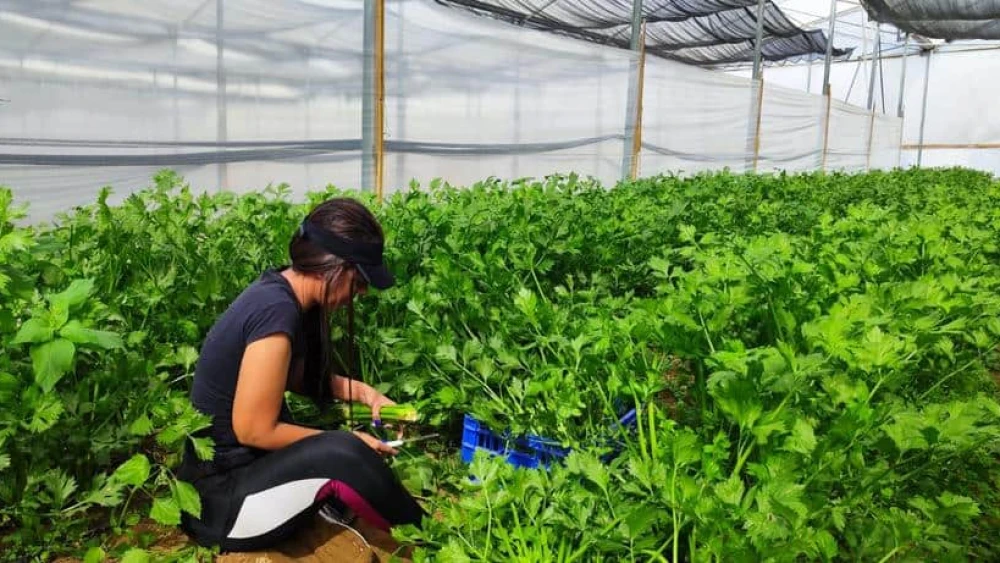
Five hundred noncombat soldiers will be assigned to help farmers each day, to help meet a shortfall of workers, the Ministry of Agriculture announced on Tuesday.
“Agricultural work is a pillar of the spirit of Zionism and is rooted in the State of Israel. Special thanks to the IDF Education Corps, without whose assistance the initiative would not have come to fruition,” said Oren Lavi, director-general of the ministry.
Before Oct. 7, Israel had 29,900 foreigners working in agriculture, mostly from Thailand. Farmers also employed 10,000-20,000 Palestinian laborers depending on the season. These workers planted and picked crops and carried out routine work in fields, orchards and greenhouses around the country.
But in the wake of the war, the ministry said 10,000 foreign workers have returned to their home countries, and Palestinian areas are under a security closure. Israelis who might have filled the labor gap have been called up for reserve military service.
This has led to a shortfall of 30,000 workers, “the greatest manpower crisis” Israeli agriculture has experienced since the country’s founding, the ministry said.
According to the arrangement with the IDF, noncombat soldiers, who are not working on routine security operations, will be connected to farmers in the southern and central areas for sufficient time for the soldiers to become proficient in the agricultural work.
The ministry is exploring ways to expand the pool of volunteers, including from programs such as National Service, pre-military preparatory schools and yeshivas.
The government recently approved the entry of 5,000 foreign agricultural workers and began offering incentives of thousands of shekels per month to draw Israelis to the sector.
Meanwhile, a survey released on Thursday found that farmers across Israel are facing decreasing produce and revenue. Due to security concerns, farmers near the Gaza and Lebanese borders cannot even reach many of their fields and orchards.
When asked to estimate their expected losses, farmers on average predicted a 35% drop in both production and revenue. The area facing the Gaza Strip is regarded as Israel’s breadbasket and farmers there project an average 70% loss of produce and income.