


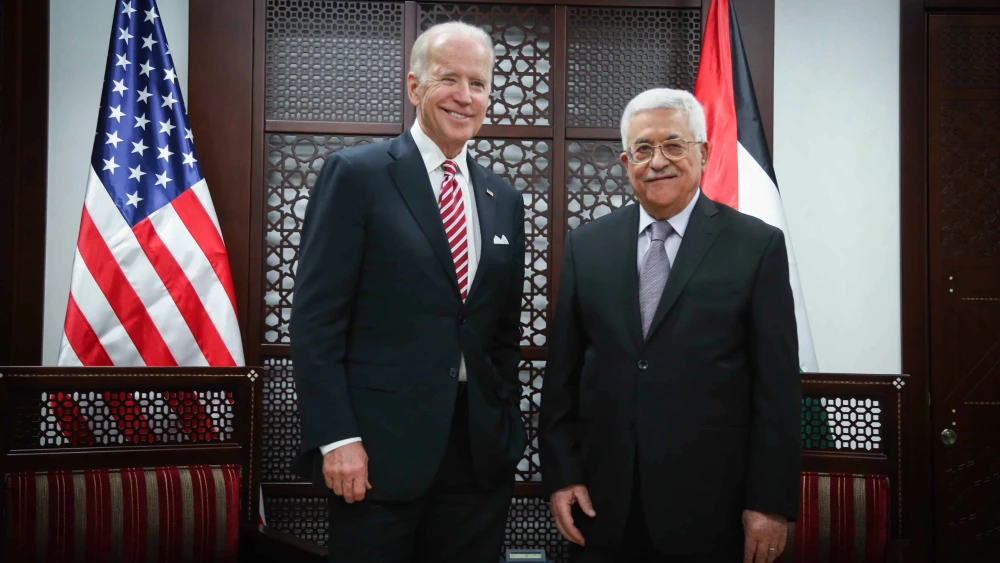
The Palestinian Authority’s top diplomat on Thursday slammed the Biden administration as “weak” over its failure to date to launch a negotiating process with Israel.
“I’m frustrated,” P.A. Foreign Minister Riad al-Maliki told a gathering of reporters in Ramallah, adding, “It seemed that [President Joe Biden] wanted to change all policies [former President Donald] Trump had taken, but not when it comes to Palestine.”
Al-Maliki pointed to what he said was Washington’s failure to rein in Israeli construction in Judea and Samaria and curtail IDF counterterror operations there.
“We have a weak [American] administration when it comes to Palestine,” said al-Maliki. “We re-engaged with the administration hoping that they would have the strength and the courage to move forward.”
Earlier this year, P.A. chief Mahmoud Abbas outlined a series of demands for Israeli concessions during a meeting with U.S. Secretary of State Antony Blinken in Ramallah.
In May, Abbas likened Israel to Nazi Germany during a speech at the United Nations marking “Nakba Day,” meaning the “disaster” or “catastrophe” of the establishment of modern-day Israel on May 14, 1948.
“Zionists continue to say that Israel made the desert bloom. As if Palestine was a desert and they made the desert bloom,” said Abbas. “These are lies. They continue to lie, like Goebbels, and they continue to lie until people believe them.”
The P.A. leader also demanded the “right of return” for some 5 million descendants of Palestinians displaced during the Arab-initiated war to eradicate the nascent Jewish state following its modern-day rebirth.
Last month, a bipartisan group of U.S. lawmakers called on the State Department to update Congress on negotiations to end the Palestinian Authority’s policy of paying terrorists.
In a letter sent to Blinken, the 50 members of Congress noted with concern the uptick of violence in Judea and Samaria in recent months and the P.A.’s refusal to condemn the killings of Israelis while at the same time continuing its “pay for slay” program.
The Trump administration cut off aid to Ramallah; Biden has restored more than $1 billion in funding to the Palestinians.
On Thursday, al-Maliki also said the P.A. is pushing for Saudi Arabia to condition any normalization with Israel on the creation of a Palestinian state.
“One of these conditions is really the end of the Israeli occupation and the materialization of the state of Palestine,” he said. “I hope that the Saudis will stick to that position and not yield to any kind of pressure, intimidation coming from the Biden administration or any other power.”
On Monday, Israeli Foreign Minister Eli Cohen the door for a U.S.-brokered deal between Jerusalem and Riyadh would remain open until the U.S. election season kicks into high gear in March.
While he noted that it was too early to comment on specific concessions Israel might have to make for an agreement, he said convincing Saudi Arabia to join the Abraham Accords was not only an Israeli interest but an American one.



