


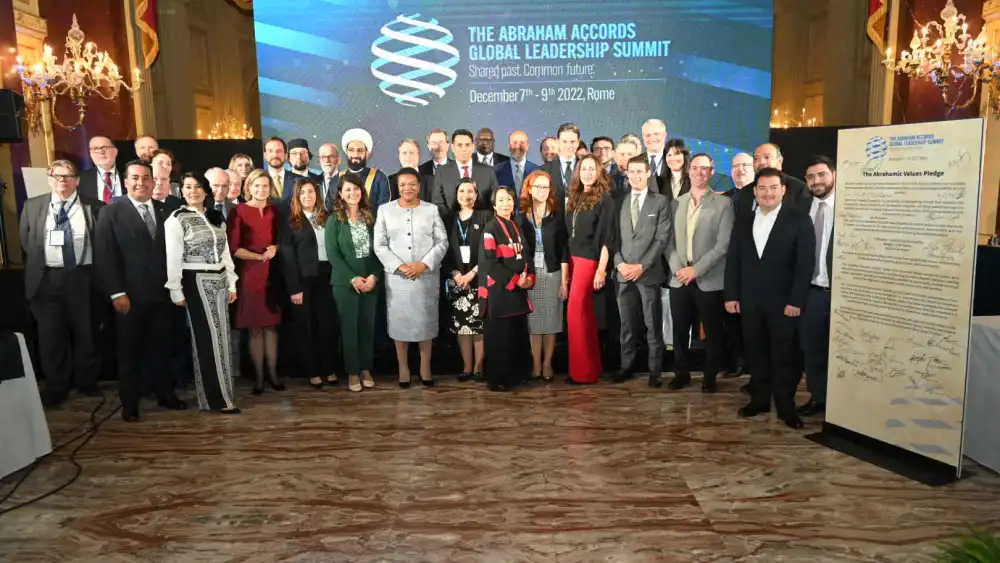
World leaders, entrepreneurs, lawmakers, academics and clergy from over 30 countries converged in Rome on Wednesday for the First Annual Abraham Accords Global Leadership Summit, an event that focused on new ways to increase peace and tolerance.
The summit celebrated the seismic change that the Abraham Accords, which normalized relations between Israel and several Arab countries, have brought to the Middle East and North Africa.
Delegates from the United Arab Emirates, Bahrain, Morocco and Israel shared their insights with policy-shapers from around the globe.
The summit culminated with the adoption of the Abrahamic Values Pledge, which states, “We are united by our shared Abraham values that have sustained our societies for thousands of years. We take immense pride in our mutual responsibility for one another.”
“While our shared humanity is constantly challenged by trends that question the traditional values shared by all Abrahamic religions, our deep-rooted heritage has enabled us to build a vibrant and well-knit society that is both entrepreneurial and innovative in its nature,” it continues."The spirit of the Abraham Accords has allowed our communities to reap the fruits of peace and flourish in an ever-evolving socio-economic environment and has underscored the importance of the following foundational pillars: Tolerance, coexistence and diversity; Religion and family; Economic Peace.”
“We hereby commit to take responsibility to further educate our communities in the fundamental significance of the traditional Abrahamic values, and the importance of our shared humanity that has flourished for thousands of years,” it concludes.



