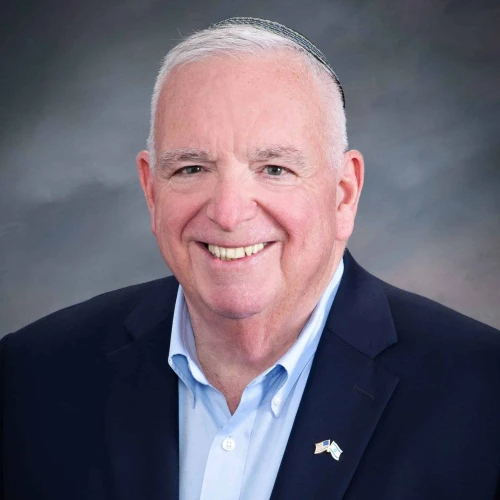
The majority of Likud lawmaker Amit Halevi’s work over the past three years has been devoted to security, counterterrorism and war-related matters, he told JNS earlier this month.
“When I was elected in January 2023, I felt this was the most important area,” said Halevi, a member of the Knesset’s Foreign Affairs and Defense Committee, during an interview in his office. “After Oct. 7, there is no need to explain why Israel must confront and correct many of the flawed security concepts and gaps that have accumulated over the years,” he added.
His efforts have focused on dismantling terrorist infrastructure that threatens the State of Israel, he explained.
“We must deal not only with intercepting missiles on their way to strike our people, but also with the religious, intellectual and educational terror infrastructure—in our case, radical Islamic schools of thought—that threatens Israel and the free world,” he said.
He noted that two bills he advanced to combat terror incitement in the education system have been approved. The first bars educators who have expressed sympathy for terrorism, glorified terror or were involved in terrorist activity, as defined under Israel’s anti-terror law, from teaching in the Israeli education system.
As an example, Halevi cited Sgt. Rose Lubin, who fought at the gate of Kibbutz Saad on Oct. 7 and was later killed in a stabbing on Nov. 6, 2023, by a student educated at the Rashidiya School in Jerusalem. The attacker’s teacher had been responsible for the 2021 murder of Eliyahu “Eli” David Kay in Jerusalem’s Old City, he said.
“The teacher, Fadi Abu Shkhaydam, taught anti-Israel messages and left a mission to students and teachers to kill Jews. One of his students murdered Rose Lubin. This is educational terror infrastructure,” Halevi told JNS.
Last month, Halevi added, Aviv Maor and Shimshon Mordechai were murdered by a terrorist who entered Israel illegally from the town of Qabatiya.
“The imam of Qabatiya calls time after time to kill Jews. Why not arrest him? We are focused on the bullet on its way to us, but not on the infrastructure that creates the bullet and shapes the hearts and minds of terrorists,” he said.
The second piece of legislation Halevi referenced restricts the employment of teachers holding academic degrees from Palestinian Authority institutions.
“There is no P.A.; it’s a fake construct. What they have is the PLO, which is the essence of the P.A.,” he said. “Their high school program is anti-Israel, glorifies terrorism, demonizes Jews and calls for terror activity. This is their Tawjihi,” he added, referring to the high school exit exam in Jordan and the P.A.-controlled areas.
Addressing President Donald Trump’s 20-point peace plan for Gaza, which calls for a reformed P.A., Halevi said that while Trump has put forward statements and visions, the reality is that P.A. leader Mahmoud Abbas is a Holocaust denier who sponsors the killing of Jews.
Following Hamas’s Oct. 7 massacre, Halevi submitted a bill that would allow Israeli courts to impose the death penalty on Palestinian terrorists who participated in the attack. The bill has not yet advanced.
“My legislation was unique and specific to Oct. 7, meant to define all the terrorists who took part, much like the Nazis and Nazi Collaborators (Punishment) Law of 1950,” Halevi said. “I took that 1950 law and copied it because I believe this is the same neo-Nazi ideology, and we should treat them the way the Western world treated the Nazis.”
The legislation is necessary because Oct. 7 terrorists should not be handled like ordinary criminals, he argued.
“Other legislation requires proving intent to commit genocide, but the ideology they are part of preaches it. I say we must treat them like we did the Nazis—we don’t need to prove intent, only that they were there,” he said.
“The punishment can differ. Not all should receive the death penalty, just as not all did at Nuremberg—but all were part of a genocide machine,” he added.
Discussing reforms to Israel’s military and intelligence establishment, Halevi cited his Bill to Establish a Division for Consolidating Alternative Intelligence Conceptions within the intelligence agencies.
“After the Yom Kippur War, a second-opinion unit was created, but it was placed under the research division. In the army, soldiers don’t challenge their superiors, so there is effectively no second opinion. I want to move it outside the military, to the Prime Minister’s Office,” he said, describing the proposal as a direct lesson from Oct. 7.
Another bill he advanced would allow any Israel Defense Forces soldier to escalate intelligence assessments related to security alerts directly to the prime minister.
“I know from my work on the Foreign Affairs and Defense Committee and from other sources that at least five or six times the prime minister was not alerted ahead of Oct. 7. That is why even a surveillance soldier would be able to pass information up to the prime minister,” he said.
Halevi has also initiated several bills in the international political arena, one of which addresses the International Criminal Court.
“The legislation I initiated regarding The Hague is similar to the U.S. Hague Invasion Act. The bottom line is that Israeli authorities will not cooperate with the ICC, and no Israeli citizen may share information—unless specifically authorized. It’s a criminal offense,” he said. “This is meant to strip the cover from UNRWA, the ICC and others who present themselves as judges but are, in reality, enemies of the free world.”
Another bill would define hostile states and enemies of Israel, including Qatar, prohibiting Israelis from maintaining ties or conducting trade with them.
While a Knesset lawmaker’s work includes legislation, committee activity and media appearances, Halevi said the media is often the most effective tool for driving change.
He recounted what he described as one of the most meaningful moments of his tenure, when a soldier in civilian clothing approached him to express thanks. The soldier, a platoon commander, said he had heard Halevi argue publicly for conducting the war through effective sieges rather than repeated raids.
“He told me he changed how his platoon operated,” as a result, “and since then there were no more casualties,” said Halevi.
“I told myself I could retire from the Knesset tomorrow and be fine. If one soldier’s life was saved because of something I said, that’s enough. The impact of public discourse is no less important than legislation,” he added.
In November, during Likud’s first Central Committee elections in 14 years, Halevi ran as part of the party’s liberal faction and secured 40% of the vote in Jerusalem.
“Likud has about 167,000 registered members. The Central Committee includes around 4,000 representatives elected by the membership,” he said. “We achieved 40% of the vote running against 12 groups, including former Jerusalem mayor and current Economy Minister Nir Barkat and Minister of Regional Cooperation Dudi Amsalem.”
“Voters want me to keep working for truth and justice in Israel, for the security of our soldiers, and to change the existing security conception,” said Halevi. “That result was a direct reflection of the work we’ve discussed.”