
Everyone in Israel asks the same question. Not analysts or generals, but friends, relatives, colleagues and interviewers—anyone who cares enough to ask honestly: when will the war with Iran begin?
The only truthful answer is that no one knows. Yet almost everyone in Israel believes it will happen.
This is not prophecy; it is deduction. The United States does not reposition major naval strike groups, rare reconnaissance aircraft, refueling fleets and thousands of troops across the globe for diplomatic theater alone. Nor does Iran continue arming proxies, rebuilding missile arsenals and advancing its nuclear program to pave the way for a compromise at the final moment.
The decision point is approaching.
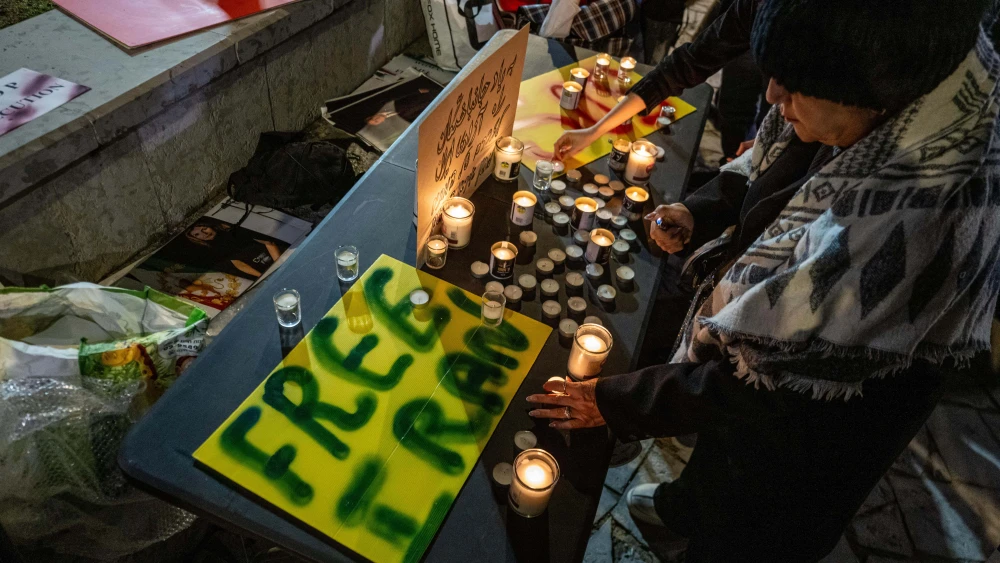
U.S. President Donald Trump, who signalled that he would decide on whether to pursue diplomacy or war in 10 to 15 days, has begun framing the confrontation not only strategically, but morally. On Friday, he stated for the first time that 32,000 people were killed by the Iranian regime during a recent crackdown on anti-government protests, calling it “very, very, very sad,” and indicating that failure to reach a fair agreement could justify military action.
If diplomacy collapses, Iran will strike where it believes deterrence is most sensitive: Israel, together with American bases in the region.
Israelis understand this equation without drama. Eight months ago, in June 2025, ballistic missiles already demonstrated the scenario. Not theory—memory.
The next round would likely be broader.
And yet Israel is not frozen in anticipation. It is functioning in routine. Families prepare quietly before sleep—water near the door, jackets for shelters, radios on. Children ask whether the night will be quiet, and parents answer with the only honest word available: hopefully.
The army repeats readiness without extraordinary instructions. Schools open, restaurants fill, airports operate normally and supermarkets remain stocked. Television discusses weddings, small businesses started by reservists returning from service, ordinary life continuing under extraordinary circumstances.
This is not denial. It is experience.
For centuries, Jews faced destruction without the capacity to prevent it. Today they possess layered defenses—Iron Dome, David’s Sling, Arrow, Patriot and soon laser interception—a shield that changes not fear but expectation.
Israel’s leadership, therefore, confronts a familiar but existential calculation. If Iran launches an attack, Israel absorbs and responds. If intelligence reveals an imminent strategic attack, Israel may have to strike first. A regime built on apocalyptic ideology may gamble everything when threatened; hesitation could be fatal.
What is remarkable is not only military preparedness but civilian resilience. Any other country expecting heavy missile fire would empty markets and halt daily life. In Israel, people postpone trips, not existence.
The Jewish people reacts to danger as it has for millennia: living, studying, arguing, building families—but now with sovereignty and an army capable of defense. As Prime Minister Benjamin Netanyahu said, the Israeli military is ready for any scenario.
Israel may soon face the most dangerous confrontation in decades. Yet it will face it not as a society paralyzed by fear, but as one that continues to function while waiting with courage.
For most of Jewish history, threat meant helplessness. Today, any threat against the Jewish state meets readiness—and that alone marks a revolution in history.