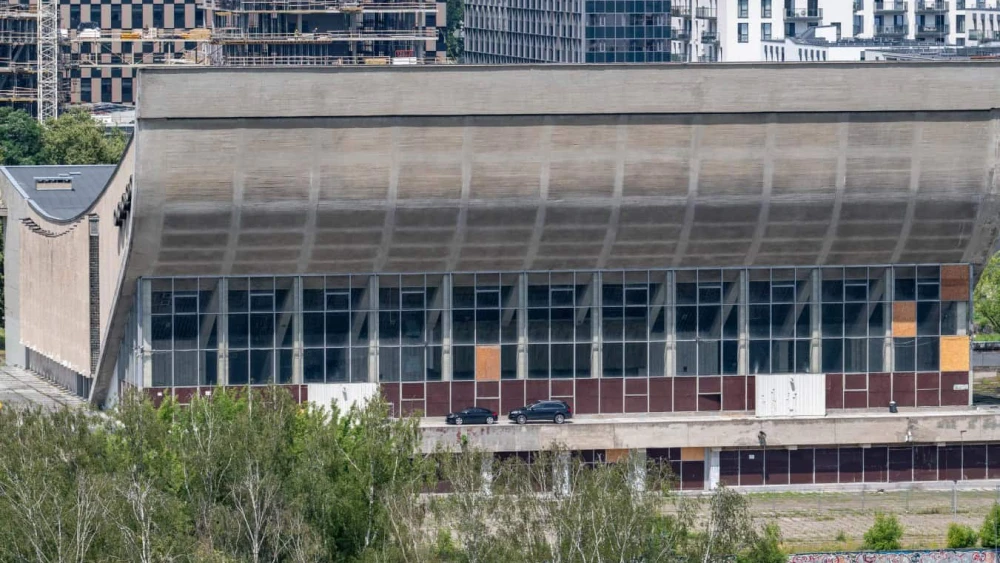
Two years after Vilnius, the capital of Lithuania, vowed to preserve a former Jewish cemetery the Soviets had destroyed, the government said it wanted to revive plans to build a conference center there, rekindling protests by local Jews and beyond.
“It is proposed to return to the advanced project initiated more than a decade ago—the adaptation of the Vilnius Concert and Sports Palace building to establish the Vilnius Congress Center,” the Lithuanian government wrote last week in a statement.
When Lithuania was still part of the Soviet Union, authorities built the Vilnius Concert and Sports Palace on top of the Šnipiškės cemetery, also known as the Piramónt Cemetery. It is the oldest Jewish cemetery in Vilnius, containing the remains of countless Jewish luminaries from the city’s past, dating back as far as 400 years.
The 18th-century sage known as the Gaon of Vilna was originally buried there, although his remains were relocated in 1949. The Soviets allowed local Jewish residents to move only seven bodies from Piramónt before they destroyed the graveyard and eventually built the sports center there in 1971. It remained operational until 2004, when it was closed down and fell into disrepair.
Lithuanian authorities tried to advance a plan to erect a conference center on the grounds but backed down in 2023 following vocal opposition by local and foreign Jewish groups, which cited Jewish laws that forbid disturbing human remains.
The controversy added tension to an already loaded relationship between the Lithuanian state and some Jewish organizations over Lithuania’s Holocaust-era record. It had featured enthusiastic local collaboration with the Nazis in the murder of about 90% of the country’s Jewish population, which was one of the world’s most illustrious Jewish diasporas.
In the announcement, Lithuanian Prime Minister Gintautas Paluckas said the construction project will be “focusing on the commemoration of the Jewish cemetery and the events of Jan. 13.”
The date was a reference to clashes in 1991 with Soviet authorities in which 15 people died.
“The implementation of the project will preserve attention to both the significance of this place for Lithuanian history and the memory of the events that marked it,” he said.
‘Undermine trust in our state’
The announcement prompted expressions of surprise and protest by local Jews and others.
“We urge the Lithuanian government to immediately reverse course,” the American Jewish Committee wrote in a statement on Friday, in which the group expressed its “shock at the Lithuanian government’s surprise announcement.”
It “reverses an internationally endorsed decision of the previous government, which rightly committed to transforming the site into a place of Jewish remembrance and education,” AJC wrote. The “abrupt nature of this decision raises serious questions and casts a shadow over Lithuania’s stated commitment to Holocaust memory and Jewish heritage.”
Rabbi Pinchas Goldschmidt, president of the Conference of European Rabbis, called the announcement “a painful betrayal of Lithuania’s own past commitments and a desecration of the interned deceased.”
Faina Kukliansky, chairwoman of the Lithuanian Jewish Community, stated that her organization was not consulted over the new plan and is “surprised” by it.
Her group will “refrain from commenting on this decision, as we have no information regarding its content or the reasons behind such a change,” she wrote, adding “such actions undermine trust in our state and damage Lithuania’s reputation in the eyes of its strategic partners.”
Before the announcement, Kuklianskys’ group was part of a committee working on a project “approved in 2024 concerning the memorialization of the Old Šnipiškės Jewish Cemetery and the commemorative site at the current Vilnius Concert and Sports Palace,” she said. “This project has been under development for several years and was carefully coordinated” by local and international Jewish groups.