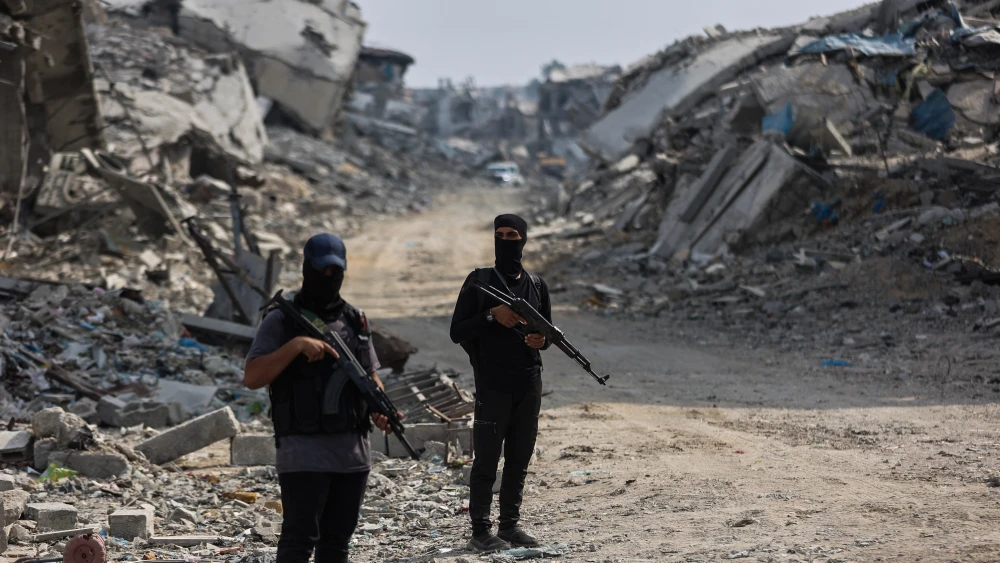
The Izz ad-Din al-Qassam Brigades, Hamas’s “military wing,” on Sunday denounced calls for its disarmament under U.S. President Donald Trump’s ceasefire plan as “extremely dangerous.”
In a televised statement translated by Reuters, a Hamas spokesman said that raising the issue of demilitarization “in a crude manner” is unacceptable.
“What the enemy is trying to push through today against the Palestinian resistance, via our brotherly mediators, is extremely dangerous,” said Abu Obeida, a nom de guerre used by Hamas spokesmen.
The statement said Washington’s demands for disarmament were “nothing but an overt attempt to continue the genocide against our people, something we will not accept under any circumstances.”
Abu Obeida urged mediators to address what he described as Israeli violations of the first phase of Trump’s plan before any discussion about the second phase.
“The enemy is the one who undermines the agreement,” the terrorist spokesman said.
Hamas has told mediators it will not discuss disarmament before receiving guarantees that the Israel Defense Forces will fully withdraw from the Gaza Strip, three sources told Reuters on Thursday.
The terrorist group met with Egyptian, Qatari and Turkish mediators in Cairo on Wednesday and Thursday to give its first response to a disarmament proposal presented by Trump’s Board of Peace, two Egyptian sources and a Palestinian official told the wire agency.
Hamas presented several demands and proposed amendments to the Board’s plan, including an end to Israeli “violations,” implementation of the entire ceasefire plan and withdrawal from the enclave by the Israel Defense Forces, the two Egyptian sources said. The sources said Hamas refused to discuss laying down weapons before those issues are addressed.
Nickolay Mladenov, the Board of Peace’s high representative for Gaza, said on Wednesday that “all sides have endorsed the plan, the international community has supported it, now is the time to agree to the framework for its implementation.”
The Board of Peace continues to work toward a Gaza “that is reconstructed and secured by the transitional Palestinian administration ... free of weapons and tunnels, and reunified with the reformed and legitimate Palestinian Authority,” he tweeted.
An unnamed senior U.S. official told NPR last month that mediators presented Hamas with the proposal in Cairo. However, a Hamas official told the U.S. public broadcaster that the Iranian-backed terrorist group was awaiting the outcome of the joint U.S.-Israeli campaign against the regime in Tehran before responding.
Under the terms of the proposal, Hamas would give up its heavy weapons, including rocket launchers, and share maps of its underground terror tunnel network, NPR reported.
Top Hamas leaders, including Khaled Mashaal and Musa Abu Marzouk, have rejected key parts of U.S. President Donald Trump’s plan in recent months, including disarmament, despite having agreed to the proposal in October.
“The resistance and its weapons are the ummah’s [Islamic nation’s] honor and pride,” Mashaal told an anti-Israel summit in Istanbul on Dec. 6.
“A thousand statements are not worth a single projectile of iron,” he said.