The Negev desert is famous for its vast stretches of sand and roads that seem to go on forever. While it makes up 60% of Israel’s land area, most Israelis know it mainly as the region they drive through on the way to Eilat.
But now Israeli winemakers are hoping the Negev will become internationally known for wine after the region was recently designated a unique wine region, or “appellation.” It joins the Judea appellation in Israel and is believed to be the first desert appellation in the world.
“In a landmark development for Israel’s wine industry, the Negev has officially received recognition as a protected Geographical Indication (G.I./Appellation) under the name ‘Negev.’ The designation places Israel’s southern region and its ancient winemaking heritage firmly on the global wine map,” the Ministry of Tourism confirmed in a press release.
The ministry noted that the recognition was based on extensive professional research conducted by leading Israeli experts, “demonstrating that wines produced in the Negev possess a distinct and identifiable profile unique to the desert terroir.”
The initiative was led by the Merage Foundation Israel, a private philanthropic foundation dedicated to strengthening the Negev, which has spearheaded efforts to position the Negev as an internationally recognized wine tourism destination. The process took approximately four years and has now resulted in the formal designation of a new Israeli wine region stretching from Kiryat Gat in the north to Eilat in the south, the ministry said.
“It indicates that there is an actual wine region in the Negev,” Nicole Hod-Stroh, the executive director of the Merage Foundation, told JNS. “There is a unique terroir (a French agricultural concept of a ‘sense of place’ based on climate and soil and other factors) and it’s the first desert wine appellation in the world. It comes as the winemaking world, like everywhere else, is dealing with climate change.”
The Negev wine region currently includes more than 60 wineries and vineyards, producing more than one million bottles annually.
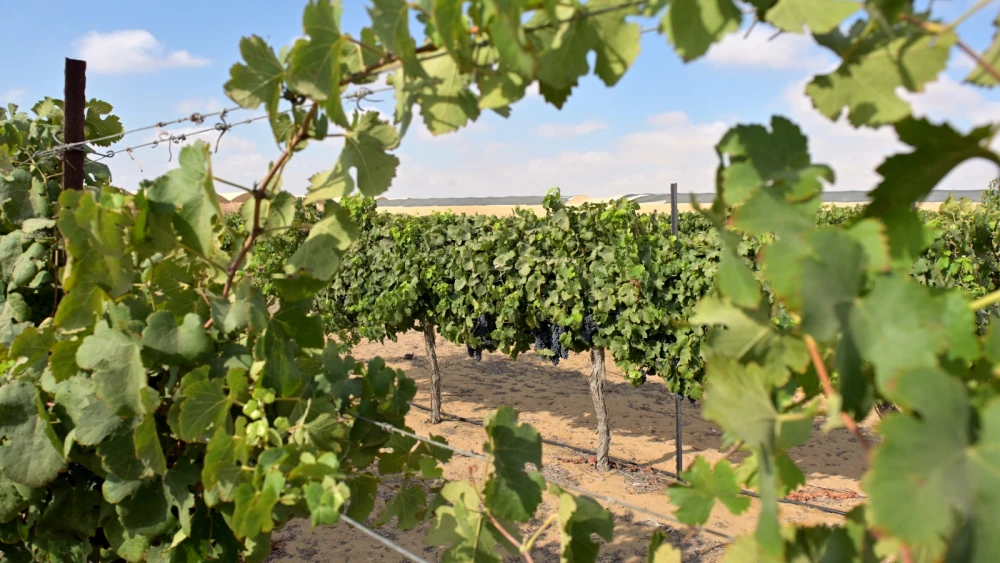
“The designation also revives a winemaking tradition dating back thousands of years; the Negev was renowned for its wines as early as biblical times, though modern winemaking in the region resumed only in the 20th century,” the Tourism Ministry said. “Today, using advanced agricultural and irrigation technologies, local growers are demonstrating that vineyards can successfully thrive in desert conditions, even amid global warming and extreme climate challenges.”
Strengthening Israeli wines
The new recognition is expected to significantly strengthen the international positioning of Israeli wines by combining a compelling story, distinctive flavors and cutting-edge agricultural innovation, the Tourism Ministry said.
“With this achievement, the Negev becomes the second wine region in Israel to receive official appellation status, joining the Judea Wine Region, which paved the way several years ago,” it said. “This designation places the Negev alongside globally recognized wine regions such as Champagne, Chianti, Bordeaux and Napa Valley.”
It took a while to get the appellation recognized by the Israeli Justice Ministry, which oversees Israel’s participation in the Lisbon Agreement. The international treaty allows producers of agricultural products, including wineries, to create and protect appellations of origin, such as the word “champagne.”
“Let’s say you’re standing in the store and you’re trying to buy a bottle of wine for your dinner tonight,” Guy Haran, who consulted with the Merage Foundation and runs wine-themed trips around the world, explained to JNS. “You see two bottles at the same price. One says champagne and the other says sparkling wine. Ninety-nine percent of the people around the world will choose the champagne.”
In fact, he said, several years ago, an Israeli company bottling mineral water released a campaign calling its product “the champagne of nature.”
French growers in Champagne sued, saying the appellation “champagne” was unique to them, and the Israeli company was forced to drop the campaign. Even in France, wine regions outside the Champagne appellation must use the term “sparkling wine,” as the term “champagne” refers to a specific area in France.
In Israel, the first appellation dates back to the 1960s for Jaffa oranges. In terms of wine, Judea is the country’s first wine appellation, divided into two separate areas—the Judean Hills and Judean Foothills.
A long process
Haran said getting the Negev defined as an appellation was a long process that took several years, beginning in 2020.
“We had to prove that we have a specific style of wine in the Negev,” he said. “We prepared a 150-page report describing the soil, the climate, the history, the geography, the topography and the agriculture of the region, all proving that we have something unique in the Negev.”
He said that when the process began, there were 12 wine producers in the Negev, and now there are 60. Of these, 40 are actual wineries, while the others grow and sell grapes. He said new wineries are continuing to open in the area, while long-time growers are also establishing wineries of their own.
The Negev region’s unique terroir also affects the way wine is produced there. Because of the heat and dryness, growers need to use fewer pesticides on the grapes to prevent mold. The heat also causes the grapes to ripen more quickly, making them among the first harvested in Israel each summer.

‘Wonderful taste and aroma’
The wines also have a distinctive flavor profile.
“The white wines have a wonderful taste as they are grown with a lot of sun and harvested much earlier,” Jonathan Livny, a wine writer for the online magazine E-food, told JNS. “I also think the aroma is different from the aroma of regular wines. You are drinking wines that are not something you can drink in the rest of the country.”
When it comes to the Negev’s red wines, Livny said the Syrah is peppery with strong spice notes, while the Merlot is much lighter than varieties grown elsewhere in Israel. The Negev is also well-suited to varietals less common in Israel, such as Malbec, which is widely grown in Argentina.
He said wineries in the Negev are also experimenting with an ancient grape called Syriki, using seeds discovered in the Negev desert that were historically used to make wine in Greece and Lebanon.
The forces behind the Negev appellation hope it will also foster a greater sense of community among wine producers in the region, while encouraging tourism from both Israel and abroad.
The COVID-19 pandemic sparked an increase in domestic wine tourism, as many Israelis, unable to travel overseas, began visiting wineries, taking picnic baskets and bottles of wine into the vineyards, especially on weekend mornings.
Israelis are not major wine drinkers, consuming just 7 to 8 liters per person annually. But wine producers say younger Israelis are increasingly interested in wine and are willing to spend more on a quality bottle.
There are now more than 300 wineries in Israel, including the 40 in the Negev. Those Negev wineries are growing rapidly and organizers hope the new appellation will give the entire region a major boost.