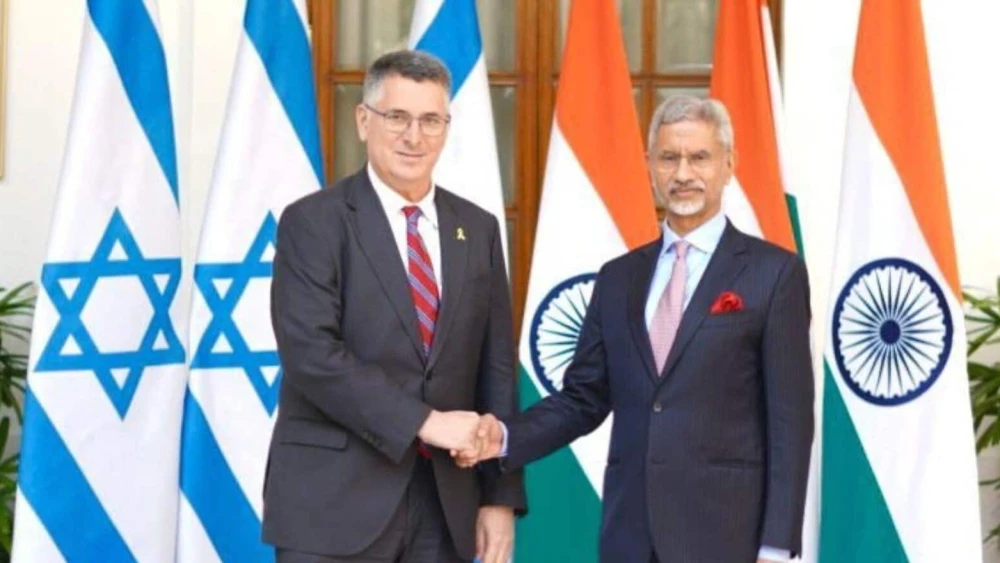
Israeli Foreign Minister Gideon Sa’ar on Tuesday discussed the fighting in Iran and Lebanon during a phone call with his Indian counterpart and “friend,” Subrahmanyam Jaishankar, Jerusalem’s top diplomat said.
“I said that the firm American stance in the negotiations on conditions that would prevent Iran from obtaining nuclear weapons (no enrichment in Iran, removal of enriched material from Iran) is critical for the entire international community,” Sa’ar tweeted.
He emphasized that the “harm to freedom of navigation and the global economy” through Tehran’s “economic terrorism” in the Strait of Hormuz requires action to “ensure the freedom of navigation for all countries, including India and our friends in the Gulf.”
A good conversation, as always, with my friend, India’s Minister of External Affairs @DrSJaishankar. We discussed Iran, the Strait of Hormuz, and Lebanon.
— Gideon Sa'ar | גדעון סער (@gidonsaar) April 14, 2026
I said that the firm American stance in the negotiations on conditions that would prevent Iran from obtaining nuclear… pic.twitter.com/miTi4YlXYE
“A good conversation, as always,” Sa’ar added.
Jaishankar, in a brief statement posted to his X account, said the call with Sa’ar “covered different aspects of the West Asia situation.”
Indian Prime Minister Narendra Modi has shifted his country’s foreign policy to a pro-Israel stance from a historically pro-Palestinian one. Jerusalem and New Delhi only established full diplomatic relations in 1992.
Under Modi, India and Israel have significantly deepened their strategic, economic and defense ties, cooperation driven by shared security concerns and technological collaboration. Bilateral trade has surged, more than doubling since 2013 to a record-breaking $5 billion in 2024. The volume of trade shrank in 2025 to $3.6 billion.
Just days before the war with Tehran broke out on Feb. 28, Modi arrived in Israel for a two-day trip at the invitation of Israeli Prime Minister Benjamin Netanyahu, where he addressed Knesset lawmakers.
Modi opened his remarks by saying, “Shalom, Namaste” and describing the long histories spanning many centuries of Israel and India. “I bring with me the greetings of 1.4 billion Indians and a message of friendship, respect and partnership,” he said.
The trip included the signing of a series of strategic agreements to boost security and economic cooperation between the two countries.
Sa’ar also hosted Czech Deputy Prime Minister and Foreign Minister Petr Macinka in Jerusalem on Tuesday, marking the visit with a joint commemoration at Yad Vashem on Holocaust Memorial Day.
He described the Czech Republic as “one of Israel’s greatest friends,” announcing the launch of a new Joint Economic Commission that he and Macinka will co-chair to deepen bilateral cooperation and strengthen strategic and trade relations.
Honored to host my friend Czech Deputy PM and FM @petr_macinka in Jerusalem.
— Gideon Sa'ar | גדעון סער (@gidonsaar) April 14, 2026
We visited “Yad Vashem” together, commemorating Holocaust Memorial Day.
The Czech Republic is one of Israel’s greatest friends in the world.
We launched a Joint Economic Commission, which the Minister… pic.twitter.com/DUQCEHGcmW