


Almog Hovav figured that basic training in the U.S. military is partly about whipping everyone into shape and getting them to follow orders. But he wasn’t expecting the reaction he got on his first day of training, when he told his superiors that he didn’t eat pork after receiving a non-kosher packaged meal.
“The drill sergeant that was leading there at the time had told me that I would eat the un-kosher meal and that my religion was now the Army,” Hovav told JNS. “That set the stage for what I was going to expect for the rest of the four years that I spent in the military.”
Hovav, who is studying for rabbinic ordination in an online Chabad program after serving as a Hebrew linguist and intelligence analyst and a geospatial intelligence imagery analyst in the U.S. Army, told JNS that the drill sergeant was replaced after a complaint.
He also received “some comments” from peers in the military, which he decided not to take too personally.
“When you’re joining the Army, you’re meeting such a wide variety of people, so there’s bound to be moments of tension and learning,” he told JNS. “A person respects a Jew who respects themselves. So when you’re confident about who you are and what you believe in and what you require, people take notice of it, and they help you.”

Former Jewish service members and Jewish advocates, who work with Jewish members of the U.S. military, told JNS that there has long been anti-Jewish bias and a lack of understanding of Jewish needs in the military. But a rabbi who works with Jews in the military said that there is new hope that such issues will be addressed.
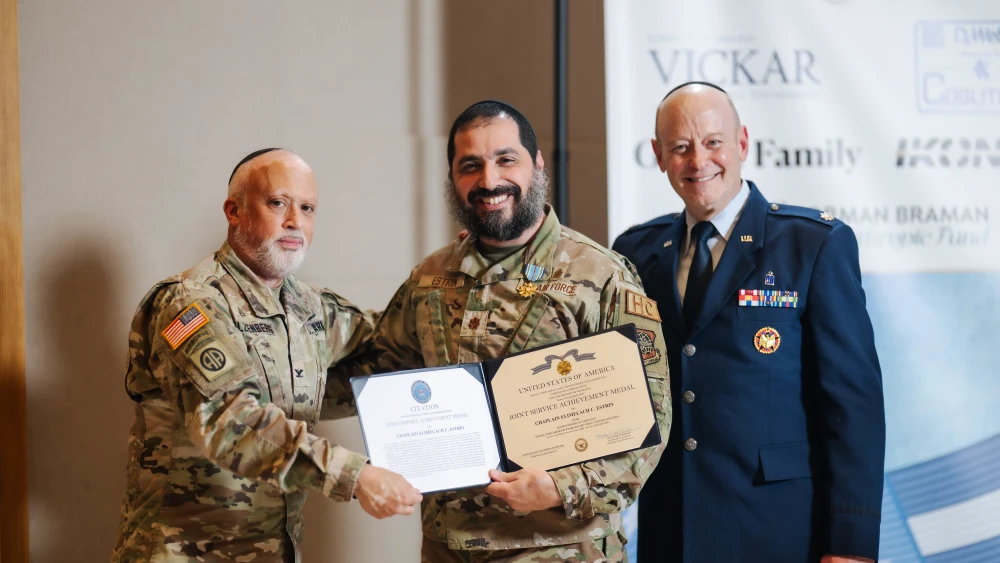
Rabbi Elie Estrin, director of military programs at the Aleph Institute, which provides religious support to Jewish members of the U.S. military, told JNS that the institute met recently with Ryan Higgins, a senior adviser to Pete Hegseth, the U.S. defense secretary, who he said addresses faith issues.
“That gives a tremendous amount of heft to the entire conversation,” Estrin told JNS. “We’re dealing with things on a two-star level, and this obviously elevates things past the four-star level.” (The Army chief of chaplains is a two-star rank, but dealing with the defense secretary’s office directly can give Jewish advocates access to the military’s highest levels.)
Higgins is “very motivated” to protect religious liberties and promised to work with the rabbi, according to Estrin, who intends to work with senior chaplains to identify areas of improvement quickly to get the Pentagon to “feed them down into the chaplaincy and hopefully fix as many of these things as possible.”

‘Religious apathy’
Hovav, the former service member who is now studying to become a rabbi, told JNS that he advises soldiers facing discrimination to “not be afraid and to speak up for whatever it is that they deserve, whether it be time for prayer or kosher meals or time to be able to participate in the high holidays.”
He thinks that there is a broad “religious apathy” in the U.S. military.
“There are formations every single morning to care about physical health, and there are sermons that are done in relation to emotional health and behavioral health,” he said. “However, there is definitely a lack of spiritual undertaking.”
A U.S. Defense Department official told JNS that as U.S. President Donald Trump and Hegseth have “made clear on numerous occasions, this administration and the Department of War are cognizant and sensitive to any forms of discrimination, particularly those forms that violate our service members’, civilians’ and military families’ constitutional protections.” (The president and many in the administration refer to the Pentagon as the War Department.)
“With regard to our Jewish members specifically, this is something we have dedicated significant time to reviewing and helping find quick and meaningful solutions to,” the Pentagon official said. “We have worked to create professional relationships and an open line of communication with both outside Jewish organizations as well as many of our Jewish service members.”
“Under Secretary Hegseth’s leadership, we are working overtime to shift culture toward the complete eradication of any infringements on the free exercise of religion and consider any restrictions on this right as serious violations,” the official told JNS. “Since Secretary Hegseth was sworn in, much progress has been made toward this goal.”
Hovav, the former U.S. Army analyst who is now studying to become a rabbi, told JNS that if the military addresses the spirit in addition to the vice of young men it aims to “heal,” it could “give a sensitivity to the soldier to be able to interact with his peers in a much more productive way.”
“You get a soldier who’s able to focus more on a mission, because he’s less worried about his own spiritual standing,” he said.
There have been many instances of Jew-hatred in the military documented in recent years to the U.S. Department of Justice’s Religious Liberty Commission and the Aleph Institute, including graffiti, vandalism, Nazi salutes by service members and a recruiter spewing Jew-hatred online.

“The military at large is not systemically antisemitic,” Estrin told JNS. “However, there are definitely incidents that have occurred that we’ve been collecting over the past three years, and there’s definitely a lack of concern for religious needs.”
Instead, he said, there is a need for more training about Jewish needs in the military.
‘Didn’t want to be bothered’
Amram Palas, who serves in the 175th Wing, a unit of the Maryland Air National Guard, at Warfield Air National Guard Base in Middle River, Md., has had trouble keeping Shabbat and kosher and setting time for prayer and donning tefillin.
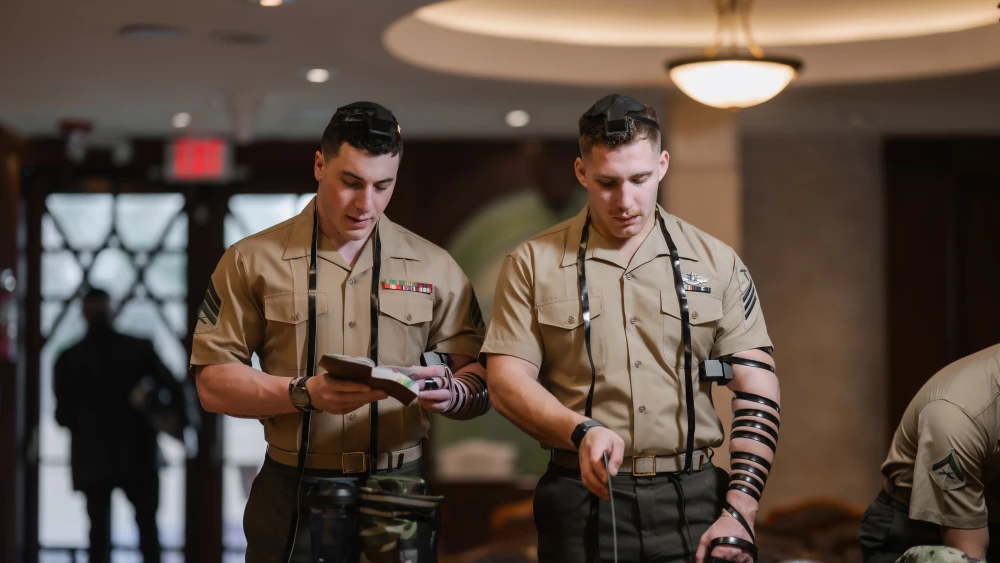
The “irony of ironies,” he told JNS, is that he has had the most difficulty “from other Jews in positions of power, who don’t like observant Jews.”
Non-Jews can have a lack of understanding, but he has mostly had a “helpful and supportive” chain of command, he said. Not so with a rabbi chaplain, whom he called “Conservative,” during basic training who “didn’t want to be bothered” to help Palas procure grape juice for Friday night kiddush.
That Conservative Jewish chaplain told Palas’s drill sergeants that “they were over-accommodating me by giving me kosher food,” he told JNS. “I almost got kicked out as a result of that.”
“They said that I was being a delinquent and going on a hunger strike,” he said. “It was definitely hostility and subversiveness at the hand of that conservative chaplain.”
Another service member, who spoke to JNS on the condition that no identifying details be published, grew up secular and became religiously observant early in his military career.

He applied for and was granted an exemption for his beard, which he grew in accordance with his understanding of Jewish law, he told JNS.
A “fair amount” of people in the military have been “generally curious” to learn about Jews, and he has felt privileged to help those who “have never encountered a Jew in their little corner of the country to learn more about who Jews are,” he said. “That’s a really wonderful thing.”
Stateside, his exemption to grow a beard drew some “very endearing” jokes from members of his unit. Then his unit was deployed overseas, and the service member decided to pause his education and a relationship to ship out for what would likely be nine months to a year.
When he arrived, his new commanding officer protested, even though he said he would show up on Saturdays, provided he wouldn’t need to break any Jewish laws, and that his faith allows him to break Shabbat rules to save lives.
The officer told him, “You haven’t even joined the unit yet. You’re demanding all these things,” the service member told JNS.

Those “demands” included access to uncooked fruits and vegetables in the mess hall, for kosher reasons, and a small refrigerator in his quarters to keep kosher food separate from non-kosher items.
A few days later, the commanding officer called to apologize. He also sent the service member back to the United States, even though the latter had no home or educational program to which to return. The service member’s senior base officer offered to help lodge a protest, but weeks later, the commanding officer was ousted for an unrelated misconduct.
“I dealt with a lot of ignorance in the military,” the service member told JNS. “That was an instance where I dealt with a fair amount of ignorance, but also malice and people who didn’t have compassion.
“The lesson I learned from that is that bad people do bad things in multiple areas sometimes,” he said. “Since then, I haven’t had any other major experiences like that.”
The Aleph Institute has advised the Pentagon to require that members of the military learn about the right to free religious expression under the First Amendment and to educate recruiters and drill sergeants about religious accommodations.
Estrin told JNS that he had spoken recently with a chaplain stationed in the Middle East who didn’t think, ahead of the Passover holiday, that he would be able to secure matzah.
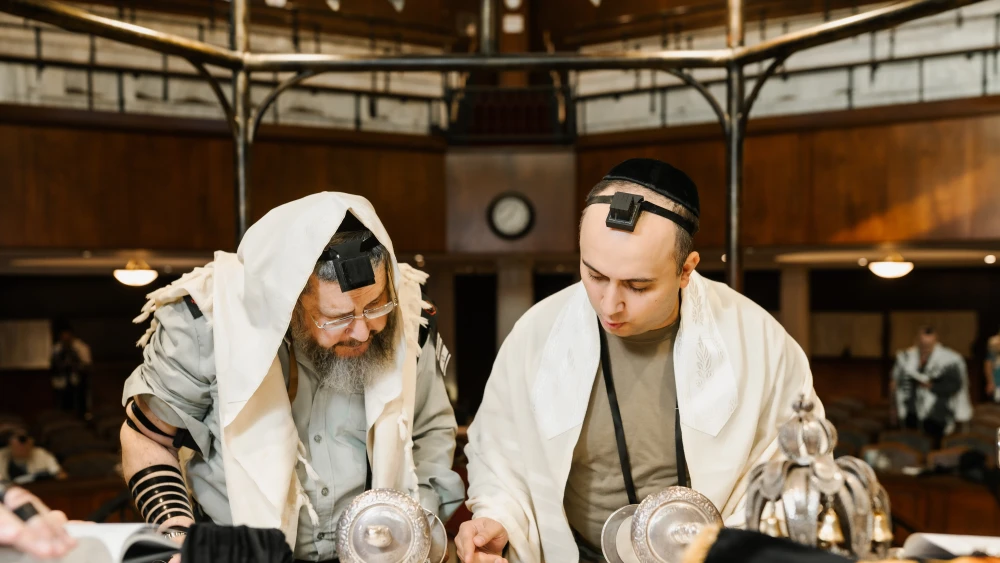
“We would be very happy if there was understanding of basic Jewish needs in the chaplaincy, and that they would be fully equipped to deal with the unique elements of these needs,” the rabbi said. “Then, it will remove a lot of the problems, because the chaplain can get in and get involved when things are in a much less combative zone.”
Higgins, the Pentagon adviser, promised to update training for chaplains, according to Estrin.
But many have had concerns after Hegseth fired William Green as Army chief of chaplains, a role that holds the rank of major general and in which he served since 2023, in early April. There was no reason offered for that move, and the military hasn’t named Green’s replacement.
The red tape at the Pentagon is also a challenge, according to the rabbi.
Offering kosher meals-ready-to-eat, or MREs, the military’s fully cooked, shelf-stable, lightweight and high-calorie rations, isn’t that difficult. But one must also “take into account the millions of other products the Department of Defense has to supply,” he said. “There are things that get lost because of that.”
Higgins told Estrin to come up with three to five of the most important issues “that can be solved and to present a complete solution within all of his frameworks, to be able to really give him a complete picture of what would need to be done,” the rabbi told JNS.



